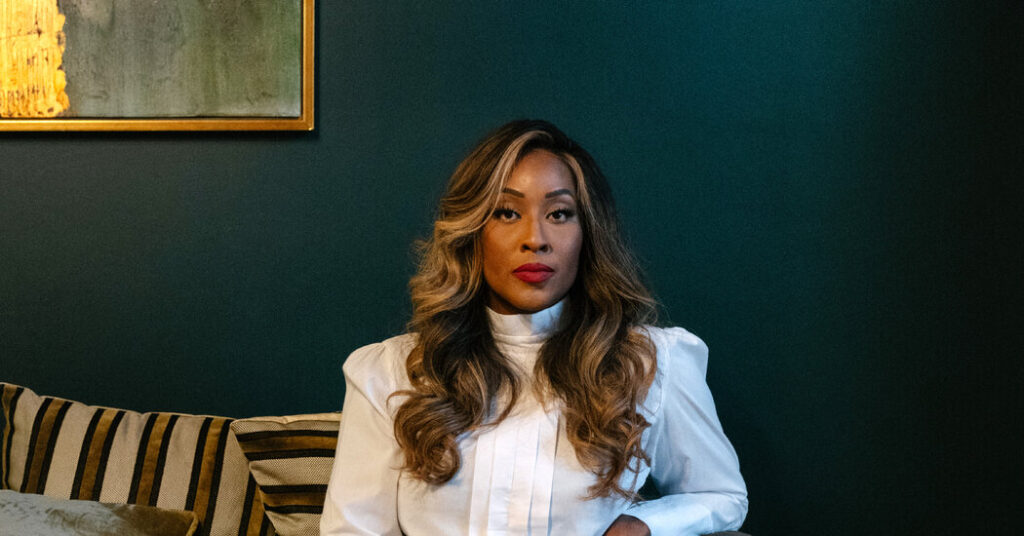
When Nneka Obiekwe started a WhatsApp group chat in September, she was just trying to help her out-of-work friends.
A consultant and skilled networker, Ms. Obiekwe, 37, is the kind of person friends turn to when they are looking for a referral or connection to a hiring manager. But since March, she had been receiving pleas every few weeks. By autumn, her network was tapped out.
Most of the people reaching out were, like Ms. Obiekwe, Black women, and she started to feel that they needed a community as much as referrals. She created the WhatsApp chat, called Black Women Rising, and posted the link to it on Threads.
Within 24 hours, more than 500 people joined. Most were midcareer or senior professionals who had been laid off in the previous few months.
Ms. Obiekwe moved the group to Discord, a messaging platform that could better organize the 500 or so daily messages people were sending in channels with names like “Share Your Good News” or “Vent Among Friends.”
They shared job updates: “I have a screening call with a recruiter tomorrow. Wish me luck!” or lamented about getting ghosted. “They said I’m in the lead but haven’t heard from them in a month,” one person wrote.
The job market is not great right now. Hiring has slowed. Artificial intelligence is replacing some knowledge workers. But Black women have been hit especially hard. The unemployment rate for Black women rose significantly from the start of 2025 to December, where it stood at 7.8 percent. That pattern of dramatic job loss was not seen for other groups.
“You don’t see that same loss with Black men, you don’t see that same loss with other groups of women,” said Valerie Wilson, a labor economist and director of the program on race, ethnicity and the economy at the Economic Policy Institute, a left-leaning think tank. “It was a sharp and unique decline in employment for Black women.”
More specifically, it was college-educated Black women — not those with less education or advanced degrees — who lost the most ground. In 2024, 74 percent of Black women with bachelor’s degrees were employed; that rate fell to 71 percent in the first nine months of 2025, while the rate for employed white women with bachelor’s degrees fell less than one percentage point during the same period.
Ms. Wilson has tried to puzzle out that decline. In an analysis, she noted that Black women, who are overrepresented in the federal labor force, were laid off during the Trump administration’s mass federal cuts. But more important, she wrote, were private-sector losses. Many more jobs were lost in professional and business services like human resources, where college-educated women are frequently hired. “It would not be a huge leap to assume that” losses in those areas “are probably having a negative impact on Black women’s employment,” she wrote.
In interviews, 15 Black women professionals described what felt like a jarring shift. They expressed pride in their achievements — both personal and as a group. The share of Black women who earned a bachelor’s degree or higher had risen nine percentage points in a decade, for instance. After the killing of George Floyd in 2020, their education and experience got more recognition, and professional doors opened wider.
Those doors began to close after the Supreme Court ruled against affirmative action in university admissions in 2023 and companies started to pull back on diversity and inclusion commitments. President Trump’s return to office seems to have accelerated that trend. In 2025, the number of companies publicly committing to diversity and inclusion dropped significantly.
From the first day of his administration, Mr. Trump sought to remove diversity, equity and inclusion initiatives, both in the federal government and the private sector. Those programs were originally designed to eliminate historical biases in hiring. Many of the women interviewed, echoing broader criticisms, said Mr. Trump seemed to be deliberately misconstruing the term D.E.I., turning it into a reason to dismiss highly qualified Black people. D.E.I. professionals started to lose their jobs, but even Black women not involved in diversity work said they felt a chill.
In December, the head of the Equal Employment Opportunity Commission issued an appeal to white men who felt they had been discriminated against, and Mr. Trump told The New York Times this month that “white people were very badly treated” as a result of protections from the Civil Rights Act.
The tone from the Trump administration is not lost on Black women looking for work. In Black Women Rising and other group texts, professionals are sharing worries and strategies as the job market shifts. Some are taking a step back from corporate careers and starting their own businesses. Those who worked in diversity and inclusion are wiping those references from their résumés.
“There are people who are hanging on for dear life and they’re calling out, like, ‘When will this season end?’” Ms. Obiekwe said.
Rewriting the Résumé
In May, Ericka Hatfield, 44, was laid off from Education Reform Now, a nonprofit think tank where she was the vice president of communications. When Mr. Trump returned to the White House she felt an “immediate” change, she said. Her organization worked with government agencies, particularly the Department of Education, and many of those federal workers started leaving or lost their jobs. Fund-raising became harder, she said. Work slowed.
Ms. Hatfield says this is the worst job market she’s experienced. She has an M.B.A. and is open to senior roles in marketing and business development or as a chief of staff. She has stopped identifying her race on job applications.
“I feel like if I do, that’s harming me,” said Ms. Hatfield, who lives in Dallas.
As she looks for work in her field, Ms. Hatfield took a job at the front desk of a SoulCycle, where she can take free spin classes. She joined Black Women Rising in the fall and now offers to provide feedback on résumés for others in the chat.
Lizz Rene, a 34-year-old who lives in a suburb of Washington, D.C., is also in the Black Women Rising chat and is thinking hard about her résumé. When she graduated from the University of Georgia, she chose jobs that allowed her to do learning and development work for underrepresented groups. She had stints at the Washington public school system, Google and, most recently, at the advertising firm Ogilvy.
At Ogilvy, she ran a leadership development program for Black men and helped plan celebrations for Hispanic Heritage Month. Funding for those initiatives dried up.
“It was just really skin and bones by the end,” she said. At the end of June, she was told she was being laid off.
Ms. Rene estimates that she’s applied to hundreds of jobs. She stopped making reference to D.E.I. on her résumé. But she’s weighing what to say if she gets to the interview stage.
“I want to be able to talk freely about my work and not having to censor myself,” Ms. Rene said.
The months of being out of work have forced her to reckon with the career she had envisioned for herself. She was the first in her family to graduate from college and has always worked. Finding the next job had always been easy. “So this whole experience has been humbling,” she said.
Goodbye, Corporate Career
Climbing the corporate ladder feels more arduous to Black women as companies have grown quieter about commitments to inclusive hiring and the job market grows more volatile, said Dr. Angela Jackson, a lecturer at Harvard and director of the Future Forward Institute. Her institute surveyed Black female executives in 2024 and 2025 and found that just 8 percent expressed optimism about their career progression, a decline from 28 percent two years earlier.
“We saw a tremendous amount of hesitancy where people either thought they were unsure of their trajectory or the vast majority were nervous that their jobs were at risk,” Dr. Jackson said.
Arit Nsemo, 39, is done with corporate life — at least for now. After graduating from college in 2009, she took on various roles at software start-ups. By early 2025, she was on the senior leadership team of a logistics software company, where she was the head of customer success, the team responsible for working with existing clients.
In June, Ms. Nsemo’s company eliminated her role. For the first time in her career, she decided to take a break.
Then she took a sharp turn: She started working at an independent bookstore. She makes a quarter of her former salary but prefers the atmosphere.
“I’m not constantly correcting people when they say something awkward about my hair or my name,” she said. “There’s so much less emotional labor required to working at a bookstore than working in tech.”
A Path Eliminated
This past fall, Francesca Weems went to dinner in the Bay Area with some of her girlfriends. All were Black women, and all had been laid off in the past year.
Ms. Weems, 39, grew up in Hawaii in the foster care system before earning a full academic scholarship to U.C. Berkeley, where she received both a bachelor’s and master’s degree.
She worked at a public relations firm in various roles, including leading the inclusion efforts in her regional office. In 2021, she was promoted to help guide D.E.I. strategies for the firm’s Fortune 500 clients and helped oversee all D.E.I. hiring and retention initiatives inside the firm.
She would tell colleagues and clients about how, before entering the foster system, she had experienced homelessness and needed supplemental nutrition assistance — SNAP benefits. It was a way to reinforce how the diversity and equity work her team was doing could make an impact.
Then in August, her firm eliminated her role. She then watched with dismay as the Trump administration stopped funding SNAP benefits during the government shutdown.
“Watching this unfold has been devastating,” Ms. Weems said. All the programs and policies that had helped her were ending or being attacked.
“I broke this year because I could not see little Fran getting into these spaces. I couldn’t see her getting out of poverty. I couldn’t see her getting to the space that I’m in now,” she said. “That was the tough part to really grapple with.”
She still sees a career working with executives who care about equity and inclusion, and has started her own consulting practice to do so.
Jordyn Holman is a Times business reporter covering management and writing the Corner Office column.
The post Black Women Turn to One Another as Their Career Paths Suddenly Recede appeared first on New York Times.