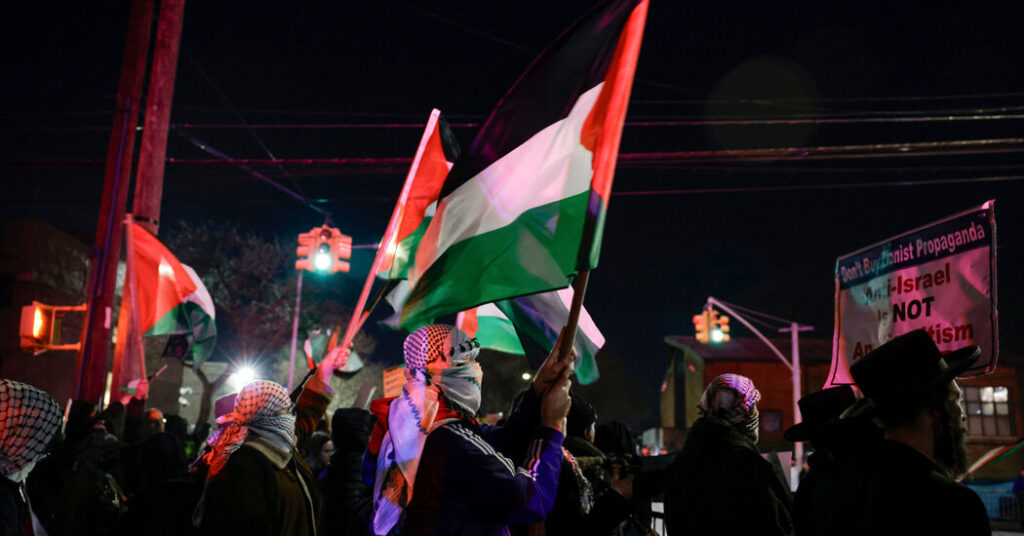
Mayor Zohran Mamdani was facing an early test on a delicate matter. Protesters had gathered outside a synagogue in a heavily Jewish neighborhood of New York City and chanted in support of Hamas.
Video of the chants rocketed around social media, and by the time the protest ended at roughly 10 p.m., attention quickly turned to how he would respond. Yet for hours, Mr. Mamdani said nothing.
His first response came after an unrelated news conference shortly after noon the next day, when he was asked about the chants as he headed to his car. He briefly condemned the language; an official statement on the matter was distributed at 3:40 p.m. in response to The New York Times. At 6:23 p.m., he posted a more thorough statement on X.
The halting responses drew some criticism of Mr. Mamdani, whose political career has been driven in part by his passionate support of Palestine, for seeming reluctant to call out extremism and denounce Hamas.
But behind the scenes, a more revealing drama was unfolding. Mr. Mamdani’s team repeatedly debated the wording and fairness of the language, drafting and redrafting his response and sending it to leading Jewish figures for review. The outreach shows the challenge the young mayor faces as he tries to navigate one of the most sensitive and explosive issues among New York voters in an age where instant communication and social media driven news cycles demand urgent messages from political leaders.
And it carries risks in all directions for a political figure whose ease of communication and authenticity appealed to an electorate weary of preprogrammed and overly cautious candidates.
It all began last Thursday on the evening of Jan. 8, when Mr. Mamdani’s liaison to Jewish New Yorkers, Josh Binderman, went to Queens to observe the protest, which had been organized to condemn an event by a real estate firm that promotes American investment in Israel and the occupied West Bank. Insults and slurs were hurled from protesters on each side.
Mr. Binderman quickly began crafting a statement on the mayor’s behalf. It was written and rewritten until he found language that he thought might pass muster with Jewish leaders and the mayor, according to detailed accounts from seven people involved in the matter.
He contacted at least one Jewish official the night of the protest and relayed the statement. The official expressed concern that it didn’t forcefully condemn Hamas. Mr. Binderman seemed to acquiesce, and that version of the statement was never released, according to one person familiar with the interaction.
Mr. Binderman wrote another statement that criticized the pro-Hamas chants, but also mentioned the Jewish Defense League, a Zionist group designated by the F.B.I. as a terrorist organization that is affiliated with the followers of Meir Kahane, a Brooklyn-born anti-Arab militant whose Kach party was outlawed in Israel for inciting racism. Online video of the protest showed some supporters carrying the group’s yellow flag.
Several Jewish leaders warned Mr. Binderman against drawing what they felt was an unfair equivalence, according to several people familiar with those exchanges. They believed the pro-Hamas chants were more widespread and pertinent than the presence of a Kahanist symbol.
A revised statement that forcefully condemned Hamas seemed to appease the Jewish leaders, several of the people said. But that version was also not released, and it was unclear why.
It was only after sundown on Friday, when observant Jews go offline for Shabbat, that Mr. Mamdani posted on social media a more direct public statement that referred to a terrorist organization, risking criticism from some far-left pro-Palestinian activists who valorize the group as legitimate armed resistance.
“As I said earlier today, chants in support of a terrorist organization have no place in our city,” Mr. Mamdani posted on X. “We will continue to ensure New Yorkers’ safety entering and exiting houses of worship as well as the constitutional right to protest.”
His spokeswoman, Dora Pekec, later said he was referring to Hamas and not the Jewish Defense League.
Ms. Pekec did not respond to specific questions for this story and reiterated the mayor’s public remarks.
The daylong effort to tamp down the anger among many Jewish leaders underscored how Mr. Mamdani, the city’s first Muslim mayor, deals with the complex challenge of leading a diverse city with large Jewish and Muslim populations. Though the mayor of New York plays no role in foreign policy, Mr. Mamdani’s words and actions will be parsed by people with strong feelings on both sides of this conflict, both in New York City and abroad.
That dynamic was evident in recent days. Scott Richman, the regional director of the Anti-Defamation League in New York and New Jersey, asserted that the mayor’s “view of what is antisemitism is not as expansive as the mainstream Jewish community.”
“That is a fundamental disconnect here,” he added, “where he is seeing antisemitism on the right, but not seeing antisemitism on the left.”
On the other side, one of Mr. Mamdani’s supporters, the YouTube personality Hasan Piker, excoriated him during a recent stream for criticizing the pro-Hamas protesters.
“He knows better, come on dude,” Mr. Piker said. “Get outta here. What did I say from the start? Do not concede on your enemies’ cynical framing.” Hamas, he continued, is the “Palestinian resistance.”
Mr. Mamdani, 34, came of age in the pro-Palestinian movement. The son of a celebrated scholar of colonialism, Mr. Mamdani founded a chapter of Students for Justice in Palestine while at Bowdoin College.
As a young politician, he often spoke at protests in New York that sometimes included inflammatory rhetoric, which has contributed to the fears of some Jewish New Yorkers. At one event in May 2021, Mr. Mamdani said he was drawn to the Democratic Socialists of America because of its support for boycotting Israel. The man who spoke after him said, “armed resistance is the only way to liberate Palestine.”
After Mr. Mamdani won the general election in November, he hired Mr. Binderman, a veteran of the liberal pro-Israel group J Street, as his liaison to Jewish New Yorkers.
Amy Spitalnick, the chief executive of the Jewish Council for Public Affairs, said Mr. Mamdani was “uniquely positioned to illustrate how a deep commitment to Palestinian human rights can and must go hand in hand with a deep commitment to Jewish safety.”
She added that she has “appreciated how the mayor has engaged with the community and there is a real opportunity right now to turn his stated commitment to countering antisemitism into real action, using both his bully pulpit as mayor as he ultimately did here and the levers of the upcoming budget, personnel and policy.”
The prolonged deliberations were reminiscent of a similar situation that happened before Mr. Mamdani took office.
In November, anti-Israel protesters gathered in front of an entrance to an Upper East Side synagogue to protest Nefesh b’Nefesh, a group that helps Jews emigrate to Israel and settlements in the occupied West Bank. They crowded the synagogue’s entrance and chanted “death to the I.D.F.” and “globalize the intifada.”
Videos of their chants that spread online alarmed many in the Jewish community, and those fears were deepened by Mr. Mamdani’s initial statement, which decried both the protesters’ language and the synagogue’s decision to host the group’s informational session. He later issued another statement making clear that he opposed chants calling for the death of anyone.
Now, as mayor, Mr. Mamdani has adopted a more studied approach, hoping to benefit from investing more time and input into the process. Still, there can be hiccups.
By the time Mr. Binderman negotiated the final draft of the statement and asked his Orthodox Jewish contacts to post it on social media, the sun had set on Friday evening.
The leaders Mr. Mamdani had sought to soothe had gone offline for Shabbat. They would be unreachable for a full day and would most likely not see the mayor’s statement until Saturday night.
Nate Schweber contributed reporting.
Sally Goldenberg is a Times reporter covering New York City politics and government.
The post Before Criticizing Pro-Hamas Chants, Mamdani Sought Jewish Leaders’ Input appeared first on New York Times.