Say what you will about “Game of Thrones,” it never did anything small. Its dragons were massive, its episodes lengthy and its battle scenes epic. Its legacy has continued to grow larger, with the prequel “House of the Dragon” building on its maximalist narrative.
So the most curious thing about the latest spinoff, “A Knight of the Seven Kingdoms,” beginning Sunday on HBO, is how small it is. It focuses, by and large, on one story line. Most of its episodes run around a half-hour because, yes, folks, this is — almost — a comedy. (HBO calls it a drama; my eyes and ears have their doubts.) Its stakes are relatively piddling, at least at the outset: not the fate of the Seven Kingdoms of Westeros but the outcome of a provincial tournament.
It is a bite-size take on the franchise, and that is the source of its (minor, but sufficient) pleasures.
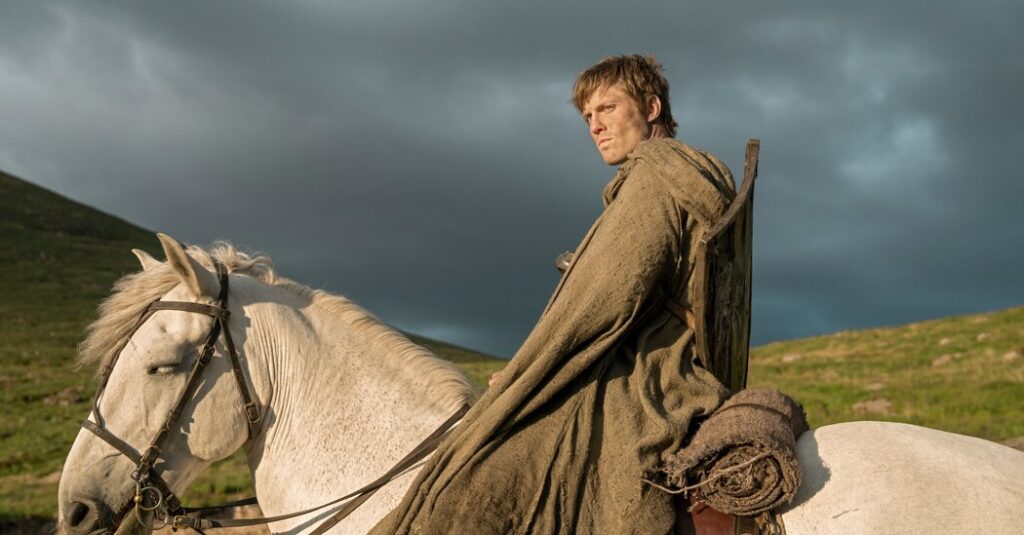
The biggest thing about “Knight” is its protagonist. Ser Duncan the Tall (Peter Claffey), known as Dunk, is a towering, sweet-natured “hedge knight” — one of a landless class of itinerant warriors who wander the country looking for glory (or simply work). Early on, the familiar, stirring score for “Game of Thrones” swells up, before we see Dunk loosing his bowels behind a tree. Silently, the series’s more modest title credit fades in.
“A Knight of the Seven Kingdoms,” the irreverent scene tells us, is more and less than it seems. So is Dunk himself. We meet him as he is burying the rough, drunken knight (Danny Webb) whom Dunk served as squire and who may or may not have actually knighted Dunk before he died. (“Any knight can make a knight,” goes the rule, but given necessity and a lack of witnesses, a knight can also make himself.)
Penniless, armorless and purposeless, Dunk decides to enter a knights’ tourney in the hopes of winning renown, as well as a better-equipped opponent’s kit. In a stable along the way, he encounters Egg (Dexter Sol Ansell), a scrawny, bareheaded boy with an oddly lettered manner of speech, a sarcastic bent and a superfan’s knowledge of the land’s top swordsmen. Knights need squires, and Dunk, not drowning in applicants for the position, reluctantly takes him on.
Pause the show at any moment and you are undeniably in the dirty-fantasy world of “Game of Thrones.” Hit play, and “Knight” is a surprising departure. It has a fast pace and a different visual grammar, using quick cutaway scenes, copious flashbacks and setup-punchline gags. At one point we hear jazz. The tone can be jarring, and the jokes are not afraid to play to the cheap seats. But the series is also surprising, in a way that the tonally faithful “House of the Dragon” rarely is.
“Game of Thrones” could often be funny, but this is something else. It’s … fun? You could think of it as the fantasy equivalent of the various recent “Star Trek” properties— “Picard,” “Lower Decks,” “Starfleet Academy” — that have taken lighter or more narrowly focused approaches to a storied franchise.
But it comes from George R.R. Martin, the author of the source novels for “Game of Thrones,” who along with Ira Parker adapted “Knight” from a series of prequel stories he wrote. The thematic connections with “Game of Thrones” are clear, including a jaded view of power and chivalry and a feel for the ingloriousness of seeking glory.
Dunk and Egg arrive at the tourney, where knights from around the realm bro out, fight dirty and engage the services of prostitutes. (Some things in Westeros never change.) The tournament is a bit like a combination Super Bowl and Oscars red carpet; spectators gather to watch the contestants joust and to gossip about the off-the-field intrigues of the feudal celebrities.
There’s plenty to talk about. The series is set a century before “Game of Thrones,” but here there are different Baratheons, Targaryens and the like, engaged in inter- and intra-house politics in their hours out of the lists. The six-episode season is not especially plot dense, but it sets up a serial narrative and deftly hides some story secrets in plain sight.
The supporting characters don’t get much time to develop in depth, but the standouts include Tom Vaughan-Lawlor as Plummer, the cynical administrator of the tourney, and Bertie Carvel as Baelor Targaryen, one of the cooler heads in the soap-opera dynasty that rules the kingdom.
But “Knight” is at heart a buddy story. “Game of Thrones” had a gift for finding child actors, and casting nailed the assignment with Ansell. He teases out the childish vulnerability behind Egg’s brainy insolence, and he has a way with a deadpan line. (Hearing a filthy drinking song about a three-fingered young woman, Egg dryly defends it as a celebration of “a misfortuned girl making the best of her natural gifts.”)
And the naïve Dunk brings the series a decency that’s rare in the “Thrones”-verse. He has a shyness, born of years of privation and beatings, that somehow turns to his advantage: People can’t resist winding up the big lunk, but they’re often charmed by his dim innocence.
Through this duo, “Knight” recaptures a delightful aspect of “Game of Thrones”: the conversations and unlikely bonds between mismatched companions on the road. (Imagine an entire series about Arya and the Hound.) “A Knight of the Seven Kingdoms” doesn’t match the scale of the series it’s spun off from. But it’s a clever, close-focus look at the little people, even if one of them is enormous.
James Poniewozik is the chief TV critic for The Times. He writes reviews and essays with an emphasis on television as it reflects a changing culture and politics.
The post ‘A Knight of the Seven Kingdoms’ Review: Go Westeros, Young Man appeared first on New York Times.