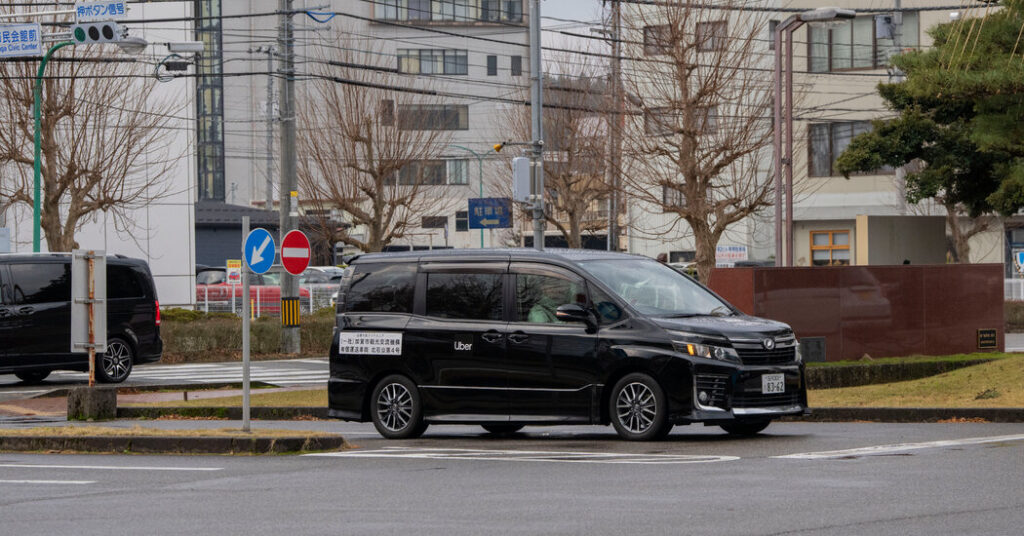
On a dreary morning in December, Uber’s boss, Dara Khosrowshahi, stood outside the faded concrete municipal offices of Kaga, a small hot-springs town in western Japan, and hailed a car.
Since Uber entered Japan in 2014, the country, one of the world’s largest taxi markets, has remained a fortress. Japanese officials have fiercely guarded the taxi industry with regulations that restricted Uber’s app to hailing only licensed cabs. Recently, however, demographic pressures have begun to force the government to change.
Japan’s rural heartland is hollowing out as the country’s population declines, leaving the pool of public drivers dry and many of the remaining elderly residents without transportation. Kaga is among a handful of provincial areas where legislators have permitted the peer-to-peer ride-share operation that defined Uber’s global rise.
That is also why Mr. Khosrowshahi recently found himself in an Uber — driven by the slightly nervous owner of a local soba restaurant — in this remote corner of Japan.
“I’m here because one of our most important initiatives in growing our ride-share business in Japan is growing outside of the big cities,” Mr. Khosrowshahi said, watching as Kaga’s aging overpasses gave way to winter-bare cabbage patches and rice fields.
Having conquered the market in America, Uber has poured billions of dollars into its global expansion. It has secured significant market share in Britain and parts of Latin America, and today generates nearly half its revenue outside the United States and Canada — up from 38 percent in 2022. Yet some markets, like Japan, continue to be a challenge.
For more than a decade, Uber has lobbied Tokyo to permit its standard model, in which drivers use their own vehicles to ferry passengers. However, Japanese regulations mandated that local taxi operators manage and dispatch such services — a restriction that effectively limited apps like Uber to hailing licensed cabs. That mobile taxi-hailing market has been dominated by a domestic rival, Go.
In 2024, Japan started to allow private-vehicle hailing in specific areas, such as Kaga, where public transit and taxi fleets are considered insufficient. Uber started operating in Kaga that same year. The hope is that the city will serve as a blueprint for expansion into other rural regions across the country, Mr. Khosrowshahi said.
In Japan, “the promise of growth is huge,” he said. “Breaking in here — it has been a challenge. It’s a very particular market.” Still, he added, “over the past year or so, we’ve seen more and more deregulation that has allowed Uber to expand.”
In Kaga, as in many rural areas, the population, about 60,000, is in decline while the elderly demographic swells. Older residents are surrendering their driver’s licenses, forcing many of them to rely on taxi and public-bus systems plagued by driver shortages.
“When it comes to public transport, we have a very serious issue,” said Toshiaki Yamada, the mayor of Kaga. Uber has offered relief, he said, adding that local users describe the service as “very convenient.”
Mr. Yamada said that he was uncertain about how widely Uber would spread given low public awareness, but that Uber’s recent marketing efforts should help.
“I was born in Kaga, have worked in Kaga and will probably die in Kaga,” he said. “I would have never imagined the chief executive of Uber would show up here.”
Uber has introduced similar rural ride-hailing programs in other underserved areas, including the northern coast of the western Tango Peninsula and the snowy highlands of northern Nagano Prefecture.
In Kaga, early data is providing some encouragement for Uber’s rural push. Monthly rides have climbed to more than 300 from 100 at the start, Mr. Yamada said.
At the same time, many of elderly residents grapple with the basics of smartphone apps, let alone the nuances of Uber’s interface.
“If you miss one bus, you have to wait half a day,” said Setsuko Yamada, a resident who was buying groceries in downtown Kaga. Ms. Yamada, who lives in a housing complex in the mountains outside the city center and is not related to the mayor, has petitioned the regional bus operator for more frequent routes. She was told there were not enough drivers.
Asked if she was familiar with Uber, she was succinct: “No. I’m 85.”
To bridge the gap, local officials have turned to grass-roots outreach, hosting seminars at the municipal office to guide residents through the app’s functions. Uber posters are visible throughout Kaga, from City Hall to railway platforms.
During his drive, Mr. Khosrowshahi reflected on Uber’s decade-long tenure in Japan, describing it as an exercise in persistence.
“Our business in Japan is different from anywhere else in the world,” he said. “I’m by nature an impatient person, but Japan is forcing me to be patient,” he added. “The key here has been compromise.”
River Akira Davis covers Japan for The Times, including its economy and businesses, and is based in Tokyo.
The post Uber’s Quest to Crack Japan Leads Through a Rural Hot-Springs Town appeared first on New York Times.