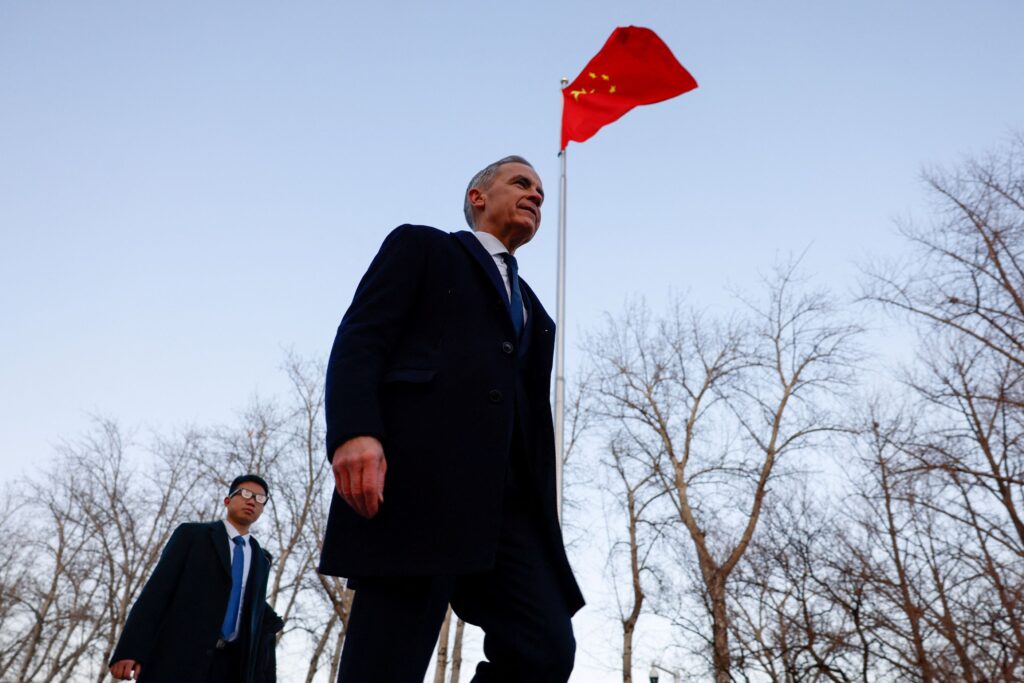
TORONTO — Prime Minister Mark Carney hailed a “new strategic partnership” and tariff deals with China on Friday, capping a visit to Beijing aimed at resetting a deeply troubled relationship and diversifying trade away from the United States amid President Donald Trump’s tariffs and threats against Canada’s sovereignty.
Carney announced the easing of some of the tariffs the two countries had imposed on each other, with Canada agreeing to allow in 49,000 Chinese electric vehicles at a much-reduced tariff of 6.1 percent, while China will cut canola seed tariffs from 84 percent to about 15 percent. Canada had imposed the tariffs in 2024 as part of an effort to align with U.S. trade policy on China.
The moves were a sign of how Trump’s tariffs on allies and adversaries alike are reordering global economic relationships, pushing two of the United States’ largest trading partners closer together to offset the costs after years of strained ties. Trump has also mused about using “economic force” to make Canada the 51st state.
“The global trading system is undergoing a fundamental change, and the effectiveness of multilateral institutions on which trading partners such as Canada and China have greatly relied … has been greatly reduced,” Carney told reporters in Beijing. “This is happening fast. It’s large. It’s a rupture.”
To adapt, Canada “must be pragmatic,” he added. “That means we have to understand the differences between Canada and other countries and then focus our efforts to work together where we’re aligned, and it’s with this approach that Canada is forging a new strategic partnership with China.”
Chinese President Xi Jinping called the visit a “turnaround” in Sino-Canadian ties.
China, Canada’s second-largest trading partner after the United States, imposed steep tariffs on Canadian agricultural goods, including rapeseed and beef, last year. Those duties were retaliation for Canada’s levies of 100 percent on Chinese-made electric vehicles. Ottawa announced those tariffs in 2024 to match Biden administration policy.
Carney said Beijing had also agreed to remove tariffs on Canadian canola meal, crabs, peas and lobsters from March 1 “until at least the end of this year.” It will also offer Canadians visa-free travel, he said.
Zhao Minghao, deputy director of the Fudan University Center for American Studies, said the visit amounted to an opening “icebreaker,” with both sides focusing on “the so-called low-hanging fruit first.” Despite the tariff deal and the optimistic tone of Carney and Xi, the Sino-Canadian relationship still faces “many difficulties,” he added, “especially in areas like ideology and national security.”
The most striking aspect of the visit, Zhao told The Washington Post, was how Canada was “using the restoration of ties with China as a way to de-risk its relationship with the U.S.”
Carney, a political rookie who won a federal election last year by casting himself as the best person to manage the break in U.S.-Canada ties, has pledged to double Canada’s non-U.S. exports by 2035. The China visit has required walking a tightrope.
Carney’s predecessor and fellow Liberal, Justin Trudeau, was the last Canadian prime minister to travel to China. He, too, sought closer economic relations with Beijing, but his 2017 visit ended with the two sides deeply divided on several issues and without an expected announcement on the start of formal free-trade talks.
Ties went into a deep freeze the next year, after China detained two Canadians — former diplomat Michael Kovrig and businessman Michael Spavor — in what was widely viewed as retaliation for Canada’s arrest of Meng Wanzhou, a Huawei executive wanted in the U.S. on fraud charges.
Kovrig and Spavor were held in secret prisons on vague charges of espionage and stealing state secrets — allegations for which China never provided evidence — and were tried in secret proceedings from which Canadian diplomats were barred, in violation of a consular agreement between the two countries.
The Canadians were released in 2021, after Meng reached a deal with the U.S. Justice Department that allowed her to return to China in exchange for acknowledging some wrongdoing in the criminal case. A Pew Research Center poll that year found that a record 73 percent of Canadians had an “unfavorable” view of China — up from 45 percent in 2018.
Canadian intelligence officials have accused China of “clandestinely and deceptively” seeking to interfere in Canada’s federal elections with the goal of supporting candidates favorable to its strategic interests. They have also alleged that the country conducts transnational repression in Canada, targeting dissidents and lawmakers who are vocal opponents of Beijing.
During last year’s federal election, Carney identified China as Canada’s biggest security threat. On Friday, the Canadian leader said that he had raised concerns about China’s human rights record during his meetings, but that it did not help to “grab a megaphone and have conversations that way.”
“We take the world as it is,” he said, “not as we wish it to be.”
Critics of Carney’s rapprochement with China have argued that closer ties could spell trouble, given Beijing’s history of weaponizing access to its markets. Not long after Kovrig and Spavor were detained, China imposed tariffs on Canadian canola in what was widely viewed in Canada as further retaliation for Meng’s arrest.
Opponents of the recalibration in the relationship have also warned that it could draw the ire of the Trump administration, which has been seeking to curtail China’s influence, ahead of a planned review this year of the U.S.-Mexico-Canada Agreement (USMCA). Chris LaCivita, a former Trump campaign manager, said on X that drawing closer to China “won’t end well for Carney.”
The Trump administration on Friday offered contradictory views on the deal.
U.S. Trade Representative Jamieson Greer told CNBC that it was “problematic for Canada” and predicted that “in the long run, they’re not going to like having made [it].”
But Trump said it was a “good thing” for Carney to reach an agreement with China.
“If he can get a deal with China, he should do it,” he told reporters in Washington.
Canadian officials and businesses view the continued existence of the USMCA as critical for the country’s economic prosperity. But Trump, who brokered the USMCA and called it “the best agreement we’ve ever made,” said this week that he doesn’t “really care about it.”
“There’s no real advantage to us,” Trump told reporters in Dearborn, Michigan, renewing fears in Canada that he could rip the deal up. “It’s irrelevant to me. … Canada wants it. They need it. We don’t.”
Carney has been unable to reach an agreement to ease the tariffs that the U.S. has imposed on Canadian goods. In October, Trump terminated all trade talks with Canada over a television advertisement critical of tariffs that was broadcast on U.S. networks and paid for by the government of Ontario. Canadian officials said they had been close to a deal before Trump suspended negotiations.
Trump’s tariffs and threats against Canadian sovereignty have infuriated Canadians. A Pew Research Center poll in July found that 59 percent of Canadians viewed the United States as their country’s top threat, while just 17 percent saw China that way.
Canada’s relationship with the United States “is much more multifaceted, much deeper, much broader than it is with China,” Carney told reporters Friday. “But … in terms of the way that our relationship has progressed, in recent months, with China, it is much more predictable, and you see the results coming from that.”
At home, the China reset has also proved tricky.
Provincial leaders and farmers in Saskatchewan and Manitoba, which have been hardest hit by the Chinese tariffs, have long pressed Carney to ease the levies on China. Saskatchewan Premier Scott Moe, who joined the prime minister’s delegation in China, said Friday in a post on X that the deal was “very good news.”
But it immediately drew criticism from labor leaders and officials in Ontario, the heart of Canada’s auto industry.
Officials there have supported the tariffs on China, viewing them as necessary for protecting Canadian auto jobs and citing national security concerns. Canada’s auto sector is facing an existential crisis, analysts say, because of Trump’s tariffs on vehicles, steel and aluminum. Trump administration officials have repeatedly asserted that they do not want to make cars with Canada — or for Canada to make cars at all.
Ontario Premier Doug Ford on Friday criticized the deal.
“Make no mistake: China now has a foothold in the Canadian market and will use it to their full advantage at the expense of Canadian workers,” he said in a post on X.
Matthew Holmes, executive vice president of the Canadian Chamber of Commerce, called the tariff agreement a “cautious first step” at easing trade frictions.
“Canada is right to reengage with the world’s second-largest market, but expanded access — particularly around EVs and advanced technology — raises real implications for Canadian manufacturers, cybersecurity and our [USMCA] commitments,” he said in a statement. “Any renewed partnership must be built on clear, enforceable rules that both sides are prepared to follow.”
The post Trump’s tariffs push Canada and China to strike a deal of their own appeared first on Washington Post.