There are plenty of obvious reasons Minneapolis, despite ranking far down the list of U.S. cities in terms of its immigrant population, is the latest Democratic-led urban area targeted by President Trump’s punitive anti-immigration raids. There is Tim Walz, the governor and Trump’s 2024 rival. There is the genuinely stunning fraud scandal, recently revealed, that happened on Walz’s watch. And there is the long shadow of George Floyd. But to understand both the crackdown and its stakes, it’s also worth revisiting a speech Trump gave in the city in November 2016, two days before the election that would first deliver him to the White House.
“Oh, Minnesota,” Trump told the crowd, dropping into the just-you-and-me-talking mode that has always been one of his greatest assets as a politician. “You know what’s going on. You know what I’m talking about. Do you know what I’m talking about? Be politically correct. Just nod — quietly nod. The whole world knows what’s happening in Minnesota.”
What was happening in Minnesota then was a slow-burning tension surrounding the state’s Somali community, its second-largest immigrant population. In 2008, a young Somalia-born man from Minneapolis was recruited by the Somali Islamist militant group Al Shabab and detonated a car full of explosives outside a government building in his birth country’s Puntland region, the first of dozens of young men from the community who would fight for Al Shabab in Somalia and, later, for the Islamic State in Iraq and Syria over the next decade.
Minnesota had been a haven for refugees since after World War II, when it was an early destination for Holocaust survivors in the United States, and especially since the late 1970s, when it began taking in thousands of South Vietnamese and Hmong people on the wrong side of America’s withdrawal from Southeast Asia.
This hospitality had historically been a point of pride for the state, a piece of the exceptionalism that Minnesotans, performatively modest as they are, have always claimed. It was a product of a broader, deep-rooted civic idealism: the state’s preponderance of religious charities, community-level nonprofit organizations and in particular its Nordic-style social safety net, among the most generous in the country.
But amid the Shabab and ISIS recruitment, Minnesotans had grown ambivalent. A 2014 poll found that while the state’s residents were broadly supportive of immigration, less than half supported welcoming Somali immigrants.
For over half a century, Minnesota has embodied the civic ideal that Trump seems intent on overturning.
At an October 2015 listening session in the small city of St. Cloud, where tensions had run particularly high, the state’s Democratic governor, Mark Dayton, addressed the Somali community. “This is Minnesota, and you have every right to be here,” he said. The state, he said, was “not like it was 30, 50 years ago,” when it’s population was nearly entirely white — and bigots who had a problem with that should “find a state where the minority population is 1 percent or whatever. It’s not that in Minnesota. It’s not going to be again.”
Trump’s message, a year later, was that, in fact, it could be that again. If elected, he promised, his administration would “not admit any refugees without the support of the local community where they are being placed — the least they could do for you. You’ve suffered enough in Minnesota.”
The speech crystallized one of the core themes of Trump’s politics, which has become the overwhelming argument of his second term: that the country’s foundational idea of a civic nation — one whose people are bound by a shared commitment to principles rather than ancestry or cultural identity — is a sort of liberal swindle. In Trump’s America, shared prosperity requires exclusion: a policing, by force if necessary, of the boundaries of who gets to call themselves American based in large part on where they come from.
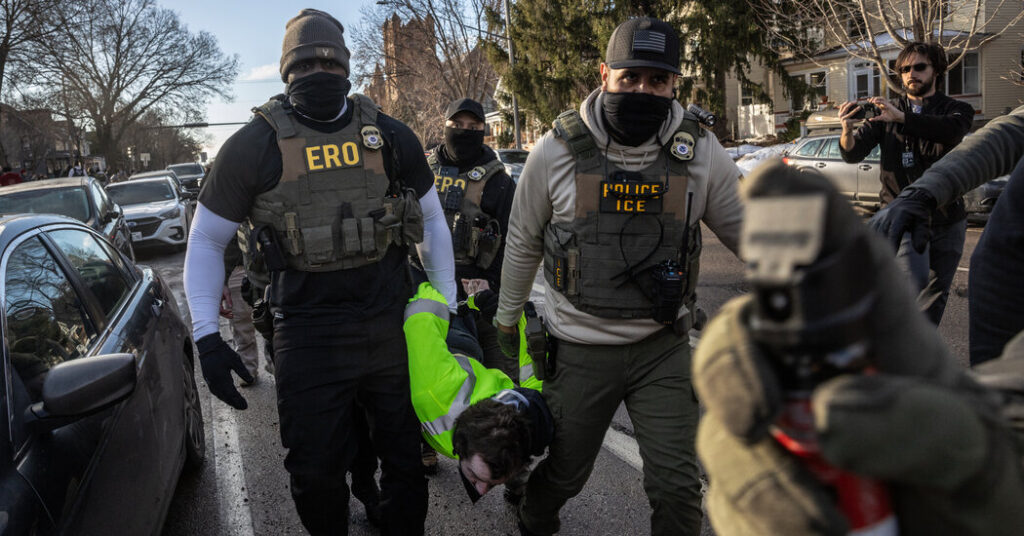
It is both fitting and not incidental that this agenda has been made so visible this month in Minneapolis, where immigration agents shot a woman dead and, in recent days, fired tear gas and smoke grenades at protesters on residential streets. On Wednesday, after a top Trump Justice Department official declared Minnesota’s resistance to the federal deployment an “insurrection” on social media, Walz posted on X that his state “will remain an island of decency, of justice, of community, and of peace.”
His statement made clear how the state government and many of its citizens see this conflict. Generalizing about any state’s political temperament is impossible in 2026, when practically all of them, including Minnesota, have variations on the same map of highly polarized rural reds and urban blues; rural Minnesotans, whose support for Democrats has collapsed in recent years, likely have a far different view than Minneapolitans do of Trump’s deployment.
Nevertheless, Minnesota is still a Democratic stronghold in presidential elections, and for over half a century, it has more clearly than perhaps any other state embodied the civic ideal that Trump seems intent on overturning. On the ground in Minneapolis, this is very overtly what the city’s residents who are tracking and confronting federal agents see themselves fighting for. Still, the largely unified local response to the flood of federal forces into Minneapolis is remarkable in light of the city’s very recent history, which has involved a deep soul-searching about precisely that ideal.
‘A State That Works’
In 2022, Lance Morrow, a former Time magazine writer and fellow at the conservative Ethics and Public Policy Center, wrote a column for The Wall Street Journal titled “How Minnesota Went From Tom Sawyer to Huck Finn.” Surveying Minneapolis’s grim crime statistics in the wake of the rioting and prolonged malaise that had followed George Floyd’s murder — a near-record number of homicides, a 537 percent year-over-year increase in carjackings — Morrow proclaimed the state to be “a microcosm of an America in crisis.”
Less than two years after the protests over Floyd’s killing, this was hardly an uncommon argument. But coming from Morrow, it carried an unusual sting. In 1973, he had written the ur-text of Minnesotan exceptionalism, a Time cover story called “Minnesota: A State That Works.”
Touring Minneapolis and its suburbs, Morrow, who had covered the 1967 riots in Detroit and the Vietnam War, seemed genuinely in awe of how little Minnesota appeared to have been touched by the traumas and upheavals wracking the country. “It is a state where a residual American secret still seems to operate,” he wrote, surveying Minnesota’s wonders one by one: a thriving and diversified economy; the lowest high-school-dropout rate in the country and the third-lowest crime rate; per capita incomes above the national average; an abundance of outdoor recreational opportunities that its unnervingly hale residents flocked to. (The cover of the issue featured Wendell Anderson, the state’s handsome young governor, on a lake in a plaid shirt, beaming over a freshly caught northern pike.)
But mostly, Morrow was struck by the “extraordinary civic interest” of Minnesotans. Citizens’ lobbies thrived. Minnesota-based companies voluntarily ponied up millions of dollars to improve downtown Minneapolis and build the Mayo Clinic. Voters cheerfully accepted statewide tax increases to better fund underserved local school districts. The state’s elected officials seemed to all be starry-eyed idealists motivated by a genuine commitment to service and little expectation of reward.
Daniel J. Elazar, the Minneapolis-born political scientist and scholar of American federalism, described Minnesota as a “moralistic” political culture, one of three such cultures he identified, along with the “individualistic” and the “traditionalistic.” The moralistic strain in American public life, in Elazar’s definition, saw politics as a noble pursuit, one that did not just guard liberty or identity or pursue interests but could be a tool for actively improving people’s lives. And Minnesota, Elazar argued, embodied the moralistic culture “more so than any other in the Union or perhaps in the world.”
This owed something to history — the state’s civil society was shaped in the 19th century by Yankee antislavery Republicans and later immigrants from Scandinavia and Germany, all deeply moralistic political cultures — and something to politics: The most powerful force in Minnesota politics for decades has been the Democratic-Farmer-Labor Party, a midcentury left-liberal fusion organization shaped in its early years by a cohort of cerebral amateurs, several of them young political science professors.
The D.F.L., in its early history, was particularly preoccupied with race relations: Hubert H. Humphrey, one of the party’s founders, led the campaign to insert the civil rights plank into the national party platform at the 1948 Democratic National Convention, prompting the Dixiecrat walkout and the realignment of American partisan politics that followed. The fact that this commitment existed in one of the least diverse states in the country — as recently as 1980, Minnesota was 96.7 percent white — seemed, to Minnesotan liberals, a further testament to the state’s exceptionalism.
But as race has become a ubiquitous lens for social science analysis, Minnesota has come in for a harder look. For a quarter-century now, researchers, drawing on data from around the world, have noted a clear correlation between the generosity of a country’s welfare state and the homogeneity of its population — a finding that invites a new reading of the idea of moralistic government as just another form of self-interest.
A particular criticism of Minnesota, which rocketed to the foreground following George Floyd’s killing, is that Minnesota’s proud progressivism on race was itself a counterintuitive product of the state’s lack of diversity and pervasive segregation. Beneath its rhetorical commitments, the state possesses some of the country’s most severe racial disparities across a wide range of metrics, from unemployment to homeownership to incarceration to educational attainment.
“African Americans are worse off in Minnesota than they are in virtually every other state in the nation,” the University of Minnesota economist Samuel L. Myers Jr. has written, describing what he has called the “Minnesota Paradox.” Well-off white people, living in neighborhoods surrounded by other well-off white people, could afford to subsidize a generous welfare state and were mostly insulated from its failings, when they were aware of them at all. The self-image the state’s white liberals had drawn from its history of civic idealism had kept them from seeing the many ways in which that idealism had come up short.
‘This Is Not Who We Are’
These are both critiques from the left, but the new right that has ridden into the center of American politics with Trump’s re-election turns them on their head. If diversity seems antithetical to the liberal dream of a welfare state that effectively serves its citizens, the right asks, then why are liberals so hung up on diversity? And if the sort of self-satisfied liberalism that Minnesotans are famous for hasn’t served the people of color that those liberals are so concerned about, then what is the point of it, exactly?
The fraud scandal in Minnesota, in which dozens of members of the state’s Somali community are implicated in stealing over $1 billion from the state’s much-vaunted social services system, has struck bone because it fits so neatly within this line of argument: that liberals’ civic commitments are not just empty and unproductive but also a cover for looting the state by the very people liberals are most preoccupied with protecting.
Walz, addressing the specters of extremism and political violence in the 2024 campaign, often fell back on a well-worn phrase from his gubernatorial candidacy, “This is not who we are.” But who are we, then? Liberalism, in Minnesota and elsewhere, has always struggled more with that question than the right, with its cultural conservatism, or the socialist left, with its appeals to class solidarity. Walz’s predecessor’s response — “This is Minnesota” — is not quite a complete answer. Much of Minnesota’s recent history is the story of a state learning that pluralism in the abstract is less complicated than pluralism in reality.
Minneapolis is still haunted by 2020 and the deep rift it cleaved within its liberal population.
But whatever its misgivings, Minnesota is still Walz’s state more than Trump’s. Much of the political particularity that nurtured Minnesota’s civic culture is gone now. But the state brushed off Trump’s appeal in 2016 and, for good measure, elected Ilhan Omar, the country’s first Somali congresswoman. Predictions that Trump would win the state in 2020 and 2024, after Floyd’s murder and its consequences, proved wrong, too.
Minneapolis is still haunted in many respects by 2020 and the deep rift it cleaved within its overwhelmingly liberal population. But it has been possible to see, in the very different and mostly unified local revolt against Trump’s federal deployment, a sort of foxhole reconciliation — a recognition that the city’s people do still share a broad vision of what the civic ideal means to them.
This has been true nationally, too. The response to Trump’s first year back in office has made clear that ambivalence and opposition are not the same thing. It is hard to think of a federal action that has become more unpopular more quickly than Trump’s immigration raids. Last February, a YouGov poll for The Economist found that a plurality of independent voters — 42 percent of them — had a favorable view of Immigration and Customs Enforcement. In a poll conducted the day of Renee Good’s shooting, 56 percent of independents disapproved of the agency’s work, 44 percent of them strongly.
That is a picture of a country that mostly agrees with Walz that this is not who we are — even if it is not entirely sure who it is instead. If Trump’s candidacy was a sustained attack on the idea of civic nationalism, his second presidency has very quickly become a clarification of what the alternative looks like — and what it looks like for now, in Minneapolis, is a masked federal agent shooting a woman in the face through the windshield of her own car.
The post Trump’s Fight With Minnesota Is About More Than Immigration appeared first on New York Times.