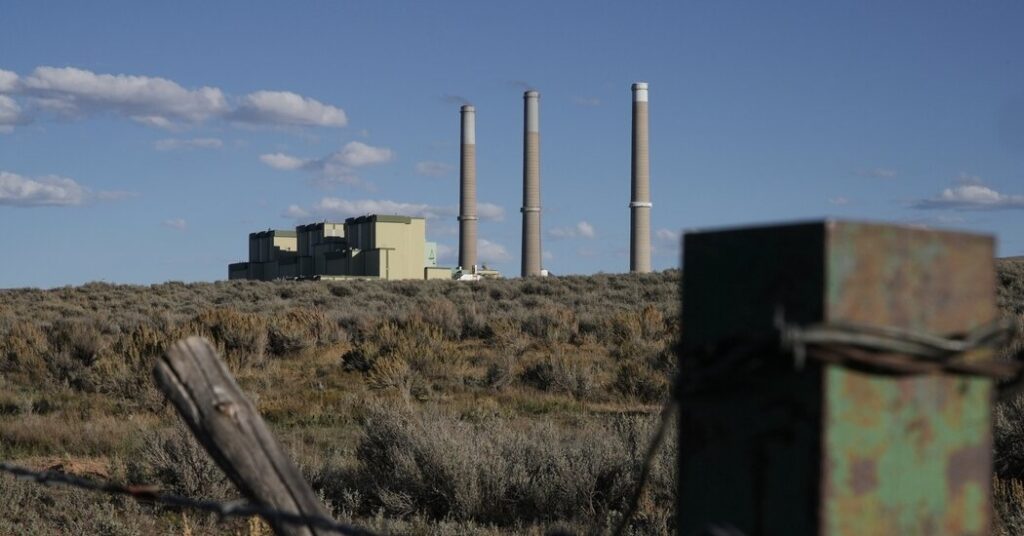
Over the past eight months, the Energy Department has taken the extraordinary step of ordering that generators at five coal-burning power plants that had been headed for retirement stay open and keep running.
That’s just the beginning, officials say.
At a White House event on Thursday, Trump administration officials said they planned to keep open as many coal plants as they could and prevent any further retirements over the next three years.
“The goal is to stop the political closure of coal plants,” Chris Wright, the energy secretary, said during the first meeting of the National Coal Council, which had lapsed under the Biden administration but which President Trump has revived. Dozens of representatives from the coal industry were present.
The moves are part of a sweeping plan by Mr. Trump to revive America’s coal industry, which has been declining for years. Mr. Trump has expressed a certain affection for the fuel, calling it “beautiful clean coal” to goad environmentalists, who note that coal is the dirtiest of fossil fuels and a major driver of global warming.
Administration officials say that keeping coal plants open is necessary to avoid blackouts and meet rising energy needs.
On the ground, however, efforts to halt coal retirements are already causing complications. Two of the coal units that the Energy Department ordered to stay online in December are broken, and it’s unclear when they might be repaired.
Some plants that were ordered to keep running had already shuttered their coal mines and stopped maintaining old equipment. Now, utilities and operators are straining to revive them. The costs of extending coal-burning plants are significant, and federal and state regulators are embroiled in disputes over who will ultimately pay.
“These are old plants, and they are expensive to refurbish and keep open,” said Ari Peskoe, director of Harvard Law School’s Electricity Law Initiative. “The costs are going to fall on somebody. The question is whether it’s the plant owners or the public.”
The debate over whether to keep aging coal plants open comes amid an astonishing turnaround in the coal industry’s political fortunes.
Since 2005, the number of operating coal plants in the United States had been declining precipitously as utilities switched to cheaper and cleaner natural gas, wind and solar power. Even Mr. Trump in his first term couldn’t stop the slide; more than 150 coal-burning units shut down between 2017 and 2020.
This time around, the Trump administration has gone much further to rescue coal, with more success. Last year, the amount of electricity produced by coal increased 13 percent, and retirements have slowed.
The administration has been aided by a surge in electricity demand nationwide driven by a boom in data centers, which has led some utilities to postpone coal plant closures. Federal agencies have also rolled back environmental regulations on coal, which produces more air pollution than other sources like natural gas. Burning coal also emits mercury, a powerful neurotoxin, and other heavy metals.
Even more drastic, however, has been the Energy Department’s use of emergency orders to mandate that coal plants that had been set to retire keep operating, as the agency has invoked Section 202(c) of the Federal Power Act.
Historically, this provision has been used to keep plants online during temporary emergencies such as hurricanes or heat waves. But the Trump administration has claimed that the emergency this time is an expected shortage of reliable power over the next decade, and officials are trying to avert as many closures as they can.
The impact is already visible: At the start of last year, utilities were expected to close roughly 8.5 gigawatts of coal capacity in 2025, according to federal data. But they ended up retiring only 2.7 gigawatts, the lowest amount since 2011.
At the White House event on Thursday, Mr. Wright said that many states were closing their coal plants for environmental reasons and that the administration would do everything it could to stop that. More than 20 gigawatts of coal capacity is currently scheduled to retire by 2028.
“I think you will not see those plants close during this administration,” Mr. Wright said, adding that there might be a few exceptions for the very oldest plants.
Mr. Wright said he hoped other actions by the administration to support coal would eventually make emergency orders “unnecessary.” But, he claimed, many utilities were quietly welcoming the orders to save coal plants at imminent risk of closure. “We get a lot of inbound calls now saying, ‘Can you 202(c) this plant?’”
Trump Administration: Live Updates
Updated
- The Trump administration says it erred in deporting a student traveling for Thanksgiving.
- Judge proposes restricting the deportation of scores of noncitizen Academics.
- N.S.A. nominee promises to protect elections from foreign interference.
Those orders are also facing a backlash. Environmental groups and states like Michigan and Washington are mounting legal challenges. The grid operator in the Midwest and state officials in Colorado have said their regions already have adequate electrical capacity, even with coal retirements.
Even analysts who agree that the country needs more power plants that can run at all hours say that forcing aging coal units to stay online can be counterproductive, because they can distort energy markets and make it harder for states and companies to plan to bring new power plants online.
“Using a blunt instrument like this to keep the legacy coal fleet online could backfire,” said Devin Hartman, director of energy and environmental policy at the R Street Institute. “There are a ton of risks.”
Broken plants, busy railroads
Reviving a geriatric coal fleet isn’t easy: Many plants are more than 50 years old and need major repairs.
On the shores of Lake Michigan, the J.H. Campbell coal plant was set to retire last May under a plan backed by the state and the electric utility that operates it, Consumers Energy. But, at the last minute, the Energy Department ordered that the plant’s three coal units stay open for 90 days during the summer. The agency has since twice renewed the order and is widely expected to order that the plant remain open indefinitely.
That created headaches for the operator, which had canceled roughly $161 million in maintenance for the plant in the years leading up to the scheduled retirement, according to one engineer’s testimony. The plant has struggled to generate reliable power: One unit faced extended outages in June and produced electricity for only a handful of days, according to legal filings by environmental groups.
Other plants may be in rougher shape.
In December, the Energy Department ordered that the R.M. Schahfer plant in northern Indiana keep two coal units operating past their planned retirement. Yet one of those units has been offline since the summer because of a turbine failure.
Repairing the unit could ultimately take “six months or longer,” Vince Parisi, the chief operating officer of the Northern Indiana Public Service Company, which owns the plant, told regulators last month. “It’s just the reality of that unit being close to retirement.”
In Colorado, a rural electric cooperative had been planning since 2016 to close a coal-burning unit at the Craig Generating Station. Last month, the Energy Department ordered that the unit stay open. Yet the coal unit is offline because of a broken valve, and it is unclear how long it will take to fix it.
There’s also the question of where to get fuel.
Until recently, the Craig unit in Colorado obtained some of its coal from a local mine operated by its part owner, the Tri-State Generation and Transmission Association. But that mine closed last year, laying off all its workers.
“This makes no economic sense or functional sense, to extend the life of an effectively broken coal plant,” said Gov. Jared Polis, Democrat of Colorado, who opposes the order and says the federal government had done little to consult with the state.
Last month, when Bob Guenther drove past the coal-burning power plant in Centralia, Wash., where he worked for 34 years before retirement, there wasn’t much coal in sight. The power plant had been winding down for years and was scheduled to close by Dec. 31 until the Energy Department ordered that it stay open. Coal piles that once filled acres had dwindled.
“It’s going to cost a lot of money to put that plant back in shape,” Mr. Guenther said.
Some local officials and unions have cheered the lifeline for coal plants, which are often an engine of local economic activity. But environmental groups have pointed to the hazards from air pollution and coal-ash waste.
“Northwest Indiana has long borne the brunt of industrial pollution,” said Ashley Williams, the executive director of Just Transition Northwest Indiana, a nonprofit group, criticizing the order to keep the R.M. Schahfer plant open. “We will continue to suffer.”
Mounting costs, legal threats
The cost to keep coal plants open could prove especially divisive.
In Michigan, Consumers Energy spent $164 million from May to September to keep its coal plant running, according to regulatory filings. During that time, the plant earned only $84 million in revenue.
It remains to be seen who will ultimately pay for the rest. Consumers Energy has proposed that the costs be shared by ratepayers in multiple states in the Midwestern regional grid, rather than paid for by its customers alone. But other groups have challenged this proposal.
In Colorado, Tri-State has said that its ratepayers may have to bear the full cost of repairing and operating the Craig plant — which state officials say could cost $80 million per year or more. In Washington, state law now forbids utilities to buy electricity from coal plants, raising legal complications.
Preventing the nation’s coal plants from retiring over the next three years could cost consumers at least $3 billion per year, according to a report from Grid Strategies, a consulting firm.
“A lot of these plants were retiring because they’re no longer economic to operate,” said Michael Goggin, an executive vice at Grid Strategies. “It’s expensive to keep them going.”
Opponents have challenged the coal orders in court, arguing that Congress intended for emergency powers to be used only in rare, temporary cases. If the orders are struck down, it is unclear who would bear the cost of spending millions of dollars to repair run-down plants.
While federal forecasts still expect coal generation to decline next year, the Trump administration is trying to prevent that from occurring.
The Environmental Protection Agency is rolling back numerous air pollution and climate rules that have made coal plants more costly to operate. It has also given electric utilities more time to clean up contamination from toxic coal ash landfills.
At the same time, the Energy Department has offered up to $350 million to try to bring back to life coal plants that have already closed.
Michelle Bloodworth, chief executive of America’s Power, a coal trade group, estimates that at least 29 coal units with roughly 13 gigawatts of capacity have recently closed but are not yet demolished and could be candidates for restarting. She added that more utilities were voluntarily postponing coal retirements and that the future for the industry is looking brighter under the Trump administration.
“There’s a huge opportunity for the coal fleet,” Ms. Bloodworth said. “It’s a big change after years and years of punitive environmental regulations.”
Claire Brown covers climate change for The Times and writes for the Climate Forward newsletter.
The post Trump Wants to Halt Almost All Coal Plant Shutdowns. It Could Get Messy. appeared first on New York Times.