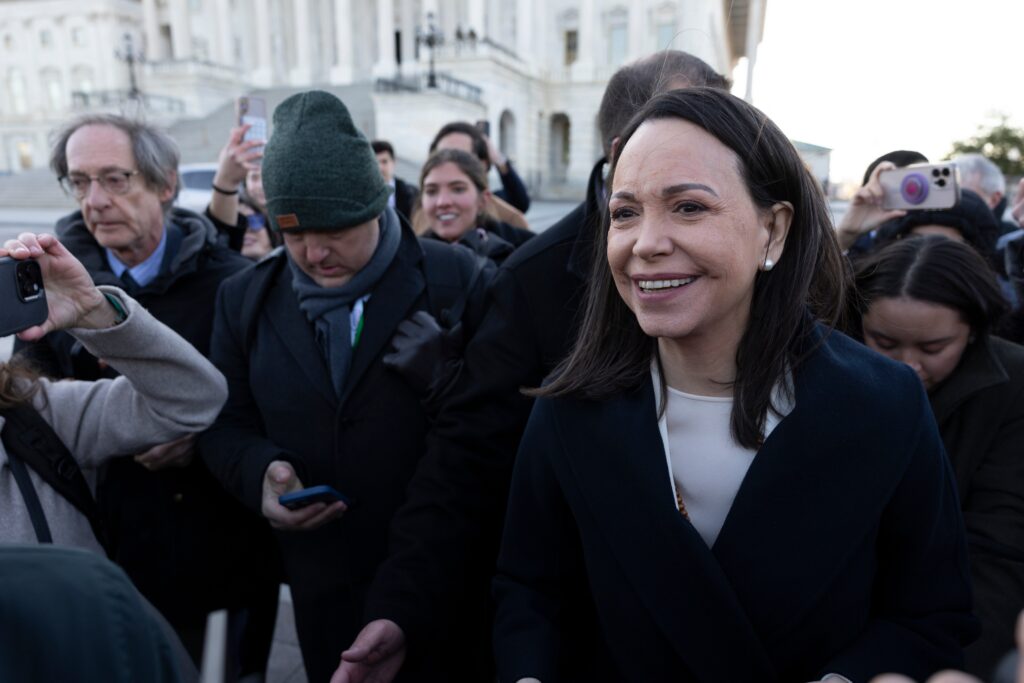
President Donald Trump on Thursday accepted a Nobel Peace Prize medal from Venezuelan opposition leader María Corina Machado, a striking bid by the current laureate to sway a U.S. president who recently declined to support her challenge to Venezuela’s ruling regime.
The gesture came 12 days after the U.S. president toppled Venezuela’s longtime leader, Nicolás Maduro, then chose to preserve ties with the existing regime rather than back Machado, whose movement claimed victory in 2024 elections.
Machado’s meeting with Trump was an effort to regain influence over Venezuela’s future as the threat of U.S. military action continues to hang over the new leadership in Caracas — and as Trump has demanded Venezuela open its oil fields to U.S. companies. Machado was her nation’s democratic leader-in-waiting until Trump backed the existing vice president, who has indicated willingness to bend to U.S. demands.
Machado “is a wonderful woman who has been through so much,” Trump wrote on Truth Social after the meeting. “María presented me with her Nobel Peace Prize for the work I have done. Such a wonderful gesture of mutual respect.”
President Donald J. Trump meets with María Corina Machado of Venezuela in the Oval Office, during which she presented the President with her Nobel Peace Prize in recognition and honor.
pic.twitter.com/v7pYHjVNVO
— The White House (@WhiteHouse) January 16, 2026
Machado’s effort to win the president’s sympathies through handing off her prize sparked a sharp reaction from the Norwegian Nobel Committee, which has said that a prize cannot be re-awarded to another person.
Machado said the Venezuelan people were giving Trump the medal “as a recognition for his unique commitment with our freedom.”
Since the Jan. 3 raid that captured Maduro and brought him to a New York courtroom, Trump has questioned whether Machado has the clout to assume a leadership role in her country. Instead, he has thrown his weight behind Delcy Rodríguez, who was Maduro’s vice president but has indicated she is willing to put a U.S.-friendly spin on her leadership while keeping the existing regime in place.
Machado entered the West Wing around noon and left after 2½ hours to go to meetings with Congress. Her meeting with Trump took place without cameras — a rarity for a president who typically publicizes such encounters. The low-profile visit may have signaled Trump’s preference for strengthening ties with the current Venezuelan leadership rather than elevating Machado.
Trump on Wednesday spoke by telephone with Rodríguez in what is their first known direct conversation, and both spoke positively about the encounter — a sharp turn given each side’s furious past rhetoric toward the other.
“We just had a great conversation today, and she’s a terrific person,” Trump told reporters in the Oval Office on Wednesday.
Trump was expecting Thursday’s encounter with Machado “to be a good and positive discussion,” White House press secretary Karoline Leavitt said as the meeting was beginning, calling the opposition leader “a remarkable and brave voice for many of the people of Venezuela.” But she downplayed the significance of the meeting, saying Trump’s opinion that she doesn’t have the clout to lead the country “has not changed.”
Trump is pleased with the job Rodríguez is doing so far, she added.
“We obviously had a $500 million energy deal that was struck in large part because of the cooperation from Ms. Rodríguez,” Leavitt said, and noted the release of five American political prisoners.
The president, Leavitt said, remains committed to a transition to a democratic government in Venezuela and “to hopefully seeing elections in Venezuela one day.”
The meeting came the same day a senior official from the Rodríguez government traveled to Washington, the highest-level emissary from Caracas to come for senior visits with counterparts in the U.S. capital in years. The Venezuelan ambassador to Britain, Félix Plasencia, planned to meet with officials at the State Department, among others.
“We maintain ongoing dialogue with the interim authorities, including Amb. Plasencia who is transiting the United States on his way back to Venezuela,” the State Department said in a statement.
Plasencia, a Western-educated career diplomat, is close to Rodríguez.
When Machado was announced as the Nobel Peace Prize recipient in October, she dedicated the award to Trump for “his decisive support of our cause” — seemingly mindful of the delicate politics of being awarded a prize that the U.S. president has publicly coveted.
Trump told Fox News last week it would be “a great honor” should she opt to give him the prize.
Machado, a longtime critic of the country’s authoritarian leadership, rose to international prominence after leading the opposition’s 2024 election campaign and the effort to substantiate its victory.
A former lawmaker, Machado spent years on the margins of a fractured opposition movement weakened by arrests, exile and government repression. That changed as Venezuela approached presidential elections in 2024, when she emerged as the driving force behind a unified opposition campaign.
Although barred by the government from holding public office — a restriction that prevented her from running — Machado won overwhelming support in opposition primaries and threw her backing behind a stand-in candidate, former diplomat Edmundo González. Machado led the campaign effort, rallying support for González across the country and transforming the race into the most serious electoral challenge the government had faced in decades.
In July 2024, Venezuelans voted overwhelmingly in favor of the opposition, according to ballot audits conducted by The Washington Post and independent election monitors. The government, then headed by Maduro, refused to release precinct-level results, but Machado’s team — with the help of thousands of volunteers stationed at polling sites — gathered original voting receipts from more than 80 percent of voting machines, showing González had won more than two-thirds of the vote.
As the opposition publicized its findings, the government launched a sweeping crackdown.
The campaign and its aftermath earned Machado global recognition. In October, the Norwegian Nobel Committee named her the recipient of the Nobel Peace Prize, praising her for keeping “the flame of democracy burning amid a growing darkness.” Two months later, Machado — who had been under a decade-long government ban on leaving the country — covertly escaped Venezuela with the help of the U.S. to attend the Nobel Prize ceremony in Norway.
Machado’s acceptance of the Nobel Peace Prize became a point of tension in her relationship with Trump. Two people close to the White House previously told The Post that Trump’s reluctance to boost Machado, despite her efforts to flatter him, stemmed in part from her decision to accept the award.
People involved with the Nobel Peace Prize said that the current situation was highly unusual.
“I’ve seen parallels — it’s very, very common, that one says that this prize belongs to, and then normal thing would be ‘all the Venezuelan people,’” said Henrik Syse, a professor at the Peace Research Institute Oslo who is a former member of the five-person committee that decides the winner of the Nobel Peace Prize.
“What makes this different is the way in which Trump has so clearly coveted the prize for himself, and at the same time as someone who clearly is influenced by other people’s rhetoric, they want to say things that pleases him, because one may need his support,” Syse said.
Trump’s public posture toward Machado has shifted over time. Last year, he praised her as a “freedom fighter” and repeatedly recognized González as Venezuela’s president-elect. More recently, however, Trump has questioned Machado’s political standing, saying it would be “very tough” for her to lead Venezuela.
Trump has instead emphasized the need to stabilize the country before holding elections and has spoken favorably of Rodríguez, who is serving as acting president following Maduro’s ouster — alarming opposition supporters who view Rodríguez as part of the system they voted to remove.
“I really wasn’t expecting to end up with Delcy as president. I hope we can transition to true democracy soon,” said María Eugenia Ruiz, who took part in a gathering of Machado supporters in front of the White House as the meeting was taking place. Many of the supporters waved the yellow, blue and red flags of Venezuela in the chilly sun.
“I hope Trump understands that she’s the same as Maduro, corrupt and undemocratic. He has to get rid of her, too,” she said.
Ruiz said she had spent the past several years organizing for Machado’s movement, serving as one of thousands of volunteer poll watchers during Venezuela’s elections. She said she was threatened for that work in the city of Valencia. When the hope she felt on election day curdled into despair months later, she left for the United States.
Machado’s meeting with Trump comes as Venezuela’s transition remains unsettled. Key questions remain about who will shape the country’s political future.
Earlier Thursday, U.S. forces in the Caribbean Sea seized another sanctioned oil tanker that the Trump administration said has ties to Venezuela, part of a broader effort to take control of the South American country’s oil.
The remains of 32 Cuban security personnel who Cuba says were killed protecting Maduro in the Jan. 3 U.S. operation, were returned to Havana on Thursday. In a ceremony at the Defense Ministry, Gerardo Hernández — who served over a decade in U.S. prison after conviction as a Cuban spy — called their service a “source of historical pride.”
Natalie Allison, Karen DeYoung and Noah Robertson contributed to this report.
The post Trump accepts a Nobel Peace Prize medal from Venezuela’s Machado appeared first on Washington Post.