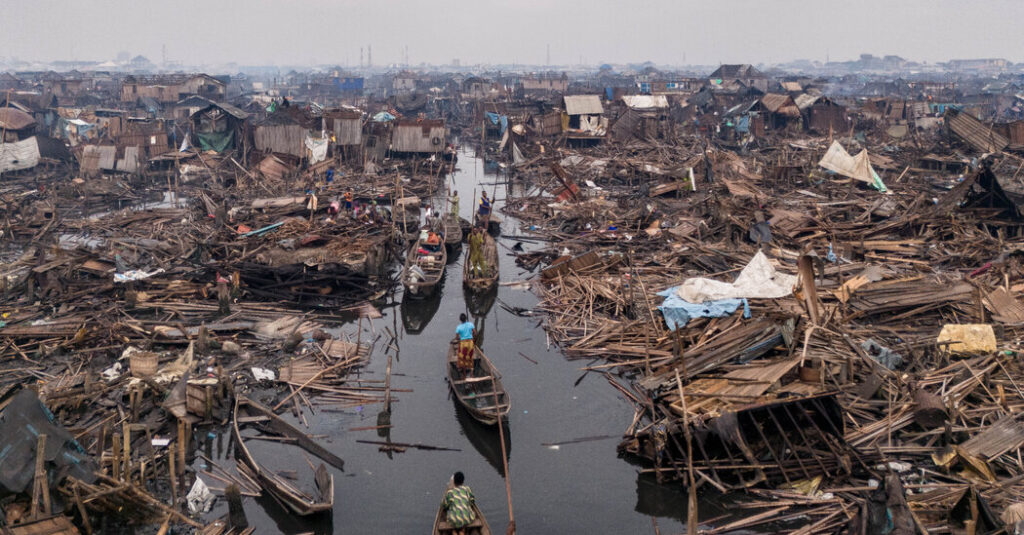
Residents of a 19th-century fishing community nicknamed the “Venice of Nigeria” have been left homeless after a government eviction that sent excavators to carry out demolitions.
Leaders in the community of Makoko in Nigeria and two other nearby settlements in Lagos Lagoon say at least 10,000 people have lost their homes during a demolition process that began in late December and was ongoing Friday.
Makoko community leaders and humanitarian groups said at least four people had died during the demolitions. Among them were two infants and a 70-year-old woman who they said suffered respiratory issues after tear gas was fired to scatter families trying to protect their homes.
A spokesman for the Lagos State government declined to comment on the reports of deaths and pointed to several news stories citing the government’s position that the demolition was necessary for safety — to move residents away from a nearby power line that could someday fall — and for urban planning.
State officials and private entities have engaged in numerous efforts in recent years to clear areas in the name of development in Lagos, a sprawling megacity of about 20 million people. Residents say that informal communities in the city are sometimes given little or no warning before being ordered to evacuate.
Families settled in the 1800s in Makoko; they live in small shacks on stilts in the lagoon, where they make a living catching and smoking fish that supplies many markets in the city.
The largely impoverished area, which residents access by canoe, is on full display for commuters traveling across a busy bridge. Last year, state government officials told Makoko residents that homes could not exist within 30 meters of the power line, which stretches across the lagoon. Later, officials extended the distance to 100 meters.
Residents met with government officials and agreed to comply. Makoko leaders planted a Nigerian flag in the water at what they said was the 100-meter mark. But as amphibious excavators began work, the machines ripped down homes well past the flag, they said. Nonprofit groups working with residents used aerial photos to estimate that the excavators had torn down homes as far as 500 meters from the power line.
On a recent morning in Makoko, loud crunching noises from a yellow excavator echoed off the water as homes and fishing shacks were reduced to piles of splintered boards, plastic bowls, crab shells and clothing. Some panicked residents preemptively began destroying their own homes, collecting planks and sheets of tin in narrow wooden canoes, hoping to rebuild elsewhere.
Isaac Atamado, 15, was threading his canoe through the inky water to get to a pile of broken planks. “This was my house,” he said, looking at what was left of the two-story shack on the lagoon, where he said 12 members of his family had lived.
He ran when he saw the excavator heading for his home Tuesday, and was left barefoot, with only the shirt and pants he was wearing after it was demolished. He has been sleeping on the wet, dirty floor of his narrow canoe with his brother. He said he was unsure where his family will live.
Francis Samson Vituwa, a Makoko community leader, said thousands of residents were in similar situations. Mr. Vituwa can trace his roots to his grandfather who settled in Makoko. “It’s a good life here,” he said. Living in Makoko has allowed him to support his wife and send his five children to school, he said. “There’s no good coming from this.”
Several residents staged protests this week at the State House of Assembly in Lagos, where officials pledged on two separate days to pause the demolitions, said Megan Chapman, co-director of Justice & Empowerment Initiatives, one of the community groups supporting residents.
But excavators have kept at it.
“There is still a community to save,” she said.
Ismail Auwal contributed reporting from Kano, Nigeria.
Dionne Searcey is a Times reporter who writes about wealth and power in New York and beyond.
The post Thousands Evicted From the 19th-Century ‘Venice of Nigeria’ appeared first on New York Times.