This is an edition of the Books Briefing, our editors’ weekly guide to the best in books. Sign up for it here.
Novelists committed to depicting contemporary life face an unprecedented challenge in this moment: How can they do so in a way that keeps readers interested when so much of the average person’s time is spent scrolling across a variety of screens?
First, here are four new stories from The Atlantic’s Books section:
- What Stephen Miller gets wrong about human nature
- “First Memory,” a poem by Mary Jo Salter
- Julian Barnes says goodbye to the novel
- A champion of modernism, in literature and life
Looking at the internet doesn’t lend itself easily to depiction in prose, and yet anyone writing about the 21st century has no choice but to address it. This doesn’t change the fact that describing someone browsing the web or scrolling without end can be mind-numbing. Different novelists have approached this fresh challenge in multiple ways: by adopting the unique vernacular or fragmented form of a social-media feed, for instance, or by showing a protagonist falling deep into a rabbit hole.
In her debut novel, Lost Lambs, Madeline Cash, a co-founder of the literary magazine Forever, has attempted to write an internet-mediated story that feels more grounded in the real world than what has come before—in large part by adopting the classic form of the family drama. She uses this approach to show not only what it looks like for a person to spend a lot of their time online, Gideon Leek wrote this week in The Atlantic, but also what that does to a person—and to their relationships. In Lost Lambs, every member of the Flynn family is influenced by their devices in a different way: The parents, Bud and Catherine, have embarked on an experiment with nonmonogamy, an idea that Catherine gets from watching a Real Housewives spin-off set in Baghdad. Meanwhile, their daughter Louise has fallen in love with an Islamic-fundamentalist boyfriend she met online in a chatroom for middle children. “Yourstruly” (the screen name by which she knows him) has taught her how to make a bomb, which she’s been assembling in her backyard treehouse. “They don’t cover this sort of thing in parenting books,” Bud remarks, confounded.
The internet can do scary things to a person, such as encouraging violence or conspiracism. Leek points out that in Cash’s novel, however, the stakes seem oddly low because nothing bad really happens. In the logic of the family novel, betrayals and mistakes should lead to a “cascade of consequences,” he writes; instead, “Cash flinches.” But perhaps what Cash is doing is simply capturing something very real about the internet. It’s a unique place that intermingles the worst of humanity with absolute mundanity—somewhere you can have a relationship with a self-professed militant that ends before anything too grave occurs offline. In Cash’s novel, the characters, just like many real people, simply get lucky: The worst doesn’t occur—and what happens online, for the most part, stays there. Maybe the internet is not just changing society, but also tweaking the rules that govern what a family novel is supposed to be.
The Unhappy Literary Families of the Internet Age
By Gideon Leek
Fiction about online life tends to mimic its dull repetition. A debut novel doesn’t quite succeed in raising the stakes—but it points the way forward.
Know other book lovers who might like this guide? Forward them this email.
What to Read
Y/N, by Esther Yi
The title of Yi’s strange and appealing 2023 novel refers to, as the unnamed narrator puts it, “a type of fanfiction where the protagonist was called Y/N or ‘your name.’” The narrator attends a K-pop show in Berlin and becomes obsessed with the band’s youngest member, the 20-year-old Moon: “a gift forever in the moment of being handed over,” Yi writes. As the narrator’s fixation grows, she begins writing Y/N fan fiction about Moon, much of which is reproduced in the novel. When Moon abruptly retires, the narrator goes to Korea to find him. Some readers might expect an indictment of fan fiction and celebrity culture; Yi swerves, though, and creates a more searching and subversive tale of love, connection, and art. Even after the narrator finds Moon, her motives remain obscure. The point of her fantasy seems to be the fantasy itself. — Erin Somers
From our list: Six books you can get lost in
Out Next Week
 How to Commit a Postcolonial Murder, by Nina McConigley
The Elements of Power, by Nicolas Niarchos
Scale Boy, by Patrice Nganang
Your Weekend Read
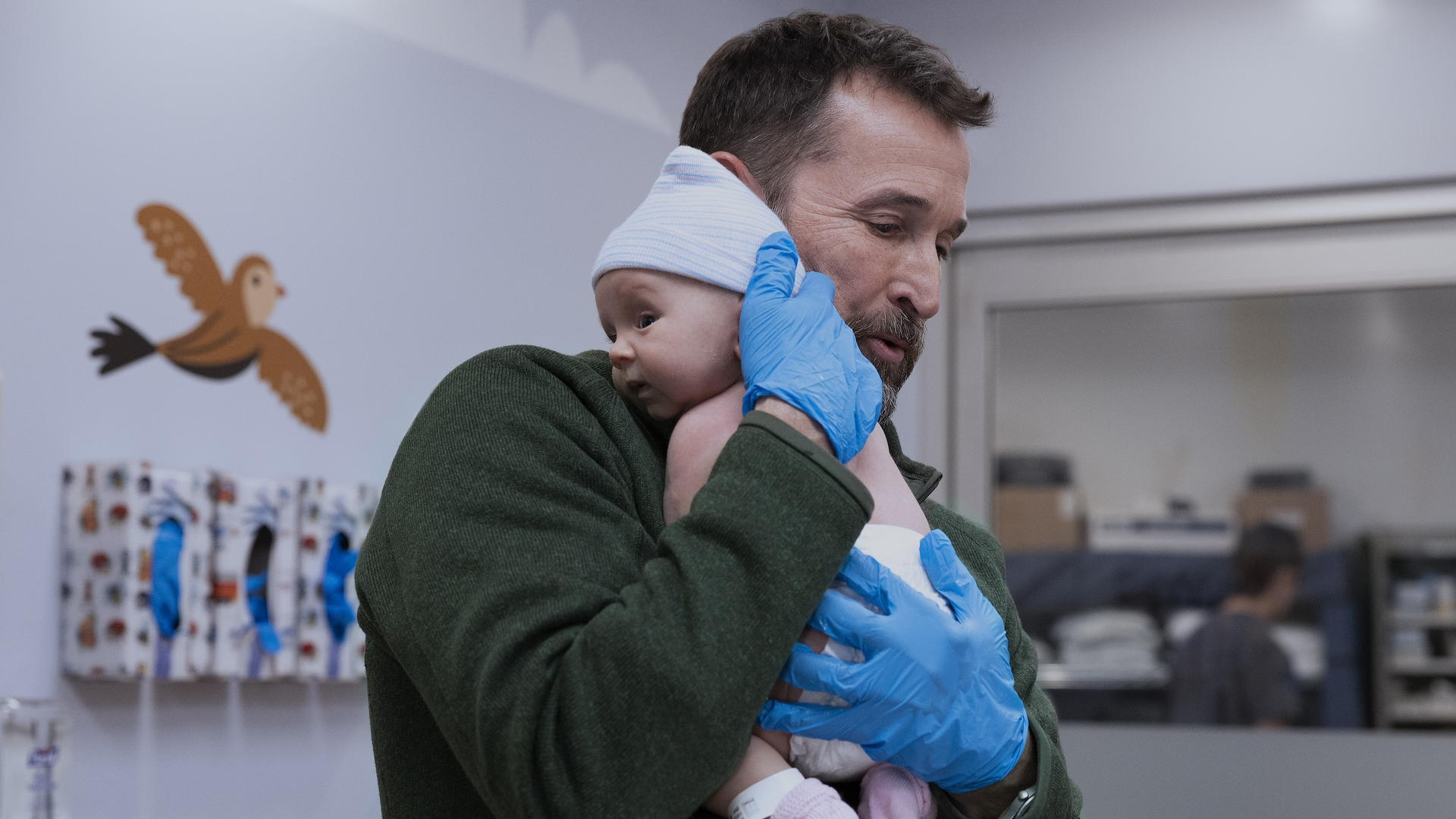
The Pitt Is a Brilliant Portrait of American Failure
By Sophie Gilbert
Some might call The Pitt preachy. (A recent Vulture review argued that the show’s righteousness has become “distractingly pedantic, even patronizing,” as though considering real-world flash points through a humanizing lens was wholly new for television rather than embedded in its history: Remember Maude’s abortion? Rose’s Golden Girls HIV test?) I’d argue, rather, that The Pitt has an emphatic moral clarity that feels awkward only because we haven’t seen it for so long. It refuses to both-sides issues that it considers straightforward. Should you vaccinate your children against measles? Yes, The Pitt says, offering up a child with not just spots all over his body but also acute inflammation in his brain and spinal cord. The show is set in the emergency room, where society’s problems become inescapable, where people who have fallen through the cracks land. In an era of relentlessly absurd and wealth-washed TV, The Pitt’s realism, its defiant lack of glamour, is bracing.
When you buy a book using a link in this newsletter, we receive a commission. Thank you for supporting The Atlantic.
Sign up for The Wonder Reader, a Saturday newsletter in which our editors recommend stories to spark your curiosity and fill you with delight.
Explore all of our newsletters.
The post Taking the Internet Novel Offline appeared first on The Atlantic.