President Ahmed al-Sharaa of Syria issued a decree on Friday affirming the rights of Kurdish Syrians, according to state media, in what was widely considered an overture to the minority group after days of deadly clashes between government and Kurdish forces.
The presidential decree recognized Kurdish as a national language, alongside Arabic, and adopted Nowruz, the Persian new year that is widely celebrated by Kurds, as an official holiday in Syria. Mr. al-Sharaa also called for the government to grant Syrian citizenship to Kurdish residents who were stripped of it after a 1962 census designed to curb Kurdish political influence.
The announcement on Friday came after days of intense fighting between Mr. al-Sharaa’s government and the Kurdish-led Syrian Democratic Forces, or S.D.F., that many feared could escalate into a broader conflict between the two sides.
“Beware of believing the narrative that we want harm to our Kurdish people,” Mr. al-Sharaa said in a video announcing the decree posted on the Syrian Arab News Agency, the state media outlet. “Your well-being is our well-being.”
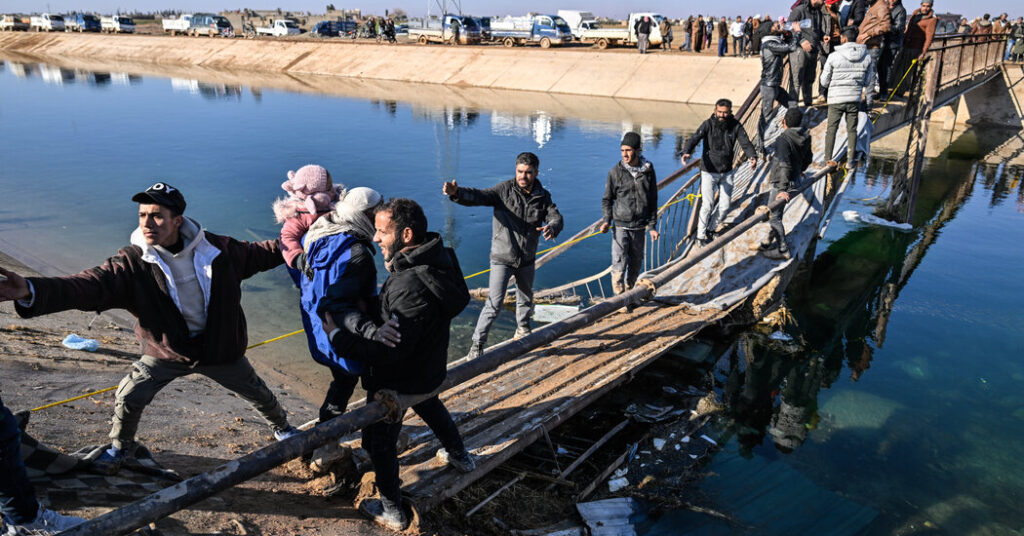
Over the past year, Mr. al-Sharaa’s government and the S.D.F. have been engaged in negotiations to integrate the group into the new national military. But progress on those talks has stalled in recent months, and last week, tensions between the two sides erupted into clashes in the northern city of Aleppo. At least 24 civilians were killed in five days of fighting while thousands were forced to flee their neighborhoods.
It was some of the most intense fighting since the end of the civil war in December 2024, when Mr. al-Sharaa’s coalition of rebel groups ousted the dictatorship of Bashar al-Assad.
On Friday evening, the prospect of another major clash hung over northern Syria after government troops amassed outside areas in eastern Aleppo held by S.D.F. fighters.
Around the time Mr. al-Sharaa announced the decree affirming Kurdish Syrians’ rights, the national military announced it had begun striking those S.D.F. positions.
Soon after, the leader of the S.D.F., Mazloum Abdi, said in a post on X that his forces would withdraw from the contested area and redeploy to regions east of the Euphrates River. It remained unclear whether doing so would head off further clashes with the government.
The fighting over the past week has underscored the challenge Mr. al-Sharaa faces as he vows to unite a country that is deeply fractured after nearly 14 years of civil war. Since his largely Sunni Muslim government came to power, two regions of Syria home to mostly minority groups — the Kurdish-controlled northeast and the Druse in the southern province of Sweida — have refused to submit to the central government’s authority.
Leaders of both are wary of Mr. al-Sharaa, the former commander of a rebel group once allied to Al Qaeda, and his Islamist-led government. Some also doubt the government’s ability to protect minority rights after bouts of sectarian-driven violence over the past year.
The Kurds, who make up about a tenth of Syria’s population, were denied many basic rights, including identity papers and business licenses, under more than five decades of the Assad family’s rule in Syria.
The decree Mr. al-Sharaa signed on Friday “breaks decisively” with decades of “Arab nationalist exclusion that denied Kurds” in Syria, according to Ibrahim al-Assil, a senior research fellow at the Middle East Initiative at Harvard.
Still, many remained skeptical of the announcement and the motivations behind it.
“Mistrust runs deep, and many Kurds are cautiously welcoming this while remaining skeptical,” Mr. al-Assil said. “Ultimately, the decree will be judged by behavior, not words.”
Reham Mourshed contributed reporting.
Christina Goldbaum is The Times’s bureau chief in Beirut, leading coverage of Lebanon and Syria.
The post Syria’s President Affirms Kurds’ Rights, in Overture to the Minority appeared first on New York Times.