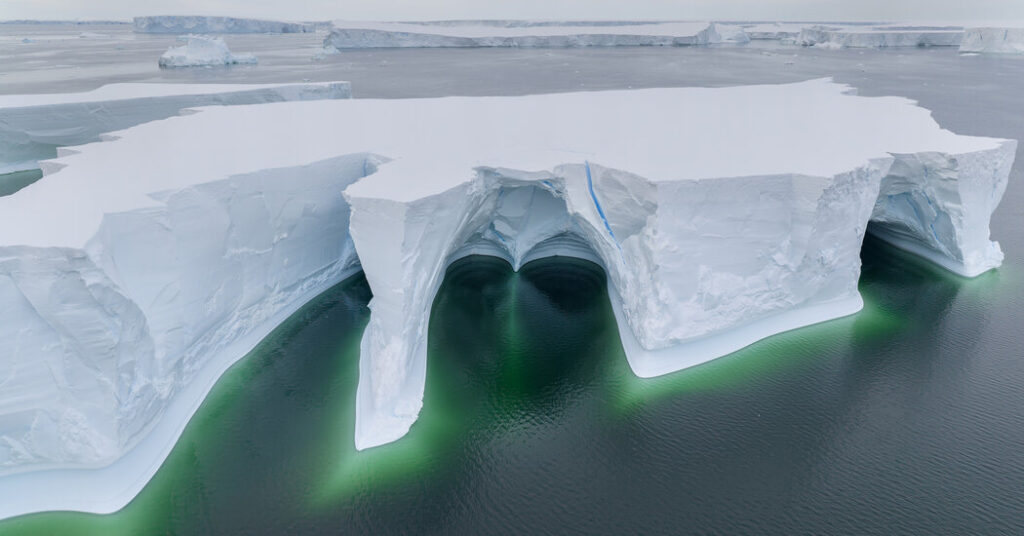
With the icebreaker Araon spending a few days away from Thwaites Glacier, the scientists aboard have had a chance to work at another of Antarctica’s fastest-deteriorating masses of ice, Pine Island Glacier.
Like Thwaites, Pine Island is being eroded by warm ocean currents that wash up against its floating end. If both glaciers melted away completely, Thwaites would add more to global sea-level rise than Pine Island. But over the past half-century, Pine Island has shed more of its ice than Thwaites.
Today, Pine Island Glacier is in such a bad state that our expedition made a little grim history on Thursday: According to Won Sang Lee, the chief scientist on the voyage, we became the first people to sail to the back of a 20-mile-long inlet that was formed when a huge section of the glacier’s floating end broke apart and floated out to sea several years ago.
This was no leisure cruise. The only way in and out of the inlet is narrow, and icebergs are peeling off the ice around it all the time. As these icebergs drift toward the ocean, they can block the entrance, penning in any ships that happen to be inside.
Some of the scientists on the Araon were nervous about sailing into what they called a “death trap.”
A few weeks ago, a huge iceberg broke off and briefly sealed off the entrance, according to satellite images. The seafloor beneath the inlet wasn’t fully mapped, so the captain wouldn’t know in advance which areas might be shallow.
But Sukyoung Yun, the oceanographer with the Korea Polar Research Institute who leads marine operations on our expedition, was eager to try. “This is a newly opened area,” Dr. Yun said. “So if we can get some data, it will be valuable.”
On Thursday at about 3:15 p.m., the ship cruised southeast through the narrow mouth, past a 3.5-mile-long iceberg that, according to satellite pictures, had detached from the ice behind it.
To our left was Pine Island Glacier. To our right, a tributary glacier called Piglet. (Why Piglet? Because in scientific papers, Pine Island Glacier is shortened to PIG.)
Pierre Dutrieux, an oceanographer at the British Antarctic Survey, was preparing to deploy an instrument that would measure how warm and salty the water was from seafloor to surface. The instrument, a three-foot-tall metal cylinder, can ascend and descend, and send data by satellite. But it lacks propellers, so it is at the mercy of currents and icebergs.
The collapse of Pine Island Glacier’s floating ice, which took place from 2017 to 2020, was “completely unexpected,” Dr. Dutrieux said as the Araon steamed through waters that had been covered by that ice less than a decade ago. Without the floating ice there to provide support, the surrounding ice has been moving more quickly toward the ocean.
The ship sailed past enormous hunks of Piglet’s ice that were leaning heavily, looking as if they could break off with a well-placed hit from a snowball. As ice accelerates, it stretches, exacerbating all its preexisting cracks and weaknesses. “The entirety of that structure is very, very thin now,” Dr. Dutrieux said.
He, too, was uneasy about sailing here. “It’s good for science,” he said. “But we’re taking some risks.”
For the past 15 years, Dr. Dutrieux has helped maintain undersea moorings near Pine Island Glacier that measure the amount of heat traveling through and melting the ice. The remote-controlled instrument he was tossing overboard on Thursday would give him a look at how heat moves through the inlet, at least for a few weeks. Ideally, the device will have drifted out to Pine Island Bay by then, he said. It would be worse if it got stuck under the ice, where it couldn’t send data.
Wearing a tether that kept him chained to the deck, Dr. Dutrieux leaned over the transom and dropped the instrument. After a few seconds, it bobbed to the surface, indicating that it was working properly. Dr. Dutrieux looked out at the little device in the water and gave it a thumbs-up.
Afterward, the Araon continued around the inlet so its sonar could map the seabed. The captain took the ship right alongside Piglet’s icy edge — close enough, Dr. Dutrieux noted, to be in striking range if a tall chunk broke off and capsized. Not until after 9 p.m. did we exit the inlet, allowing everyone to breathe easier.
In an earlier dispatch, I said I wasn’t very good at estimating the size of distant ice masses at sea. On Thursday evening, that was no issue: We were sailing even closer to Piglet than we had to Thwaites, and as I stood out on the deck, the ice loomed large. My eyes roamed the intricate surfaces and, for the first time, I felt I understood, really understood, these glaciers’ proportions.
Raymond Zhong reports on climate and environmental issues for The Times.
The post Sailing Through a ‘Death Trap’ Once Covered by Antarctic Ice appeared first on New York Times.