When U.S. Immigration and Customs Enforcement announced the Jan. 3 death of detainee Geraldo Lunas Campos at a Texas detention camp, the agency said “staff observed him in distress,” and it gave no cause of death.
An employee of El Paso County’s Office of the Medical Examiner told Lunas Campos’s daughter this week that, subject to results of a toxicology report, the office is likely to classify the death as a homicide, according to a recording of the conversation.
In the recording, which the daughter shared with The Washington Post, the employee said a doctor there “is listing the preliminary cause of death as asphyxia due to neck and chest compression,” which means Lunas Campos did not get enough oxygen because of pressure on his neck and chest. Pending the results of a toxicology report, the staffer said on the recording, “our doctor is believing that we’re going to be listing the manner of death as homicide.”
A 55-year-old Cuban immigrant, Lunas Campos died following a struggle with detention staff, according to an eyewitness account and an internal ICE document reviewed by The Post.
A representative from the medical examiner declined to comment on the recording or share any findings about the man’s death with The Post, saying that information can only be shared with family members.
In an email Thursday evening, Tricia McLaughlin, assistant secretary for the Department of Homeland Security, said that Lunas Campos died after attempting to take his own life.
“Campos violently resisted the security staff and continued to attempt to take his life,” McLaughlin said. “During the ensuing struggle, Campos stopped breathing and lost consciousness. Medical staff was immediately called and responded. After repeated attempts to resuscitate him, EMTs declared him deceased on the scene.”
McLaughlin declined to provide additional documentation, calling the matter an “active investigation.”
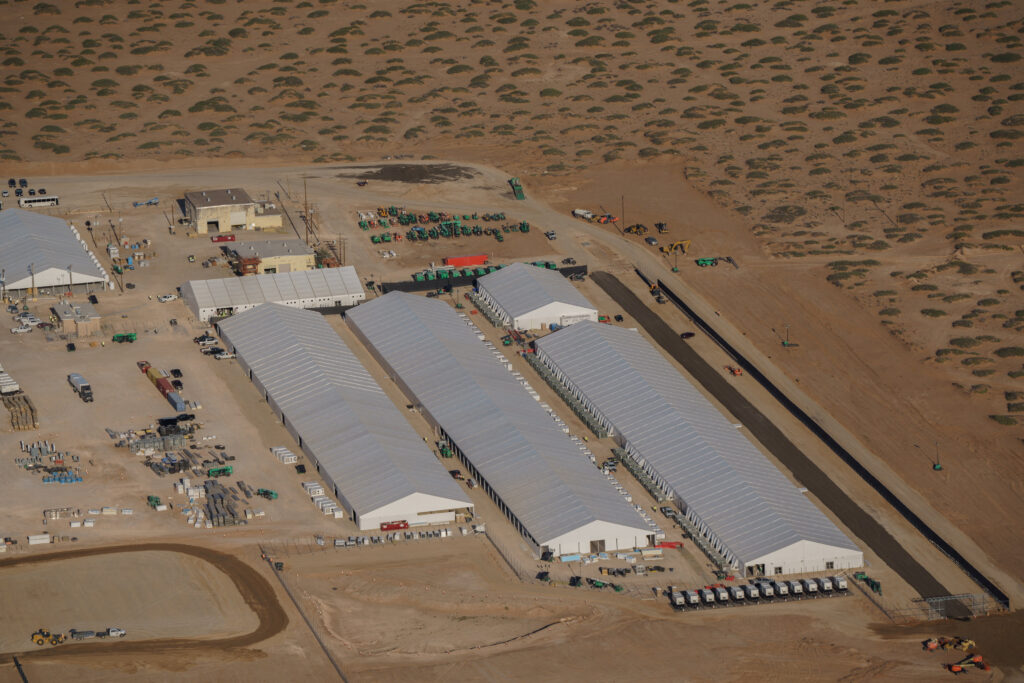
A homicide ruling from the medical examiner would almost certainly draw attention to Camp East Montana, a colossal makeshift tent encampment on the Mexican border where migrants have reported substandard conditions and physical abuse, and ICE’s own inspectors have cited dozens of violations of federal detention standards.
Lunas Campos’s death also comes amid nationwide upheaval over the fatal shooting of a U.S. citizen by an ICE officer in Minneapolis last week, an event that for many has raised questions about the training and oversight of the ICE officers helping to carry out the Trump administration’s immigration crackdown.
Court records show Lunas Campos was convicted of several crimes, including for aggravated assault with a weapon and, in 2003, first-degree sexual abuse involving a child under 11 years old. ICE arrested Lunas Campos in a “planned enforcement operation” in July, saying in a news release that his criminal record spanned from at least 1997 through 2015 and that “his luck has finally run out.”
Lunas Campos had been placed in a segregated housing unit after becoming “disruptive” while waiting in line for medication at the Camp East Montana facility in El Paso, ICE said in a statement last week. Later the same day, staff observed Lunas Campos “in distress” and contacted emergency medical personnel, who were unable to save his life and pronounced him dead, according to the statement.
ICE’s statement did not contain any detail about the cause of death. An internal ICE log reviewed by The Post documented a series of events about Lunas Campos’s case, noting his death, an attempt to contact his family, the notification of the Cuban Consulate and the transportation of his body by the medical examiner. The last event logged, six days after his death, references an “immediate” use-of-force incident but provides no date of that incident or any details.
In an interview with The Post, Santos Jesus Flores, a man who says he was detained in the segregation unit the day Lunas Campos died, said he saw at least five guards struggling with Lunas Campos after he refused to enter the segregation unit, complaining that he didn’t have his medications. Flores said he saw guards choking Lunas Campos and heard Lunas Campos repeatedly saying, “No puedo respirar” — Spanish for “I can’t breathe.” Medical staff tried to resuscitate him for an hour, after which they took his body away, Flores said.
“He said, ‘I cannot breathe, I cannot breathe.’ After that, we don’t hear his voice anymore and that’s it,” said Flores, who had contacted a family member of Lunas Campos, who in turn put him in touch with a Post reporter. The Post confirmed Flores was in Camp East Montana through ICE’s detainee locator.
Deaths in ICE detention centers have occurred with increasing frequency in recent months, as President Donald Trump’s immigration crackdown floods these facilities with record numbers of detainees. At least 30 people died in detention last year — the highest in two decades — and Lunas Campos is one of four who died in the first nine days of 2026 alone, according to ICE, which posts information about all detainee deaths on its website.
Among more than 280 documented deaths in ICE detention since 2004, there have been only a handful of confirmed instances of detainees killed by someone else, according to Andrew Free, a researcher and lawyer who has represented families of immigrants who died in detention. Last year, two detainees were killed by a gunman who fired on an ICE field office in Dallas in an attack officials saidwas politically motivated; and in 2013, an immigrant detained in Puerto Rico died after being stabbed by other detainees multiple times.
Jeanette Pagan Lopez, the mother of two of Lunas Campos’s children, said she has been contacted by agents from the FBI, who told her they are conducting an investigation into the death. A spokesperson for the FBI declined to comment.
“I know it’s a homicide,” Lopez said. “The people that physically harmed him should be held accountable.”
A medical examiner’s finding of homicide means that someone’s death was caused at least in part by the actions of another person, and does not necessarily imply any intention to kill, said Lee Ann Grossberg, an independent forensic pathologist based in North Carolina.
Lunas Campos’s death raises new questions about ICE’s reliance on private detention contractors, which the government entrusts to manage security, food, transportation and medical care for the vast majority of immigrant detainees. Those companies have taken on a larger role during Trump’s second term, winning contracts worth tens of millions of dollars to reopen former private prisons and build makeshift tent encampments to accommodate the surge in detainees.
Federal standards for immigrant detention say that force may only be used against detainees “after all reasonable efforts to resolve a situation have failed.” In most cases, the use of force should be “calculated,” where staff members take time to assess possible ways to resolve the situation, the standards say. An “immediate use of force” is permitted only when a detainee’s behavior constitutes a serious and immediate threat.
Representatives from Acquisition Logistics, the Virginia contractor that oversees Camp East Montana, and Akima Global Services, a company that employs guards there, did not respond to requests for comment.
Lunas Campos was paroled into the United States in Miami in 1996, according to ICE. An immigration judge ordered his removal in 2005, but the government said it could not obtain travel documents for him.
For years, he lived in Rochester, New York, where he had three children and one grandchild, said Lopez, who separated from Lunas Campos when their kids were young but stayed in close contact with him. She said he worked periodically delivering furniture and as a roofer, but it was hard for him to find work because of his immigration status and criminal record.
Lunas Campos is the second person to die while in custody at Camp East Montana, which now ranks as the largest ICE detention facility, according to internal ICE records, with more than 3,800 detainees.
In interviews with the American Civil Liberties Union and other nonprofit groups in November, several immigrants detained at Camp East Montana claimed they were beaten by guards for complaining, demanding medical treatment, refusing to eat or for resisting deportation.
“There is always the risk of retaliation here for trying to ask for our rights to be respected,” one of the detainees, a 35-year-old Cuban man, said in a sworn declaration to the groups. He provided his name in the declaration, and the ACLU shared the information with The Post last month on the condition that the name not be published for fear of retaliation.
People at Camp East Montana placed about 90 emergency calls between Aug. 17 and Dec. 1, or about five per week, according to 911 call logs the El Paso Times obtained through public records requests. The callers reported a variety of emergency medical problems, including chest pain, seizures and breathing problems, the newspaper reported. At least five calls stemmed from suicide attempts.
Another detainee of Camp East Montana, Francisco Gaspar-Andres, died on Dec. 3 as a result of liver and kidney failure, according to an ICE statement on his death. The 48-year-old Guatemalan man exhibited a range of medical problems after being transferred to the facility in September, including high blood pressure, jaundice and a severe sinus infection.
“From the moment they were notified of his health crisis, ICE medical staff ensured he had constant, high-quality care,” ICE said in the release about Gaspar-Andres’s death.
Aaron Schaffer, Perry Stein, Marianne LeVine, Maria Sacchetti and Nate Jones contributed to this report.
The post Medical examiner likely to classify death of ICE detainee as homicide, recorded call says appeared first on Washington Post.