María Corina Machado, Venezuela’s opposition leader and last year’s Nobel Peace Prize winner, presented her prize to President Trump on Thursday during a meeting in the White House.
Mr. Trump took to social media several hours later to thank her.
“María presented me with her Nobel Peace Prize for the work I have done,” he wrote. “Such a wonderful gesture of mutual respect. Thank you María!”
The White House shared on social media an image of Mr. Trump holding the frame containing the Nobel medal. The inscription reads that his “Principled and Decisive Action to Secure a Free Venezuela” has been recognized. The Nobel Committee has said the Peace Prize is not transferable.
For her part, Ms. Machado, speaking to reporters earlier after meeting with Mr. Trump, said she had made the presentation “as a recognition for his unique commitment to our freedom.”
The highly unusual gesture came after months of clamoring by the American president that he had deserved the prize that she was awarded for seeking to usher a peaceful transition to democracy in Venezuela.
Ms. Machado had repeatedly dedicated the prize to Mr. Trump and praised the U.S. military operation nearly two weeks ago that ousted Venezuela’s longtime authoritarian leader, Nicolás Maduro. Mr. Trump has made clear that he thought he had deserved the prize, saying he had ended several wars and castigating Norway for overlooking him.
Beyond cheering U.S. intervention in her country, Ms. Machado has remained mum about a bombing campaign against boats that Mr. Trump says are smuggling drugs. The American strikes have killed more than 100 people.
It is unclear what Ms. Machado gained out of her meeting with Mr. Trump. After ousting Mr. Maduro, he declined to install her in power, saying that “she’s a very nice woman, but she doesn’t have the respect” needed to lead the country.
Independently verified vote counts in Venezuela’s 2024 presidential election showed that Ms. Machado’s party had beaten Mr. Maduro by a wide margin. The Venezuelan authorities, nonetheless, declared Mr. Maduro the victor, and his government embarked on a harsh repression campaign against critics of the outcome.
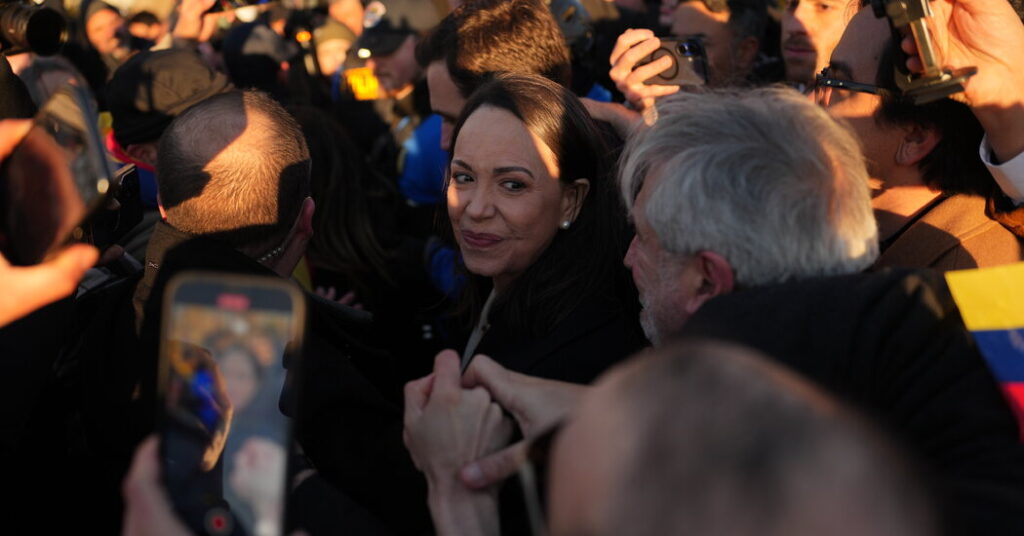
Speaking to supporters and reporters in Washington on Thursday, Ms. Machado said she was “impressed” by how clear Mr. Trump was on her country’s situation and “how much he cares.”
Her efforts to cozy up to Mr. Trump have been met with scorn across the Atlantic Ocean in Norway, where the prize is regarded not just as prestigious and freighted with symbolism, but also as the country’s primary soft-power tool — and where Mr. Trump is deeply unpopular. The Nobel Institute, which awards it, has been in serious damage-control mode.
Last Friday, after Ms. Machado floated the idea of sharing the prize with Mr. Trump in a Fox News interview, the institute offered a reminder about what the rules governing the award allow, saying that the facts were “clear and well established.”
“Once a Nobel Prize is announced, it cannot be revoked, shared or transferred to others,” the institute wrote. “The decision is final and stands for all time.”
The day before Ms. Machado arrived in Washington, Kristian Harpviken, the director of the institute, who is also the secretary of the committee that chooses award recipients, said he would not be drawn further into the deepening controversy.
“The prize is awarded on the basis of the laureate’s contributions by the time that the committee’s decision is taken,” he said.
That explanation has been insufficient for many Norwegians.
“A Nobel committee can never guard against peace prize laureates committing acts that run counter to the intention of the prize,’’ Lena Lindgren, a columnist for the Norwegian weekly Morgenbladet, said in an interview. “But what is new now is that the prize is being used in a political game, a warlike game.”
Ms. Machado’s trip to Washington also drew derision from those now in power in Venezuela. Speaking in Caracas on Thursday, Venezuela’s interim leader, Delcy Rodríguez, who gained the Trump administration’s support in taking over after Mr. Maduro’s ouster, took aim at Ms. Machado in a thinly veiled reference.
“And if one day, as acting president, I have to go to Washington, I will do so with my head held high, not on my knees,” she said.
It is far from the first time the Nobel committee has been criticized for its choice, or been accused of abetting violent leaders or governments.
Global outrage followed the choice of President Barack Obama, who at the time was presiding over military engagements on several continents.
And less than a year after receiving the award, Abiy Ahmed, the president of Ethiopia, embarked on a scorched-earth campaign in his country’s Tigray region that left hundreds of thousands dead, wounded and starving. Henry Kissinger and Lê Đức Thọ were awarded the prize before a cease-fire to end the Vietnam War broke down, with Mr. Kissinger ultimately trying to return the prize amid a wave of protests. His North Vietnamese counterpart rejected it outright.
What makes the dispute swirling around Ms. Machado unusual, according to Asle Sveen, a former researcher at the Nobel Institute, is Norwegians’ particularly dim view of Mr. Trump.
Ms. Machado “has dedicated her Peace Prize to a highly controversial president, to put it mildly,” Mr. Sveen said. “It is nearly universally accepted in Norway that Donald Trump attacks liberal democracy.”
A Norwegian tabloid, Nettavisen, conducted a poll before the announcement of the award that found three-quarters of respondents were against it being bestowed on Mr. Trump, even if he were instrumental in orchestrating a peace agreement in Ukraine or Gaza.
“The Nobel Committee has compromised the prize” by not foreseeing how Ms. Machado and Mr. Trump would use it to justify military intervention in Venezuela, Ms. Lindgren said. “Norway has been politically embarrassed and has failed to manage the symbolic capital.”
Following the 2024 election in Venezuela, Ms. Machado went into hiding for more than a year. In December, she secretly left Venezuela to receive her award in Norway. She missed the award ceremony but appeared in Oslo to greet supporters. Her escape was orchestrated by a company run by U.S. veterans with special operations and intelligence training.
American lawmakers, including Marco Rubio, who was then a Republican senator from Florida and is now Mr. Trump’s secretary of state, had written a letter to the Nobel Committee in 2024 advocating that they award Ms. Machado the peace prize.
They noted her “peaceful resistance to tyrants” and her “unwavering moral compass,” and said that her efforts showed the “urgent need for international solidarity in the face of aggressive and expansive authoritarianism.”
There is little doubt that Ms. Machado has long risked her safety to challenge an authoritarian government that jails opponents, tortures critics and censors the press. But she has also embraced Mr. Trump’s military buildup in the Caribbean, repeated debunked claims that Mr. Maduro manipulated U.S. elections, and parroted the Trump administration’s claim that Mr. Maduro simultaneously led two drug organizations, despite scant evidence.
Her assertions fueled accusations that she was amplifying misinformation in what, until now, seemed a failed attempt to gain the American president’s support.
Still, not all Norwegians agree that the award to Ms. Machado was a mistake.
If it turned out that she supported the U.S. boat strikes, that would not be the best reflection on a laureate, said Marianne Dahl, research director at the Peace Research Institute Oslo. But Ms. Machado was awarded for her pro-democracy work in 2024, Ms. Dahl said. She drew similarities between Ms. Machado and past winners who led popular movements in Nazi Germany, apartheid South Africa and Soviet republics, as well as during the so-called Arab Spring.
“It is easy to sit in comfortable Norway and criticize her for talking sweet to Trump,” Ms. Dahl said.
That, she noted, is exactly what many European and even Norwegian leaders have done. “And they don’t have a repressive regime pursuing them, as Machado has had,” she said.
Jack Nicas and Emiliano Rodríguez Mega contributed reporting from Mexico City.
Max Bearak is a reporter for The Times based in Bogotá, Colombia.
The post Machado Presents Trump With Her Nobel Peace Prize appeared first on New York Times.