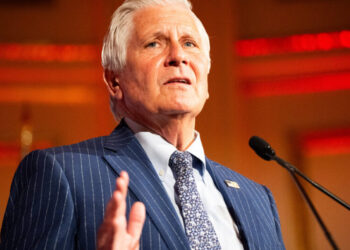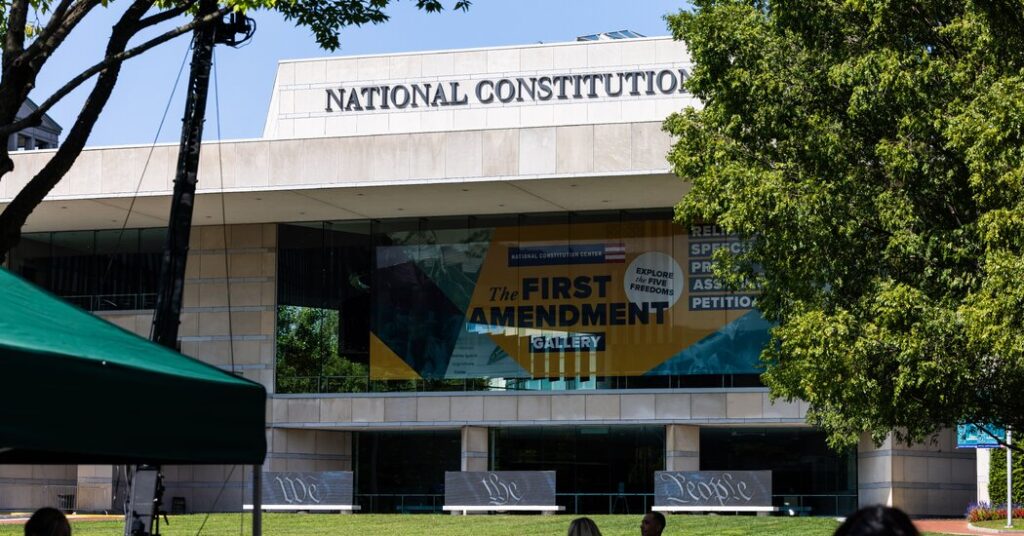
There was a constitutional crisis at the National Constitution Center in Philadelphia. And when the dust settled, Jeffrey Rosen, a legal commentator and writer who for 12 years has been the center’s public face, was out as its president and chief executive.
The center, chartered by Congress to be a nonpartisan museum and national town hall, embodies the civil center of the legal establishment. Ideologically diverse judges and business luminaries sit on its board. Students study curriculums it designs. C-SPAN broadcasts its panel discussions and Supreme Court justice interviews — nearly always moderated by Mr. Rosen.
So eyebrows shot up last weekend when the center announced that effective immediately, Mr. Rosen was now its emeritus chief executive and Vince Stango, its executive vice president and chief operating officer, was the interim president. That the center is rolling out major events for the nation’s 250th birthday made the timing of the change all the more puzzling.
The center offered no explanation, and a center spokeswoman pointed to its public statement. Mr. Rosen posted on social media that he had “decided to focus more on scholarship, writing and public dialogue.” Mr. Rosen did not respond to inquiries. Mr. Stango did not respond to a request for comment through the spokeswoman.
But interviews with multiple people familiar with the situation depict a management dispute that escalated and went off the rails, culminating in a chaotic board meeting earlier this month. The wreckage included not just Mr. Rosen’s role as leader, but the board membership of J. Michael Luttig, a retired federal appeals court judge known as a prominent conservative critic of President Trump.
The people familiar with the matter, who spoke on the condition of anonymity to discuss a sensitive internal matter, said that for years, Mr. Rosen has been the public-facing intellectual leader of the center, while Mr. Stango has run day-to-day operations behind the scenes.
The arrangement worked for years. But tensions arose last year over how their roles intersected and whether their titles accurately reflected their division of labor. From one perspective, Mr. Rosen, who rarely went into the office as he also juggled book writing and his responsibilities as a law professor at George Washington University, was getting out of his lane by revisiting management decisions made weeks earlier. From another, Mr. Stango was usurping Mr. Rosen’s position as boss.
This was a constitutional crisis. The established rules were ambiguous and each side disagreed about how to interpret them, so the normal mechanisms of authority that can resolve disagreements — defined roles and the chain of command — were called into question. The system was breaking down.
Early last fall, the departing and incoming chairmen of the board’s executive committee — Doug DeVos, the former president of Amway, and Mike George, the former president of the home-shopping company that includes QVC — quietly intervened without telling the full board of trustees what was happening, the people said.
In November, they hired an employment lawyer to confidentially interview senior staff employees other than Mr. Rosen or Mr. Stango, then pushed Mr. Rosen to keep his title of chief executive but cede his title of president — and formally delegate greater management authority — to Mr. Stango.
Trump Administration: Live Updates
Updated
- Mexico’s president defends her nation’s antidrug efforts following U.S. criticism.
- Trump pardons a convicted fraudster for the second time.
- U.S. lawmakers meet with the Danish prime minister on Greenland.
Mr. Rosen reluctantly agreed in mid-December, but changed his mind during talks over the details. By then he was strongly backed by Judge Luttig, an executive committee member who learned of what was unfolding.
By late December, compromise talks collapsed, suggesting Mr. Rosen’s contract would not be renewed after 2026. He submitted his resignation, conditional on the full board accepting it — while making clear he hoped the board would instead reject it and back him, the people said.
At that point, the full board still did not know what had been unfolding. But Judge Luttig began sending lengthy emails to the board portraying Mr. George and Mr. DeVos as unfairly trying to push Mr. Rosen out. He declared he would also step down if they accepted Mr. Rosen’s resignation.
The matter came to a head in an unruly, hourslong board meeting over teleconference on Jan. 7. Multiple board members spoke in turn, several saying they still did not fully understand what the issue was, the people said.
Mr. Rosen had wanted to address the board, but Mr. George declined to let him. Judge Luttig sent an email to the board threatening to file a lawsuit against its leaders for what he said was a violation of Mr. Rosen’s due process rights.
The meeting derailed into a debate over whether Judge Luttig had to stop participating and whether a law firm hired to advise the board about its handling of Mr. Rosen’s future had a conflict of interest because the judge had threatened to sue it, too.
Judge Luttig continued to participate, including saying he was withdrawing his offer to resign, the people familiar with the matter said. Ultimately, the board accepted Mr. Rosen’s resignation and elevated Mr. Stango.
Judge Luttig provided a statement to The New York Times: “Before forcing the board to vote over its objections, the chairmen told the board — rightly or wrongly — that I had been taking a virtual transcription of the entire board meeting.”
In the days that followed, the center tried to smooth over the rupture. It granted Mr. Rosen an emeritus title, and it appears to be maintaining a cordial relationship with him, including by distributing a new course based on his 2024 book on civic virtue, “The Pursuit of Happiness.”
The center’s website, however, no longer lists Judge Luttig as a member of its board.
Charlie Savage writes about national security and legal policy for The Times.
The post Leadership Dispute Said to Spur Abrupt Exit at the National Constitution Center appeared first on New York Times.