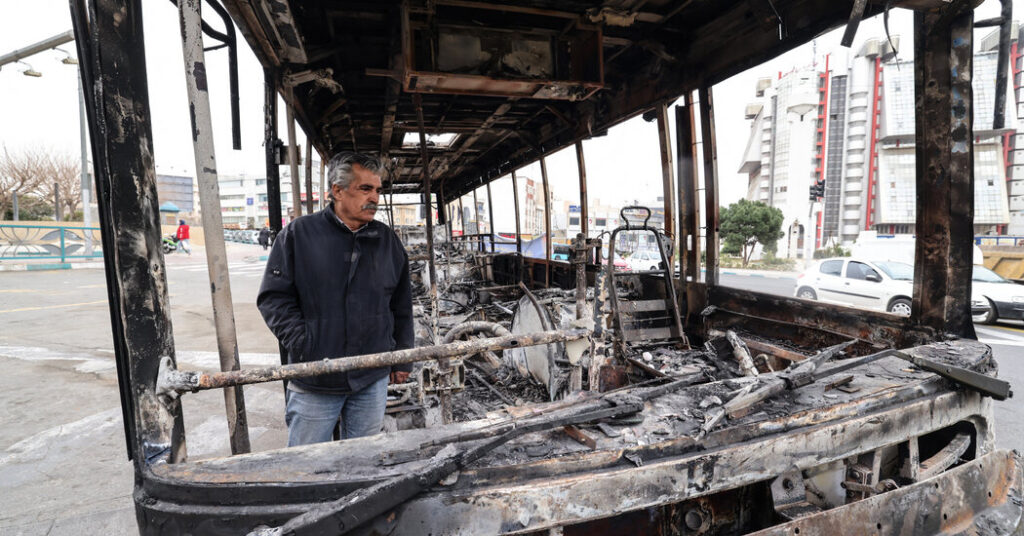
A heavy police presence and deadly crackdowns on protesters appeared to have largely suppressed demonstrations in many cities and towns across Iran, according to several witnesses and a human rights group.
For weeks, Iran has been convulsed by protests sparked by a collapsing economy and a currency in free fall, with the demonstrations snowballing into a broader antigovernment movement. The authorities have sought to quell the protests with brutal force and have plunged the country into a communications blackout that has made it difficult to know what’s happening.
Four residents reached by The New York Times in the capital, Tehran, said that the streets had mostly been quiet of protests this week as the severity of the crackdown and the high number of casualties became clear. Security forces were deployed in large numbers to nearly every neighborhood, said the residents, who lived in different parts of the city.
All four spoke on the condition of anonymity for fear of reprisal. They said that it felt as if the capital was under martial law, with the typically bustling and traffic-clogged streets largely empty. Shops and restaurants in some areas were closed after 6 p.m.
“There is massive disappointment and disillusionment,” said another resident, who worked in central Tehran and also spoke on the condition of anonymity.
There have been no large-scale protests documented in Iran since Sunday, according to Arina Moradi and Mina Khani, members of the Norway-based Hengaw Organization for Human Rights, which has been monitoring the demonstrations since they began.
Ms. Moradi said in an interview that a heavy military and security presence remained across many cities and towns, with thousands of people having been detained. She said numerous universities had closed following protests last month.
An Israeli defense assessment found that the scale of protests had noticeably declined since Sunday, following the Iranian forces’ escalating use of live ammunition and the internet blackout, according to two Israeli officials who spoke to the Times on the condition of anonymity to discuss sensitive matters.
As the numbers continued to drop, they said, several Israeli intelligence officials monitoring Iran had concluded that the current wave of protests had effectively been subdued by the regime. The two officials noted, however, that the Israeli assessment had been complicated by the disruption of internet and telephone services.
Tensions across Iran and the region have been high after Mr. Trump recently declared he was prepared to intervene to protect protesters, including potential military strikes against the country, U.S. officials said.
Israel and several Arab nations have urged President Trump not to strike Iran, a senior U.S. official said. Many Gulf States worry that an attack could destabilize the region and jeopardize their reputations as safe hubs for business and tourism.
The Kremlin said on Friday that President Vladimir V. Putin of Russia offered to mediate so as to ensure regional stability after speaking with Prime Minister Benjamin Netanyahu of Israel and President Masoud Pezeshkian of Iran.
“The situation in the region is extremely tense,” a Kremlin spokesman, Dmitri S. Peskov, told reporters on Friday, adding that Mr. Putin was trying to facilitate a de-escalation.
In recent days, the Iranian authorities have stepped back from threats to execute protesters, following international condemnation and the looming possibility of U.S. military action.
But regional analysts note that Tehran is drawing a line between ordinary demonstrators and those it labels “rioters” or “terrorists” purportedly backed by foreign powers. Experts say this careful framing is intended to intimidate the population and discourage further protests.
The government has been instilling fear into protesters by sending text messages warning families not to let their children go out into the streets. Other messages have urged people to report suspicious activities or encouraged them to attend pro-government rallies.
In a screenshot shared by a resident with The New York Times, a text message asserting to be from the intelligence branch of Iran’s powerful Islamic Revolutionary Guards Corps said it had received more than 400,000 calls to a hotline for reporting “terrorist networks,” and that they had been “identified and dismantled.”
The government’s violent crackdown has had an especially chilling effect on the protests.
Witnesses said security forces had fired on unarmed demonstrators at close range. More than 2,600 people have been killed since protests began, according to the Washington-based Human Rights Activists News Agency. The Norway-based Iran Human Rights group said that more than 3,400 people had been killed and thousands of others injured.
Earlier this month, Mr. Trump said the United States was “locked and loaded” to protect Iranian protesters, whom he later urged to take over government institutions, saying U.S. support was imminent. Since then, Mr. Trump has announced that diplomatic talks with Iran were on, then off, and most recently said Iran had responded to his demands by halting the killing and execution of protesters.
Karoline Leavitt, the White House press secretary, said on Thursday that President Trump and his team were “closely monitoring the situation” and that “all options remain on the table.”
Ronen Bergman and Paul Sonne contributed reporting.
Abdi Latif Dahir is a Middle East correspondent for The Times, covering Lebanon and Syria. He is based in Beirut.
The post Iran Protests Quelled Since Deadly Crackdown, Residents Say appeared first on New York Times.