When I ask my girlfriend about the book she’s reading, it’s a given I’ll spend the next couple of minutes in utter confusion.
Yesterday Ami responded to my query by saying her latest read made her “fall in love with horses.”
The night before, she’d been lost in Andre Gide’s “Immoralist.” I knew the novel was about hidden desires, but I had no idea Gide had taken things into the stable.
After a lot of back-and-forthing, it turns out she was referring to Cormac McCarthy’s “All the Pretty Horses.”
That’s because whatever book I last saw her reading has invariably been finished and replaced by three new books.
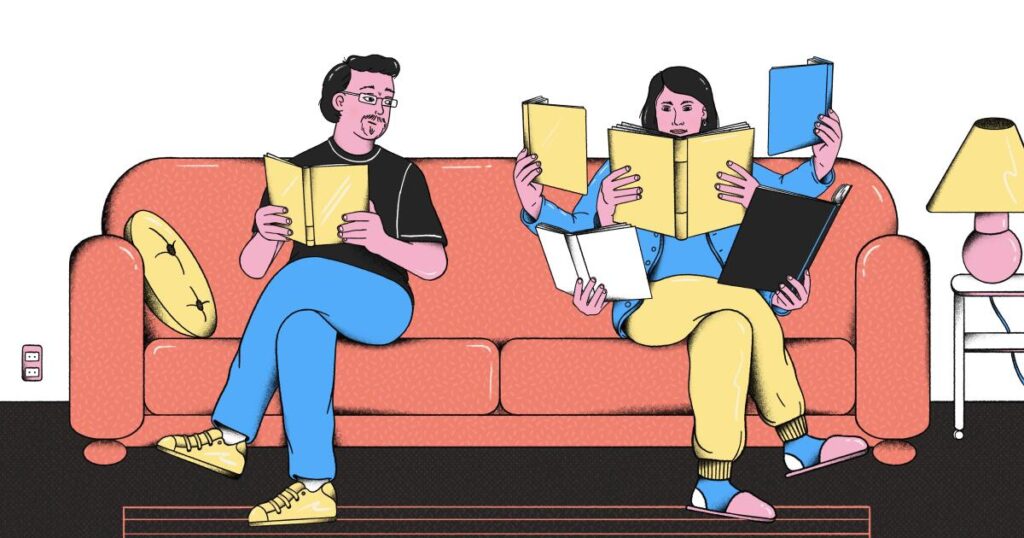
She reads six books at any given time. Classics to sci-fi potboilers. The latest bestsellers to ancient Greek poems. And she inhales them at a rate that makes me wonder if she actually has the job she claims to have or spends all day curled up with the Modern Library.
Her “ideal day” is to go to the Iliad Bookshop in North Hollywood, “visit” the cat who sits on the register and prowl the aisles until she finds three books to bring home.
Given that I’ve made my living as a writer for 45 years, you might think it’s wonderful to have a partner who shares an adoration of the written world.
Actually, it’s a torment.
Many professional writers limit their reading. George R.R. Martin and Joyce Carol Oates “quarantine” themselves so other voices don’t creep into their work, as was the case with McCarthy and J.D. Salinger.
Like my literary betters, I sometimes worry that reading distracts me from writing. But unlike them, I live with someone who consumes words at an unimaginable pace.
When I see my girlfriend devour books faster than the popcorn she keeps within arm’s reach, I feel guilty — and envious. It jolts me into remembering how much I love the printed page.
As a kid, my favorite place was library stacks. I’d brush my fingers across the spine of the books, as if they were holy artifacts. But over the years, I’d lost that delight. Nowadays, I spend more time reading friends’ screenplays than I do literature. I began to envy how my girlfriend could lose herself in words just for the joy of it the way I used to.
So, now, when Ami settles in with a book in the living room chair, I do the same. But I’m flustered by how relentless her focus is. How quickly her pages turn.
I know reading shouldn’t be a competitive sport. I really do. But writers are competitive by nature.
I was irritated by how much more she seemed to enjoy reading than I did. The instant she finished a novel, she would extol its virtues and demand we go to the Iliad or the Last Bookstore to get the author’s next offering.
Meanwhile, I was struggling to get through “Ready Player One,” a novel that had been collecting dust for years. Not wanting to be one-upped by my speed-reading girlfriend, I threw myself into it. As we lay in bed together reading, my sighs and muttering about “frickin’ three cliches in one paragraph” caused her to throw sideways glances my way.
I realized this showed a basic difference between us. My girlfriend finds something to enjoy in everything she reads. I, on the other hand, can be nitpicky and hypercritical when I peruse the copy on the back of a cereal box.
Even worse is when she reads something of mine. All I can think is I’m in a wrestling match with all the great writers she cheats on me with.
Last weekend, my girlfriend and I visited the Valley Relics Museum in Van Nuys, a repository of cultural artifacts mostly from the ’80s and ’90s. Ironically, for all my complaints about “Ready Player One,” it had inspired me to suggest the visit. We had a wonderful time, strolling through the aisles and playing the vintage arcade games.
A few days later, lying in bed, I made the mistake of mentioning that I’d written a 2,000-word essay about how the memorabilia — the giant Bob’s Big Boy statue, the cast of E.T., the arcade games — linked to events in my life in unexpected ways.
“I would like to read that,” Ami declared, her eyes not moving from the book resting on her lap.
The way my heart clenched up, you might have thought she was a mugger in an alley saying, “I would like to have your wallet.”
Flop sweat collected on my brow. I was up against her current lineup of Doris Lessing, Ursula K. Le Guin and Frank Norris. That’s a daunting standard to be judged by. And I am so critical, I know I would have torn my own essay apart if someone had handed it to me.
At the same time, I secretly longed to hear her speak about my writing in the same loving tones that she mentioned other writers.
Given that written words are the way I engage with the world, this seemed like a critical moment in our relationship. I read the piece over and over. Although it had been sent to my editor long ago, I made numerous tiny changes.
Finally, I emailed it the next morning and braced for a response.
Per usual, she finished the essay in less time than it takes me to address an envelope. Her judgment was cutting: “Cute, but I’m not into it. So C-minus.”
I cannot communicate how much this hurt. It was like a hundred paper cuts to my soul.
If the person I cared most about in the world despised my efforts, how could I hope that anyone else would like it? Had I been a fool to devote half a century to a craft I was incompetent at? Had I finally been found out?
Stifling my wounded pride, I typed out a measured response: “So what exactly about it weren’t you into?”
Her response confused me even more. “Huh?” was all Ami said.
I looked up her previous email and realized I had misread it.
She had written: “Cute. But I’m not in it. So C-minus.”
And thus I wrote this piece.
As I said, I’m competitive. I simply can’t go through the day with only a C-minus.
The author is a freelance writer in Sherman Oaks. He received an A-minus on this story; Ami deducted half a point because it didn’t mention she’s hot.
L.A. Affairs chronicles the search for romantic love in all its glorious expressions in the L.A. area, and we want to hear your true story. We pay $400 for a published essay. Email [email protected]. You can find submission guidelines here. You can find past columns here.
The post I’m a writer, and my love is an ardent reader. Can I forgive her for criticizing my work? appeared first on Los Angeles Times.