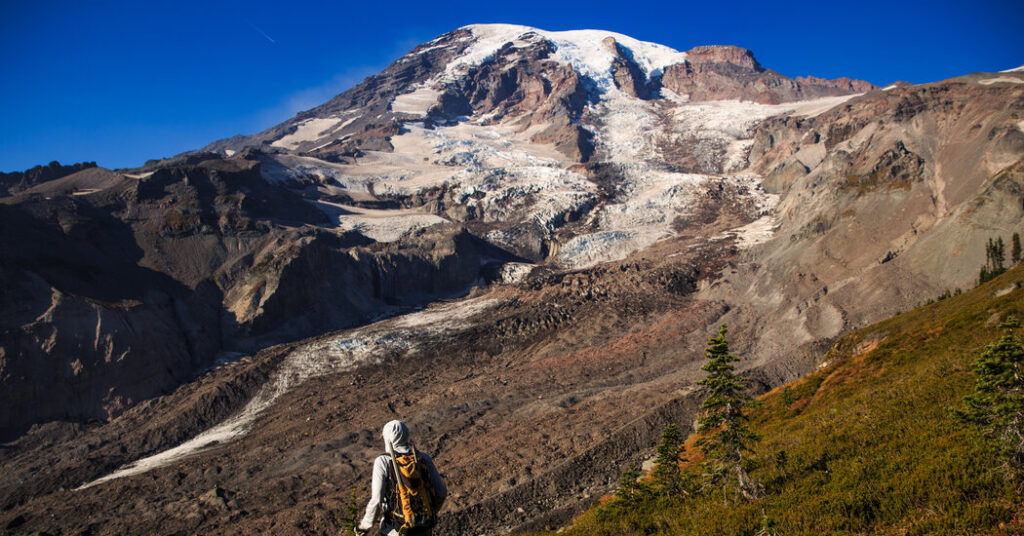
An outpouring of magma isn’t the biggest risk to people downhill from Mount Rainier in Washington. The active volcano’s greatest danger comes from lahars — amalgams of mud, rock and water that are as dense as wet concrete.
Over the past several thousand years at least nine large lahars have barreled down the steep slopes of the 14,410-foot mountain, sometimes reaching as far as the Puget Sound some 60 miles away. The largest lahar of the past 1,000 years was known as the Electron Mudflow, named for the small hamlet of Electron.
That event buried the nearby landscape in nearly 20 feet of mud. But scientists have struggled to precisely date when this event occurred. Knowing the year could make it possible to correlate the lahar with other events and therefore better predict future muddy outbursts.
In a study published last month in the journal Geology, a team of geoscientists believe they have worked out the year of that calamity by studying trees submerged by the lahar.
The Electron Mudflow, rich in slippery clay, sent debris coursing up to 35 miles away from the mountain, into what is now the small city of Orting. Previous research estimated the event occurred about 500 years ago, give or take a century or two.
Scientists believed they could use dendrochronology, or the study of tree rings, to determine a more precise date. That’s because a lahar tends to bury, uproot and otherwise kill trees, said Bryan Black, a tree ring scientist at the Laboratory of Tree-Ring Research at the University of Arizona. “Trees don’t survive long.” A tree’s outermost ring can therefore record the precise passage of a lahar to the nearest year or even season.
Finding trees that died in the Electron Mudflow involved a bit of serendipity. In the 1990s, Patrick Pringle, now a geologist at Centralia College, happened to be working in Orting. One day, he drove past a construction site. There lay an enormous tree stump in a freshly dug pit. Mr. Pringle asked the construction workers if he could take a few samples of wood.
“That began my crusade,” he said.
For roughly a decade, Mr. Pringle and volunteers collected wood from more trees unearthed at construction sites. Rosalee Lamm remembers helping out in 1997 when she was a high school student.
“I didn’t know anything about dendrochronology,” Ms. Lamm said. But the experience was formative, she added. “I went on to study geology.”
Dr. Black recently analyzed the wood from 21 of those trees, all Douglas firs. By aligning growth patterns among various trees, he assembled a tree-ring record spanning 475 years.
Dr. Black and his colleagues then compared that record with a data set of old living Douglas fir trees on Vancouver Island in British Columbia. Because those trees were still living, their rings can be precisely age dated.
By matching the Vancouver Island record with the Orting record, the researchers assigned calendar years to the rings of the Orting trees. That technique works because trees living in similar environments tend to exhibit similar patterns in ring widths. “If you get a drought year, all the trees form a narrow ring,” Dr. Black said.
Four of the Orting trees showed evidence of having bark, meaning that their outer rings were the last ones that ever grew. And those trees all died in the year 1507, the team found. That was the year of the Electron Mudflow, preserved in entombed lumber.
“We took what was a fuzzy uncertainty and now pretty much put a razor blade on that timing,” Dr. Black said. They even worked out that the trees most likely died in the mid- to late summertime.
The discovery could help determine the potential cause of the Electron lahar.
For instance, the team says it’s clear that an earthquake in the year 1700, the most recent in the threatening Cascadia subduction zone, was not the trigger. And neither was a volcanic eruption; there’s no evidence of a sizable eruption around 1507. Future work will focus on digging into temperature and precipitation records to see if climatic conditions might have predisposed the region to a lahar, Dr. Black said.
An event similar to the Electron Mudflow could easily happen again, said Seth Moran of the U.S. Geological Survey’s Cascades Volcano Observatory, who was not involved in the research. The difference now is “you have tens of thousands of people potentially in the way,” he said.
There’s a network of sensors on Mount Rainier designed to detect lahars, among other hazards, and give residents as much time as possible to evacuate.
Still, a lahar on Mount Rainier could reach a populated area in about 45 minutes or so. “It’s not that long,” Dr. Moran said.
The post If the Volcanic Eruption Doesn’t Scare You, the Mudflow Should appeared first on New York Times.