It’s going to be a nail-biter.
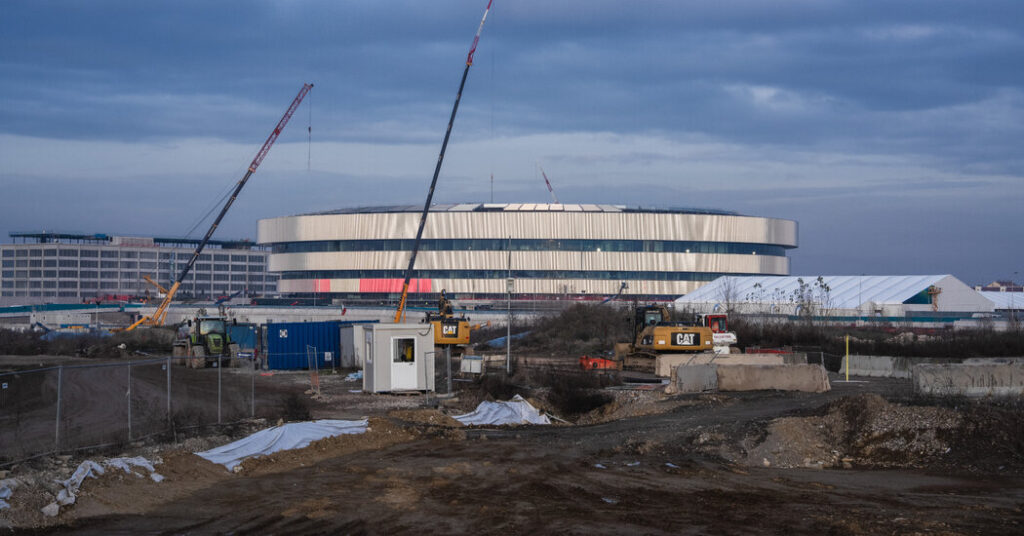
With less than a month before the start of the Winter Olympics in Milan, the arena that will host one of the Games’ premier events remained an active construction site.
At a test event on the ice hockey rink at Santa Giulia Arena last weekend, two levels of the venue were off limits to spectators, with sheets of black plastic concealing rows of seats. Paint splattered the floors, and construction dust coated railings. Large wires poked out of walls, and digital scoreboards were not yet installed.
Before the previous two Winter Olympics, in China and South Korea, organizers hosted test matches on the rinks a full year in advance.
But in Milan, where the Winter Olympics will start early next month, the first hockey players arrived on the ice just 28 days before the opening ceremony.
“This one was a bit tight,” Art Sutherland, the International Olympic Committee’s ice engineer, said on the final night of an Italian Hockey League tournament held at the rink over the weekend as its first test event.
Before any Olympics, some venues teeter on the brink of not being ready. At the Sochi Games in Russia, backhoes littered the streets days before the opening ceremony. In Paris, the mayor took a dip in the River Seine just over a week before the Summer Games to prove the water was clean enough for swimming competition.
So in Italy, where scrambling down to the wire is considered a national trait, officials beamed their optimism that the Milan-Cortina Olympics, which will sprawl across three regions at a total cost close to $6 billion, would come together — just — in time for the arrival of an expected 2.5 million visitors.
“I absolutely trust that the arena will be done on Feb. 5,” said Alessandro Giungi, a Milan city councilor and the head of the city’s Olympic committee. “So actually, that is early,” he said, for the opening ceremonies on Feb. 6.
The 11th-hour construction at the hockey rink has provoked particular anxiety because star players from the National Hockey League are expected to join the Games for the first time in a dozen years. In an interview last week, Bill Daly, the deputy commissioner of the N.H.L., warned that the league would pull out “if the ice is not safe or is not ready.”
After the matches over the weekend, the N.H.L. and its players’ association described the test event as “a good trial run.”
“There are still things that need to be done there,” Mr. Daly said in an email on Tuesday, but he added, “I fully anticipate” that the Olympic matches “will take place.”
Preparing a rink for ice hockey is a delicate and highly technical task. For days or even weeks, ice makers chill hundreds of thin sheets a layer at a time. Above all, the process requires time. The ice has to settle, and skaters and the resurfacing machines known as Zambonis must stress-test it, find any holes in the surface and make sure it is strong enough to sustain three games a day, the typical frequency during the Games.
The test event opened with a bit of drama during the first match on Friday when a hole opened in a patch of ice. Mr. Sutherland said holes were common on newly laid ice but that they were easily fixed. Officials from the I.O.C., the Milan-Cortina organizing committee and the International Hockey Federation all said they were confident the 15,300-seat rink would be ready for Olympic play.
Christophe Dubi, the executive director of the Olympic Games, said in an interview outside the arena on Sunday that 10 days earlier, he was “scared” about the condition of the ice. But after discussing the rink’s performance with experts, he said, “We’re going to make it work.”
Some fans attending the test matches were not so confident. “Thinking that in a month the Olympic Games are supposed to be here seems impossible to believe,” said Anna Calabrò, a lawyer from northern Italy and a spectator at the tournament on Sunday night, gesturing to the plastic covering the arena’s second and third levels.
More than 1,000 construction workers will work in shifts around the clock until the arena is completed, but they suspended activities for three days during the tournament. Don Moffatt, the chief hockey ice maker at the last five Winter Games, said he had not even been able to get a Zamboni onto the rink until two days before the test event because a ramp had not been completed.
Mr. Moffatt said that while he was certain the rink would be “100 percent ready to go,” he would have to delay some final steps because of the construction. Less than three weeks before the Games, he plans to shave down the top layer of ice, repaint an underlying surface white for the television cameras and add goal lines and the Olympic logo. Normally, he said, all of this would be done at least two months before an opening.
Players in the tournament last weekend deemed the arena mostly fine. Marco Magnabosco, a senior player for Migross Asiago, the victorious team on Sunday night, said that the locker rooms were missing some finishes but that the team “didn’t really pay attention to the banal things.”
Some patches of ice were harder, while others were softer. “So you just need a bit of time,” Mr. Magnabosco said.
One reason for the complications is that CTS Eventim, the German entertainment conglomerate developing the facility, is building it primarily as a concert venue. The Olympic organizers are only leasing it.
Both the coronavirus pandemic and the war in Ukraine occurred during construction, pushing up prices for mechanical systems and building materials. According to Mr. Giungi, the head of Milan’s Olympic committee, the cost of the arena ballooned to about $292 million from about $210 million. Eventim declined to comment on the exact cost.
Luca Martinazzoli, Eventim’s general manager for the arena, said the rink would “be an accelerator for this part of the town to redevelop.” Other companies have proposed building a new supermarket and residential complexes. City authorities have spent nearly $20 million on temporary transport services and to pave roads near the arena for the Olympics.
Still, Santa Giulia, which until the 1980s was the site of a steel factory, has long been the subject of redevelopment plans that have not come to fruition. That has left locals skeptical of the developers’ promises.
“As they had to sprint just to build the arena for the Olympics, they have neglected all the rest,” said Stefania Maggi, the president of a neighborhood association. “And the arena is not even finished,” she added, standing on a road down from the site, where a huge crane hovered.
Fans at the tournament over the weekend embraced the Italian spirit of the enterprise.
Italians mess around a lot, said Andrea Bernardini, a longtime fan of the champion Asiago team who attended the final match of the tournament. “But in the end, we always make it work.”
Motoko Rich is the Times bureau chief in Rome, where she covers Italy, the Vatican and Greece.
The post How Italy Is Racing to Finish an Ice Rink Before the Olympics appeared first on New York Times.