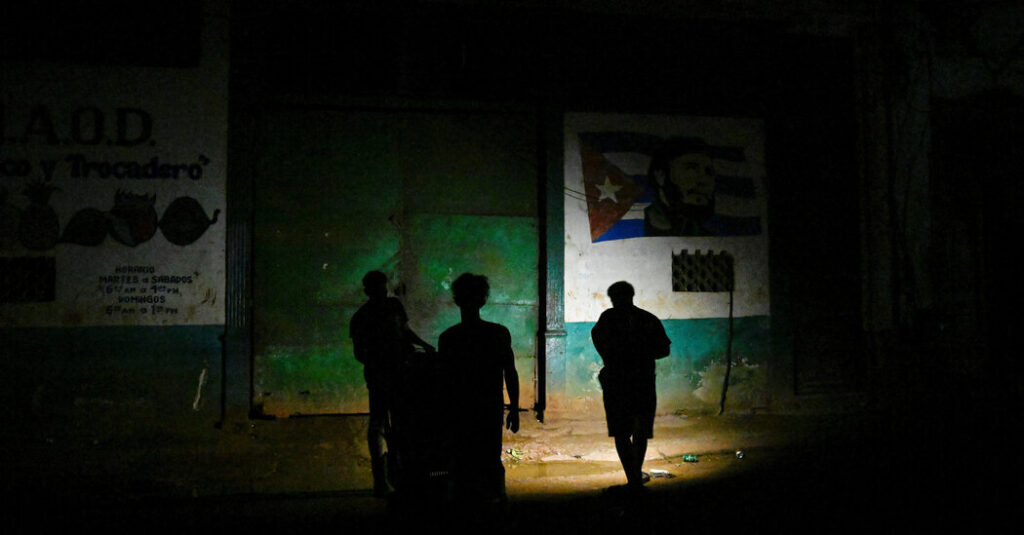
The first messages in Havana about Nicolás Maduro’s capture, sent through WhatsApp before they reached official channels, were intermittent and contradictory. People felt hope and fear. Was something going to change here? many wondered as they waited in bread lines, at the bus stop or beneath the yellowish light of a rechargeable lamp during a blackout. The downfall of one of Cuba’s most important allies wasn’t a remote event for Cubans; it was a wave hitting us full on.
The most frequent question now heard by my colleagues at the 14ymedio news site, which I direct, is about what will happen to the Venezuelan oil, which Cuba relies on so much. Many Cubans have been overwhelmed by the particular worries of not knowing whether there’ll be electricity tomorrow, whether the refrigerator will shut off again, whether the struggling public transportation system will collapse. In markets, parks and hallways, they say, one comment is repeated over and over, with the same resigned cadence: “If there’s no more oil, things are going to be even worse.”
It’s not paranoia. In the fourth quarter of 2025, Venezuela sent Cuba about 35,000 barrels of oil a day. While that isn’t enough to keep all the island’s lights on, its industry functioning and its transportation flowing, it has kept the essential gears of our nation in motion. Losing that fuel, or having it drastically reduced, would be a severe shock to an economy that is exhausted, low on foreign currency, and increasingly constrained by American sanctions. Already a U.S. blockade of tankers has cut off some of the supply, and Mr. Trump on Sunday declared that Venezuela would send “no more oil or money” to Cuba.
It is true that Havana does not depend solely on Caracas. Mexico has kept up its fuel shipments, Russia sporadically lends a hand and we have low-quality local oil. But islanders aren’t kidding themselves. The Cuban regime has always been clear about its hierarchy of needs. If it is a choice between keeping the lights on in a hospital or guaranteeing fuel for police patrols, the balance will unerringly tip toward retaining a grip on society. A whole city will go dark before the state security headquarters does.
That is why the atmosphere among Cubans right now is not one of euphoria but anxiety. Some see Mr. Maduro’s capture as a spark that could set off a blaze on our island. “If the Venezuelan dictator can be removed, what’s keeping Castroism in place?” a young friend who has never known any other political system asked me.
In the opposition and in the Cuban diaspora, what happened in Venezuela is being interpreted as a sign that the unchangeable might change. Mr. Trump fueled that feeling by adding on Sunday, referring to Cuba’s government, “I strongly suggest they make a deal, before it is too late.”
Yet that desire comes up against an uncomfortable reality: After 67 years of the same regime and a mass exodus of those most opposed to it, Cuba does not have a well-articulated opposition group on the island that would be capable, in the short term, of vying for power.
Repression and banishment has largely dismantled the Cuban dissident movement. Its leaders are in prison, in exile or subjected to constant harassment. Emigration has sharply reduced the number of potential protesters for a popular revolt such as the one that erupted on July 11, 2021. Although widespread fear has waned, it remains a powerful deterrent in a country with nearly 1,000 political prisoners.
The regime has proved remarkably capable of surviving even greater cataclysms, such as the fall of the Soviet Union, its patron, and the abrupt loss of almost all its foreign trade in the 1990s that ensued. Its strategy, when it feels up against the ropes, is to radicalize its public statements, appeal to nationalist sentiment, sharpen its anti-imperialist slogans and make some timid economic reforms that serve as an escape valve. Granting amnesty to political prisoners, as brokered by the Vatican and Spain in the past, is another way to buy time.
However, Cuba is quite different from what it was after the dissolution of the U.S.S.R. There is no Fidel Castro to turn privation into heroism, no believable ideological narrative to seduce younger generations. Leadership of the Communist Party is disconnected from the people and deeply unpopular. President Miguel Díaz-Canel lacks charisma and the capacity to mobilize society in moments of crisis.
Furthermore, Mr. Maduro’s capture has made it clear that Cuban troops are not invincible, as the party line asserts. The death of 32 Cubans who the Cuban government said died during the operation and the speed with which Washington extracted Mr. Maduro were harsh blows to the image of Castroist security forces. Throughout the island, the powerful symbolism of that failure undermines the power of the regime to intimidate.
The next few weeks will be critical. If Chavismo manages to reorganize under Mr. Maduro’s vice president, Delcy Rodríguez, and Venezuela maintains its fuel commitments to Havana, the Cuban regime will breathe a sigh of relief. If, on the other hand, the negotiations between Caracas and Washington entail cutting the oil supply to the island and ending Cuban medical missions (one of Cuba’s main sources of foreign currency) in Venezuela, the fragility of the Cuban system will become even more manifest. That weakness does not guarantee a change but it could create visible fractures in the power structure, and cracks are always very dangerous to the survival of closed regimes.
On the streets of Cuba in recent days, my colleagues and family haven’t heard talk about revolution or transition. It’s been all about survival. But now, that talk of survival comes with a question that no longer sounds completely naïve: What if the time has come? It isn’t a gushing, radiant hope. It is something much more fragile and more real: the feeling that, finally, the future is no longer completely shut down.
Yoani Sánchez (@yoanisanchez) hosts the podcast “Cafecito Informativo” and is the director of the digital newspaper 14ymedio. This article was translated by Mara Faye Lethem from Spanish.
The Times is committed to publishing a diversity of letters to the editor. We’d like to hear what you think about this or any of our articles. Here are some tips. And here’s our email: [email protected].
Follow the New York Times Opinion section on Facebook, Instagram, TikTok, Bluesky, WhatsApp and Threads.
The post Hope and Fear Mingle in Cuba With the Loss of Maduro, and Oil appeared first on New York Times.