This is an edited transcript of “The Ezra Klein Show.” You can listen to the episode wherever you get your podcasts.
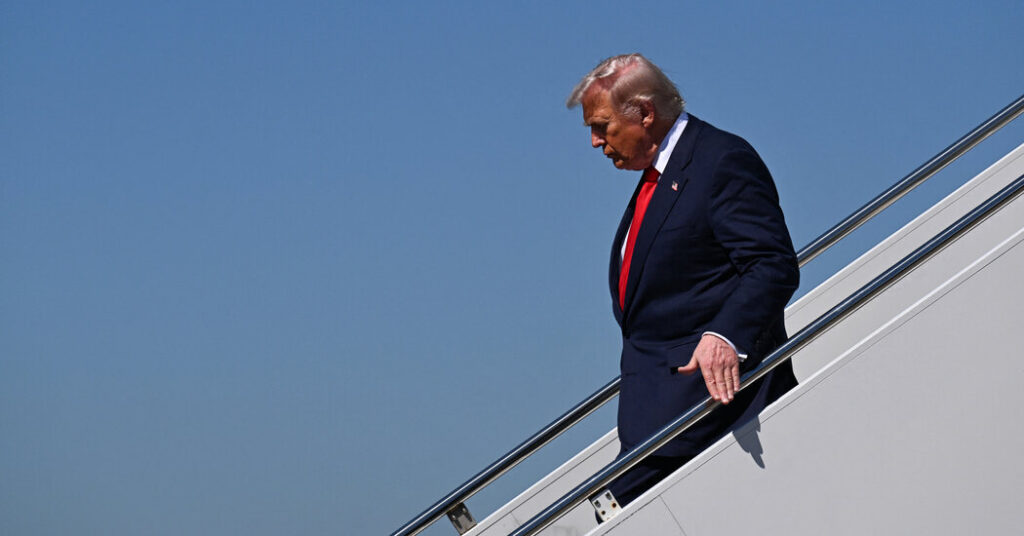
As long as it may have felt, we are only one year into Donald Trump’s second term as president. To follow the Trump administration in the news is to be exposed to the full-muzzle velocity of this presidency: the overwhelming procession of new stories, wild statements, spectacular, outrageous — sometimes terrifying — events.
It feels like so much more is happening than the human mind, than the entire media, than the country can absorb.
But how much has actually changed? How much has Trump actually gotten done? How many of these stories that were so spectacular when they began have followed through into a durable difference in how the government works or what it does or how we live?
About a year ago, just a few weeks into Trump’s second term, I had Yuval Levin on the show. Levin is one of the smartest thinkers on the right — a real conservative who thinks deeply about institutions and the nature of the presidency and how these things work in the constitutional order.
And at that time, he was in some ways a very measured voice. This was the moment of DOGE and Musk and executive orders, and he was skeptical that as much was actually happening as there appeared to be happening.
So now, after this truly wild year, a truly historic year in American politics and life, I wanted to have him back on to see what he thinks has happened and how his analysis of Trump has or has not changed.
Ezra Klein: Yuval Levin, welcome back to the show.
Yuval Levin: Thank you very much for having me, Ezra.
We talked, at least on the show last year, right after Donald Trump took office, amid the early chaos. It was DOGE and executive orders and this feeling that the entire presidency was being reshaped — and that they could do anything.
You were a little less alarmist and were skeptical that they were going to accomplish as much as it felt like they might at that moment.
We’re a year into this long second term. Where are you now?
Well, it has been a long year in a lot of ways, and there has been a lot of action, I would say. But I think that, on the whole, the view that they were not well set up to accomplish an enormous amount of durable policy change is still more or less my view.
I think that a year in, you’re hearing two kinds of stories.
So one story says there are a lot of accomplishments: The southern border is much more secure than it was a year ago; woke left-wing radicalism in a lot of institutions is back on its heels now; the Iranian nuclear program has been set back a lot; the war on Gaza is over, and the surviving Israeli hostages are home; the “big, beautiful bill” is law; unemployment is low; the economy is strong. It’s a year of achievements.
On the other hand, you can tell the story from the point of view of a Trump critic who says federal law enforcement has been contorted in the service of the president’s grudges and priorities; the administration has intimidated all kinds of institutions throughout American life; this year there are squads of masked agents pursuing immigrants around the country; federal scientific research funding is in disarray; tariffs have increased prices.
These stories are both true at the same time. But the common denominator of these stories is that they’re both stories about a lot of action.
I actually think that’s not quite right and that there’s an important story to tell about the absence of action in the past year, too — the absence of traditional uses of presidential power and authority in our system.
There has been very little legislation. It’s true the “big, beautiful bill” is law, but Donald Trump has signed fewer pieces of legislation than any president in the modern era.
The pace of regulatory action is actually slower than the last five or six presidents. If you look at the numbers, the amount that they’re doing that amounts to durable policy change is actually pretty constrained.
So I think the question is: How do you reconcile the amount of activity with the absence of durable action? To me, that’s the story of the first year of this presidency.
Walk me through the numbers you ran comparing federal spending in 2024 under Joe Biden to federal spending in 2025 under Trump.
Well, this is one of the striking things. We spent the first six months of the year watching DOGE take all kinds of actions intended to reduce federal spending and restructure the government.
But at the end of the day, because there was no legislative action to change spending, there was no real change in spending. The government was on a continuing resolution on two of them for the entire year — so we’re still at Biden’s spending levels.
Overall, because the “big, beautiful bill” spent a little more on immigration enforcement and on defense, and because appropriations were even for the year, the federal government actually spent 4 percent more in 2025 than in 2024.
So a lot of times when you see claims and descriptions and assertions of what’s about to happen, it’s worth making a note for yourself and saying: I should come back to this in six weeks and ask, Did this actually happen?
And a lot of the things that everybody got very worked up over this year — not all of them, to be clear, there’s a lot going on, and it’s especially true in immigration and trade and a few other areas — but on the whole, it’s important to see that the way the administration is acting, which is more narrow cast and focused on specific news cycles and specific instances, means they have not gotten nearly as much accomplished as they say. And they’ve not gotten as much accomplished as most presidents do in the first year of a new presidency.
One example is the National Institutes of Health. People might have heard about their gutting spending early in 2025. What happened there?
The story of N.I.H. spending is very interesting because in most areas of government, if you track it month by month — and this is the way to track federal spending — there are a lot of ways to chop up the numbers.
But there’s a monthly Treasury statement that just reports how much money went out the door. And I think that’s the number to look at. It’s public, it’s on the internet. It’s very easy to read. In most departments, those numbers looked identical in 2025 to 2024. Appropriations were the same, and so spending out the door was the same.
There was a long government shutdown, but at the end of it, all the money went out. So in the end, it looks the same.
N.I.H. looks very different. In the first six months of the year, N.I.H. spending was far behind its 2024 levels. There seemed to have been a decision made to withhold spending, to redirect spending, and I would argue, even to force a confrontation over impoundment — the president just ignoring Congress and not spending appropriated money on N.I.H. money.
Then in June or early July, you see a sudden acceleration of N.I.H. spending. Clearly, there was some decision made that the money had to go out the door by the end of the year.
They did that in a way that deformed or distorted some of that spending. They decided to spend multiyear money all in one year, on a broad range of federal grants, in order to be able to get the money out the door so that 100 percent of the appropriated amount would be spent by the end of the fiscal year.
That’s going to create problems down the road because with these multiyear grants, the institutions that receive them are not really equipped to spend them all in one year.
But in any case, a decision was made — I think it’s unavoidable, from looking at the numbers — to avoid an impoundment fight and to spend all the money. And by the end of the year, N.I.H. had spent 100 percent of its appropriated money for the year.
Something you’ve said to me, that I’ve thought about after, is: Trump governs retail rather than wholesale. What does that mean?
I think there are a couple of ways to see that — and it’s important, as a way of reconciling those two stories that we started with.
There’s a way of thinking about what the president does that is about just being in the center of every news cycle. Donald Trump is extremely good at that — focusing on the issue of the day, governing there, being the end of that story.
But broadly speaking, the role that the president of the United States has is an administrative role. It’s a role that has an enormous amount of power over vast terrains of American life — through regulatory action, through administrative action, by setting uniform rules that govern entire sectors of society.
The Trump administration, in the past year, has not been interested in exercising those powers in the ways that presidents normally do.
If you look at the Regulatory Studies Center at George Washington University, which tracks federal regulations, they have found that economically significant rule making has been slower than in the first year of the Biden administration or the Obama administration or under George W. Bush or Clinton.
There’s been, as I said, much less legislation, and the president has not had a legislative agenda.
I don’t think there is a legislative agenda for the next three years of this administration. If you ask yourself: What do they want Congress to do? — it’s actually very hard to answer that question. What the president has done, though, is use the power of the executive as a way of exercising leverage to drive behavioral change in particular institutions.
We saw this first with DOGE. A lot of what DOGE did was take control of federal grant making in ways that were hyperfocused, that were grant by grant. They were essentially trying to govern one by one.
On the whole, the DOGE experiment didn’t really work. What they tried to do didn’t succeed, and it’s mostly over.
We saw a second way of exercising power one by one like that, and that was through retail deal making in place of wholesale policymaking.
The president has gone deal by deal, one by one, trying to gain some advantage or use some leverage to drive behavioral change: in the universities, maybe to change admissions or hiring; in law firms, he wanted to get some specific concessions; through discounts from drug companies. And that’s his approach to reducing health costs. He’s buying up segments of chip makers.
It’s a very unusual way for the president to think about the role that he has. Deal making gives the president more leverage, more freedom. It allows him, in a focused way, to advance his own priorities and not go through the usual processes of rule making and legislation.
It gives the impression of a lot of action. — but is, in fact, very narrowly focused. Each of these deals achieves something relatively small. It can be significant, it can be important — but it’s not broad governance.
A lot of the institutions that are making these deals see this as a way to get through the next three years. They see it as a way to avoid changes in regulations or in law, and therefore to protect their freedom of action rather than to give ground to the government. Ultimately, these are just not ways of securing meaningful, durable changes.
You see that with the deals made with the pharmaceutical companies, for example, where they agreed to lower prices on specific drugs — and then those same companies started the year by raising prices in general. It leaves them with a lot of room. It’s not the way the government normally achieves its purposes, but it is very much the mode of action of this administration so far.
One thing we saw in Trump’s first year was an assault on the universities — the Ivy League ones, but not only them — picking them off one by one to bring them more into line with what the Trump administration wanted them to be.
What has that achieved? How do you see its status now? I think people are seeing less from it. What did it all amount to?
I think that’s really an instance where policy by deal making shows some of its limits. The administration has had a lot of influence on a small number of universities that it chose as targets, and which it forced into some governance changes — some of which will be good for those universities and some not — but which the administration wanted. It forced them into individual deals.
The administration tried to broaden that out into something more like policy. It put out a Compact for Academic Excellence in Higher Education, which it wanted all universities to sign. The response that compact received from a number of elite universities right away was basically: Well, no, let’s do one-on-one deals.
There’s a fascinating letter to the administration from Brown University’s administration, which basically said: Let’s have an arrangement between you and us that helps us figure out what you want and what we can do out of that.
The compact basically fell apart. It did not succeed. No university signed on, and the administration returned to a process of deal making.
What you find there is that the universities prefer these individual deals to changes in the Higher Education Act or changes in the regulatory structure of the government’s relationship with them because they see the deals as more manageable. They have some more negotiating leverage.
I think that some of what the administration is trying to do would be much better achieved by legislation. I actually think it’s possible to imagine a legislative change to the Higher Education Act that would get some Democratic votes — it wouldn’t do everything the administration wants, but it would do some important things.
The White House has shown no interest in that, and the universities — by acting defensively in this moment — seem to prefer those deals, too, which I think tells us a lot.
There’s an interesting dynamic where retail deal making fits the bandwidth of the news and legislation doesn’t. People do not know one-tenth of what was in the Inflation Reduction Act, the CHIPS and Science Act or the One Big Beautiful Bill Act, for that matter. Much more change is happening in legislation than people realize.
But you cannot fit it into the size of a news story. You cannot even fit it into a dozen. And people’s attention span — particularly as we’ve gotten down to social media — things are just flying by really quickly.
Whereas these deals — they cut a deal with Nvidia, they cut a deal with Japan — they actually fit. Maybe not everything in the deal, but the sense that something is happening that is graspable: They made a deal with this university, they intimidated this person, they launched an investigation here. Everything is the size of a news story, functionally.
I have never covered an administration before where the problem was not that we have a communication problem, where people don’t know how much we’re doing. Every administration — Biden, Obama, Bush — they all felt that way.
Whereas Trump, in a way, it’s almost at least in your telling, and I do want to complicate this eventually, the opposite — that the pace of events feels actually faster in some ways than the events themselves.
Yes, absolutely. There’s more said than done. There’s more above the surface than beneath the surface, and it is very well suited to a telling of the story.
One way I think about it is that the president wants himself to be at the end of every story on Fox News. So if something going on in the world is troubling or challenging, at the end of the story, Donald Trump has solved that problem.
One way to think about that is he wants to do everything. He wants to control everything. But it’s actually a very narrow notion of what the president can do, and it’s not using most of the powers as the chief executive of the American government. But it’s absolutely true.
It’s not just legislation. Regulation, too, works this way. There’s never a moment when you can say: We’ve done this. When you’re moving regulatory action, there’s a proposed rule, and there are comments, and it’s years, and at the end of the day, you’ve done something that’s going to endure — but it’s not an easy story to tell, and it’s very dull and lawyerly.
If you just instead make a deal with Brown University or with Nvidia, then you can just say it that day, and there’s the C.E.O., and he says it, too, and something big is going on.
So I think this approach of deal making has definitely expanded the distance between perception and reality. It has created an impression of an enormous amount of action when the real amount is — not zero, by any means. But we’re living in a less transformative time than we think in this way.
But deals, events, the decapitation of U.S.A.I.D. — these retail moments that are graspable, that are in many cases spectacular — they do serve to communicate things about how the country works now, how this regime works.
I do wonder if looking at federal spending numbers or rules past understates that. Let’s take DOGE. I always understood DOGE’s actual purpose as the intimidation of the civil service, of the federal bureaucracy.
There was a view among many Republicans that the federal bureaucracy was liberal and woke and opposed to them, and it hampered them in Trump’s first term. So they made examples of a series of agencies — U.S.A.I.D. and the Consumer Financial Protection Bureau, people at the Department of Education and so on.
Those were real, right? They did change those agencies — and functionally destroyed a few of them. But it was also a message to everyone else in the civil service — as the firings were, as everything was — to either shut up or get on board. You can be cowed, you can be on the team, but otherwise, they’re going to come for you.
That might have changed things at a cultural level, which would matter. Do you think that has happened?
Absolutely. This is what I mean when I say that they’ve used the power of the presidency as leverage to drive behavioral change, attitude change. They’ve used the weight of the government as a cudgel to push people around. That’s no small thing, and I think it does create cultural changes.
I do think that if you take a longer-term view — and I don’t mean a generational view, but a medium-term, five-, 10-year view — this way of doing things does achieve less than it seems to in the news cycle.
But absolutely, they’re changing the attitude of people who work for the government. They’re changing the attitude of people who rely on the government for funding or just for a stable relationship that makes business possible.
I would say that the effect that is having is to undermine people’s sense of the American federal government as a predictable, reliable player in various arenas at home and abroad.
So it’s not the specifics of what the administration is driving people to do. I don’t think it’s actually going to be possible to go back to the pre-Trump attitude toward the federal government.
A university president who was forced by the administration’s actions in the first half of the year to reckon with just how dependent that university is on federal funding and just how dependent that funding is on the president’s personal priorities is never going to look at his budget the same way again.
Even if the next president is very friendly to whatever that university president wants to do or be, it will always be in the back of his mind that this can change, that this could go away, and I shouldn’t make long-term plans that assume that this relationship is steady.
I think that’s true about a lot of other countries’ thinking about the United States, too, after the past year. The assumption that the United States would just play a stabilizing role in various environments is no longer tenable.
I think a lot of people who have depended on the government without thinking about it too much have to think about it more now. I’d say there’s some good in this — some of that dependence was really, as the president likes to say, abusing the government or using it. Universities should depend on the federal government less than they do.
But the downside of this, the cost of it, is much higher than the upside because the sheer stability made possible by a predictable, reliable federal government was a massive invisible subsidy of American life. It made it possible for Americans to make assumptions about what various institutions could do for them that we’ve never really had to think about.
There’s an engine of basic research humming in the background of our lives. There are ways in which other countries treat Americans because of what they expect our government to be for them that we just take for granted.
If we can’t take that for granted, the costs will feel and be very real. So I’m not suggesting that nothing has changed, but I think that we have to see that the way in which this president has thought about his role and his power is very different, very distinct from how most presidents do.
.op-aside { display: none; border-top: 1px solid var(–color-stroke-tertiary,#C7C7C7); border-bottom: 1px solid var(–color-stroke-tertiary,#C7C7C7); font-family: nyt-franklin, helvetica, sans-serif; flex-direction: row; justify-content: space-between; padding-top: 1.25rem; padding-bottom: 1.25rem; position: relative; max-width: 600px; margin: 2rem 20px; }
.op-aside p { margin: 0; font-family: nyt-franklin, helvetica, sans-serif; font-size: 1rem; line-height: 1.3rem; margin-top: 0.4rem; margin-right: 2rem; font-weight: 600; flex-grow: 1; }
.SHA_opinionPrompt_0325_1_Prompt .op-aside { display: flex; }
@media (min-width: 640px) { .op-aside { margin: 2rem auto; } }
.op-buttonWrap { visibility: hidden; display: flex; right: 42px; position: absolute; background: var(–color-background-inverseSecondary, hsla(0,0%,21.18%,1)); border-radius: 3px; height: 25px; padding: 0 10px; align-items: center; justify-content: center; top: calc((100% – 25px) / 2); }
.op-copiedText { font-size: 0.75rem; line-height: 0.75rem; color: var(–color-content-inversePrimary, #fff); white-space: pre; margin-top: 1px; }
.op-button { display: flex; border: 1px solid var(–color-stroke-tertiary, #C7C7C7); height: 2rem; width: 2rem; background: transparent; border-radius: 50%; cursor: pointer; margin: auto; padding-inline: 6px; flex-direction: column; justify-content: center; flex-shrink: 0; }
.op-button:hover { background-color: var(–color-background-tertiary, #EBEBEB); }
.op-button path { fill: var(–color-content-primary,#121212); }
Know someone who would want to read this? Share the column.
I think it’s short-termism. Ultimately, it doesn’t advance the ball in the way that some of the president’s supporters think. But it is changing things — and some of that change is very much for the worse.
The two places where I think there has been tremendous policy change are tariffs and immigration. Those would not show in the same way on a tracking of federal legislation passed or rules promulgated.
How do you understand those areas where Trump really has reshaped what the government is doing in ways that are affecting the real world in a very profound way?
Yes. Immigration really does show up. Immigration is the great exception to the administration’s general governing approach so far.
In immigration, they have used the traditional powers of the American president alongside all kinds of other things. There has been legislation. They got new authorities and new money from the reconciliation bill, the “big, beautiful bill,” earlier in the year.
There has been regulation. They’ve been moving a lot of rules and regs and guidance in the traditional ways. The people running immigration policy and the administration know the system extremely well, and they are operating through it. They see the immigration bureaucracy as in the service of their policy in a way that isn’t really the case almost anywhere else in the domestic sphere.
So in immigration, they absolutely have been using those powers. They’ve driven a lot of change that will be durable. I think the changes at the border, in particular, are likely to endure. They’ve achieved a lot there.
Changes in domestic enforcement are going to be a matter of the next president’s priorities and certainly may not endure. But changing what they’re doing here is going to take a lot of work.
Trade is a complicated story. On trade, the president has deployed powers that are not normally at his disposal, and it’s unclear how much of that is going to endure. As we speak, the Supreme Court has not yet announced its decision in the tariff case that it faces — that could happen literally any day.
A lot of what the administration has done could be reversed, at least temporarily. It’s worth looking at tariffs through the lens that we’ve just been using to look at domestic policy in general, because tariffs, too, have been used in a focused way, in a narrow way, country by country, but sometimes literally company by company. Trump has used tariffs for leverage in individual instances to try to change behavior, as much as he has used it for what we would traditionally think of as trade policy.
But without question, tariffs and immigration are the two exceptions to that mode of governance — and there has been a lot of action there.
You keep saying: Trump is doing this. Trump is doing that. Is that the way you understand what is happening?
Take a normal White House — the George W. Bush White House, the Barack Obama White House, I would even say this is how the Joe Biden White House worked, despite people later being less sure of that — and there is a policy process that ladders up.
There are briefs delivered, and then it goes all the way up. You have meetings with the chief of staff and the domestic policy director and the president, and then the president makes decisions. One thing that constrains how much happens in a day is that the policy process for significant decisions can only absorb so much.
Is that what you understand to be happening in the Trump White House — a complex policy process laddering up to the president? Is it something different? How do you see the actual management structure of all this activity?
I think this White House has been very different, but the effect has not quite been what you suggest there. I think in some ways it’s actually made it narrower, not broader.
But if you think about what the White House generally does — its core job in modern presidencies — the work has been to organize and facilitate presidential decision making.
That’s what most people in the White House do. Their job is to organize information and structure policy questions so that when it’s necessary, they can reach the president as a discreet question for the president to decide.
Many policy questions get resolved before that, and there isn’t really a need for a presidential decision. That’s part of the job, too.
When I started working at the Bush White House, at the beginning of Bush’s second term, the chief of staff basically told me: You work on domestic policy. We’re in the middle of two wars that need to take the president’s attention. If you’re in the Oval Office driving a decision, it probably means something has gone wrong. That was the attitude in the second term.
That’s part of how the White House works. In this White House, the basic logic of the operation is that it moves decisions down into the bureaucracy. The president decides or sets priorities — or has already said something for years or on Twitter last night — and what happens is: We do it.
There are not a lot of people around the president who are there to complicate decisions or to bring in other sources of information, which is what a lot of people in the White House normally do. Things really are driven a lot by a fairly narrow range of priorities that are known to be the president’s priorities and goals.
There’s a very centralized policymaking structure, centralized in Stephen Miller, who’s the deputy chief of staff for policy. That job, deputy chief for policy, was first created in the Clinton administration, and it has existed ever since, but it works very differently this time.
Stephen Miller, I would say, is the most powerful policy staffer in the history of the modern White House. Almost everything flows through him.
Hhe often seems to me to be the prime minister.
He drives a lot of action. He brings decisions to the president in the form of ideas.
The president does say no sometimes. It’s not that Miller is making policy by himself, but he’s the person who puts things on the president’s desk when it comes to policy, and also who takes the president’s rhetoric and tries to turn it into policy by driving the system.
I guess one reason I’m a little skeptical of describing it so rationally is that, yes, at some level, Donald Trump is a final decision maker, and he does say no to certain Stephen Miller ideas. But if you listen to an interview with Donald Trump, if you watch him speak, if you read about or talk to people who brief him, Trump’s is a very erratic mind. That’s one way to put it.
Somebody who used to brief him — I’ve always remembered this description — described briefing Donald Trump as chasing a squirrel around a garden. I don’t want to say he’s manipulated by his advisers, because I don’t think it’s quite that. But they do know which code words and intuitions and ideas excite him. And he moves toward his own excitement.
There’s something very attentional — he’s like his own Twitter algorithm. He brings conversations back to his victories or to renovating the East Wing of the White House. There was reporting on how once Rubio figured out he could describe Maduro as a drug lord, like a crime kingpin, that seemed triggering for Donald Trump.
You look at the way people in the White House and in the administration tweet, and sometimes it feels like a lot of people vying for the king’s attention as much as anything else. Yes, they’re doing it based on a theory of what he wants. But he doesn’t pay attention to dull, drab things. You’ve got to do something big to get his notice.
Well, I agree with that, but I think it feeds into a fundamental difference about the understanding of the president’s role. Where, again, a lot of recent White Houses have thought of the president’s role as making difficult decisions, the Trump White House sees it as advancing tough change. And those are different ways of thinking.
So it’s true, Donald Trump is all over the place — he says a lot of things. But all those things are about a fairly narrow range of subjects, and it’s reasonably clear to the people around him the direction that might appeal to him or that he might want to take.
And so I think there’s more contending with what’s on Trump’s mind and less contending with what’s happening in the world than there ought to be in the White House.
A simple example: Normally, senior appointed officials — say, cabinet members — play a kind of dual role where they represent the president’s views to the bureaucracy that they run in their department. But they also represent that bureaucracy to the president. They bring the expertise that’s only available at the F.D.A. or at the State Department into the decision-making process at the White House. And so the secretary of state just kind of ends up being a champion for diplomacy and the secretary of defense for military action because they’re kind of speaking for different parts of the government.
That’s not happening now, at all. As far as I can see, there aren’t debates happening in front of Donald Trump in the Oval Office — or in front of Stephen Miller. The process doesn’t land on an internal debate within the administration about policy direction. Decisions aren’t structured that way.
The process here — the structure of decision making — is very different, from what I can see.
I did a conversation with M. Gessen, my colleague at Times Opinion. And their frame of reference is Russia under Vladimir Putin and the turn to autocracy there. Something they said to me is that there are democratic metrics for what is happening in a country, in a system, and there are autocratic metrics for what is happening in a country, in a system. And in their view, the democratic metrics here don’t really tell the story.
We’ve been talking about leverage, which I think bridges the divide a little bit. But I would say there are a lot of things that look a lot to me like bribes and transactionalism and cabinet meetings where people go around and give very autocratic praise to the leader. And you have ICE agents in masks and now collisions on the streets and the National Guard in cities.
This reflects a little bit of the story you were talking about at the beginning, that maybe liberals tell. But the thing I want to push on is that, in that story, there is a point to all this: They are trying to build a different form of, not even a presidency, but regime. They are trying to make the whole system work differently.
In that respect, not going through Congress is actually part of the whole point. Because you do not want to be bound by Congress and its slowness and its deliberation and its laws. Not going through rule-making processes is part of the point. You’re trying to create this executive who functions more like an autocrat, an authoritarian, or a king.
What do you think of that?
I think there is some truth to that, but that it’s worth not being carried too far by the analogy to Russian autocracy or elsewhere, because it’s not, I think, as thought through as that for most of the people involved.
I think Donald Trump doesn’t actually know how the American system usually works. Which is a strange thing to say — he’s already been president for five years. But it’s not that he has a grasp of what that is, and he’s doing something different. What he’s doing is what he takes the job to be, of the chief executive of the national government of the world’s superpower. And his view of that is directionally autocratic. There’s no way around it. It always has been.
I think there are some people in the administration who have a more expressly, consciously transformative view of what they’re doing to the constitutional system. A sense that the government we need would have a much stronger president, would not be constrained by Congress, would not be constrained by procedural rules, and there is certainly some push in that direction. And it’s very dangerous and very damaging — and those things really are happening.
I would only add to that story one complication, which is that it’s not ultimately succeeding so far, because there is a democracy underneath all that. What they’re doing isn’t popular, and the elements of it that they are now leaning into most seem to me to be the least popular parts of what they’re doing. The masked agents on the street are not popular.
More than that, I would say there’s a disposition, a way of speaking and thinking, that emanates from this White House that is cold and hard and sees the world as just one harsh, intense confrontation after another. And that picture of American life, which is the way in which the administration speaks about the country, is not attractive — and it’s not ultimately effective.
I think, first of all, it’s not right. It lacks the kind of grace and humanity that you ought to have when you have a lot of power in a free society. But it’s also not smart. It’s not politically effective.
I think about what happened in Minneapolis, for example. I imagine if the president, wanting to build some support for the agents on the street, said something like: You look at that video, and you see two people who have both panicked, who are in a situation they didn’t expect, and they’re both acting in ways they couldn’t have thought through. And it was a tragic situation. And what the officer did there was not illegal. It was a reaction to a situation he found himself trapped in. There was a car coming at him.
You could speak that way. I’m not sure it’s true, but you could speak that way.
What Trump said instead was: This was a rabid activist who was trying to mow him down with her car. That’s what immigration enforcement is like, and it’s necessary to shoot these people.
That’s essentially what he said. That isn’t a winning argument — and it still matters whether you win the argument.
The president was elected by a coalition that was about 49 percent of the electorate, and he’s now spent a year bringing that down to 40 percent — rather than bringing it up to 55 percent. And I think that has a lot to do with the tenor that some critics perceive as authoritarian, but that is, at the very least, just cold and inhumane, and therefore, in our country also, ultimately, unpopular.
I think in many ways, I’m probably closer to your side of the argument here than the other.
But I want to voice the other, because I do think this goes to the core of: Are we looking at democratic metrics, where you think about popular opinion and elections? Are we looking at autocratic metrics, where you think about power and suppression?
Because many, many, many people, myself being one of them, have said from the beginning of these deployments: They are creating the conditions for a collision and a tragedy between federal ICE agents, U.S. Customs and Border Protection, the National Guard — whomever — and protesters, immigrants. They’re doing this in a very aggressive way, and they’re creating the conditions in which something is going to go terribly wrong.
And then it does. And it’s not like I think the order to shoot Renee Good dead came from a higher up — things were clearly happening very fast in the moment. But then you immediately see Kristi Noem and Trump and others come out with full-throated support for the agent. From one perspective, whether or not that is popular, it is a signal.
The signal to ICE agents, to C.B.P. agents, to the National Guard and to protesters is: This is what can happen. And to the protesters: Get out of our way, or you might lose your life.
That is, from one perspective — even if it’s not popular — a consolidation of power. Maybe people think twice before being at a protest now.
I’ve seen, even in the last few days, a few videos that feel like an escalation in the aggression of ICE agents, talking about these provisions they can use to jail and, it seems to me, almost disappear people who are in their way.
So if you are looking at this not as: Is it good politics? but: Is it good power consolidation? — maybe it is what they’ve, not wanted, but it fits what their directionality has been.
I agree with that, right up until the very end. I agree with the description you offer, and I think that is part of what they’re trying to do. I think you can see it in moments of crisis.
In the immediate aftermath of Charlie Kirk’s murder, it looked as if they were just getting ready to start to crack down on groups on the left that they would now define as “domestic terrorists.”
Where I don’t quite agree is that I don’t think it’s actually effective. It certainly is setting a tone. It certainly is trying to have a chilling effect on opposition — I think that’s right.
But if we think about the political life of our country in time spans longer than a news cycle — maybe longer than a year or two: Are they succeeding or failing here? I don’t think that what they’re doing is building public support.
Ultimately, I think the democratic metrics matter more, although those authoritarian metrics tell us something important. I think the democratic metrics matter more because they determine whether this is durable change.
I’ve now spent 25 years in Washington, and I think one thing I’ve learned is that it always seems like the big question of the moment is the question for the duration: that it’s going to extend into the future indefinitely and that whoever is winning now is winning. When in fact, it has turned out over and over that what looked like winning for a minute was losing.
Both parties have fallen prey to this. That’s what the cultural transformation of that woke moment in 2020 felt like. It’s what the Obama moment felt like. It’s what the post-9/11 moment felt like. It was a moment with where people absolutely did get carried away by the big question of that instant and where, in retrospect — not a generation later, but a couple of years later or an election later — it turned out that what was actually going on there was not what it seemed. And I think the administration is in the process of rendering itself unpopular.
That is not to say that I don’t worry about the effect they’re having on our system of government. The excesses of presidential power will have lasting, damaging effects. The weakness of Congress, which has been exacerbated — it didn’t start this year, but it has been made worse — will have lasting and dangerous effects.
I absolutely think we’re seeing very grave problems develop before us. But I think it’s worth keeping them in perspective so that we, on the one hand, can see some ways forward. And on the other hand, we can keep and reserve some vocabulary of authoritarianism that, if things get worse, we will need. To say the sky has fallen before it has just doesn’t leave you enough to say when you face a much more grave threat.
I think it’s worth seeing that there are ways in which they’ve been restrained by the system, by Congress and the courts. And we should try to have some perspective on what we’re seeing, even though it’s a very dramatic and, in some ways, dangerous moment.
What are some of those ways they’ve been constrained?
Well, look, let’s think about Congress. The story of Congress this year is not a happy story if you care about Congress. The institution has been pushed aside in a lot of ways. It has been ignored. It has not had a lot to do.
At the same time, the Congress at this point is in the process, through its regular appropriations, of essentially undoing the work that DOGE did that members disapproved of — undoing the changes made to scientific research funding, undoing some of the changes made on the personnel side.
The Senate has had a very active year of resisting presidential nominations that senators didn’t approve of. This hasn’t really been part of the narrative we tell ourselves, but the U.S. Senate, on its website, publishes an up-to-date list of presidential nominations withdrawn in this session of Congress. And that number at this point is 54. Fifty-four is a very high number.
So just about once a week now, for a year, on average, the president has withdrawn a nomination that he had sent to the Senate.
The Senate has resisted presidential appointments below the cabinet level — to a much greater degree than we imagine — and is pushing back some with appropriations.
It’s not enough. The Congress is underactive, as you know. If you get me started on that question, I have a lot to say about it — I’m a congressional supremacist. But there has been some restraining action.
The courts have done a lot to restrain the administration. The administration has faced a lot of federal cases against it — 573 cases were filed. About 230 of them are still in process. Of the ones that have been decided, the administration has lost 57 percent. That’s a very, very poor record for the federal government in federal court.
A very small number of those losses were then appealed to the Supreme Court. The administration has had an interesting strategy of appealing only cases that the solicitor general really expects to win. They’ve appealed only about 25 cases, having lost something like 200 cases. And so the courts have restrained the administration quite a bit.
What we haven’t seen is the kind of confrontations that I certainly was worried about last year, a year ago. We haven’t seen a big fight over impoundment — I thought that would happen, and it hasn’t. And we haven’t seen the administration openly defying the Supreme Court.
Now, that could happen. The tariff case is an example of an issue that the president really cares about. But it hasn’t. And that’s worth seeing, too.
What did you make of the criminal probe that got opened into Jerome Powell, the chairman of the Federal Reserve, and his response?
Yes, I think it’s bizarre. It’s an example of the first and most significant problem we’ve confronted this year, which is the deformation of federal law enforcement in the service of the president’s own grudges and whims.
I don’t know yet — and I think we will know — where this decision came from. The president said that he didn’t know anything about it — that’s possible. But I think somebody at the Justice Department certainly thought that it would please him if there was a case started against the Fed chairman, and I think it did please him.
Does the head of the mafia always know who’s going to get whacked?
Right, right. There’s a certain amount of plausible deniability here, but what we’re seeing here is the deformation of federal law enforcement.
I thought it was both right and impressive that Powell came out and said: This is just political. They’re trying to get us to change monetary policy, and that’s not going to happen.
I think it’s a case that won’t go that far. I think Powell will easily win that case.
But, look, it’s a form of intimidation. There’s no way around it. And they’ve used federal law enforcement that way — to provide favors on the one hand and to intimidate opponents on the other hand — all year, to a degree that we have not seen before.
One thing I thought about watching it was that Powell is quite unique in that he has a very potent independent power base, and that power base is the markets. If the markets actually believe the Fed is going to be compromised, you will see bond prices go wild. You will see stock market turmoil.
It made me think about how often something like that is happening — not always with a criminal probe, maybe a threat of firing, maybe forms of leverage we don’t see or don’t know about. But the person does not have independent power, and they do not have the standing to go release a video that will become headline news. How much intimidation has occurred out of our sightlines?
Yes, quite a lot.
Right. There are things we know. We saw the F.C.C. and Jimmy Kimmel — I mean, there are a couple of stories that really break through. But there are a lot of quiet resignations and that sort of deeper corruption of the system.
To your point about Donald Trump maybe not knowing that this was coming: That, to me, in a strange way, makes it worse. And what I was saying earlier, about the way normal policy process would work, is you would never — you would never — want to surprise the president with an attack on the Federal Reserve that would lead the Federal Reserve chair to release a video that might send markets into turmoil. Right? Somebody would want to know about that beforehand and weigh the cost benefit of what you’re about to do. You could say the same thing, maybe, about the Kimmel situation.
It’s more about the fact that people think: This is what the president wants, and if it turns out badly, maybe he doesn’t want it. He only wants it if it turns out well.
But the sense that signal has been sent out — and at all kinds of levels, from what ICE agents do to what career and political appointee prosecutors do — that this is what they think the White House wants, whether or not the White House told them to do it, seems very significant to me.
Yes, I think there’s no doubt about that. I would say that the Powell case is maybe a little less obvious because federal prosecutions don’t generally get presidential approval in advance. In fact, the Justice Department is usually much more independent than it is.
Right. If I thought this was a legitimate prosecution, I would feel differently about it.
But I think broadly speaking, one way to think about how presidents run their administrations is that there has to be some way in which a midlevel political appointee can say to himself: If the president were in my job, what would he be doing? If the president were the deputy secretary of labor, what would he do?
And that means that the administration very often has the personality of the president. I think we could describe it very clearly in the Clinton years and the Bush years and the Obama years. It was harder in the Biden years because it was just never clear what the president’s own priorities actually were and what he cared about. And you saw that, too — that administration was underactive for that reason.
In this respect, this Trump administration is like those. It’s just that the president’s personality is very different. And what that under secretary says when he thinks: What would the president do if he were in my job? — it often isn’t like what we would expect the person in that job to do.
And I think this is a tremendously damaging problem. It creates enormously damaging precedents in the use of executive power. It’s one reason president of the United States should not be the first job you have in government, and why our presidents should be formed somewhat by the system of government we have before they rise to that powerful position.
Donald Trump is the first president we’ve had who was not formed by any of the existing institutions of our government. He came in with a very different view of what the role is and was. And this time around, even more than last time, his personality is shaping implicitly the judgments of a lot of people throughout the administration.
I think we see the effects, and they are very damaging effects.
We’ve talked here about change the administration is making that may not be durable — institutions that they’re intimidating that might snap back into their older form in a couple of years if Trump is succeeded by a Democratic president and this system has held. But I think there’s one institution, movement, culture that is changing, which is the right itself — what it means to be a 20-something, ambitious young Republican or young conservative or whatever term you want to use for it.
This is a world you’re much more enmeshed in than I am. We all know that Washington is run by 20-somethings and 30-somethings, and the ideological trends and movements among young, ambitious politicos in any given moment do tend to seep out into the system pretty quickly.
From your perspective, the traditionally conservative think tank, how do you see the right — particularly the young right — changing?
I think these changes are very important. People are formed by the political environment they enter into when they sign up to be part of a political movement or party, and younger people on the right today have really only known politics under Donald Trump.
Trump, by the time this term ends, will have been the dominant figure in our politics for longer than any particular individual since Franklin Roosevelt. He will have been president not just for eight years, but, effectively, on the right, for 12, because he will have dominated the right even during the Biden years.
The effect of that is hard to overstate. And I do think that the culture of younger people on the right is shaped by an attitude toward government, an attitude toward the country and an attitude toward the left that’s very different than it was when I was a younger conservative.
It’s not totally different, but it’s more harder edged. It’s, I would say, despairing in a way. That wasn’t really my experience — a sense that America is on the brink and about to fall off the cliff and much less possessed in its own self-understanding of any kind of commitment to American constitutionalism.
There was a lot of talk about the constitution on the young right when I was younger and on the right. Obviously, it wasn’t all perfectly earnest, and people in power are never simply what they say. All that’s true.
But it matters what you say. It matters how you understand yourself.
I do think that younger people on the right now are shaped much more by a sense that presidential power can break through the boundaries and the barriers. So they are less interested in the kinds of constitutional ideas about the role of government, less committed to the American political tradition, less committed to the market economy.
It’s not obvious what of this lasts and what doesn’t, but important parts of it will last. There’s also a much more marginal but still significant fringe that is genuinely open to racism and to antisemitism in ways that I think are very worrisome.
I would say one dynamic on the right that matters a lot now is a kind of mirror image of a dynamic on the left in the last five years or so. That is a generational tension within institutions in which younger people are pulling toward the political margin, and older people are struggling to keep the institution focused on something more like the political middle. And the younger people are winning.
If you describe what’s happening in some of the institutions of the right now, it would be familiar to someone who had to struggle in a left-wing nonprofit five years ago or maybe in left-wing journalism, too. That generational tension is very real now on the right.
Do you see this as a story of continuity? People can look back at Sam Tanenhaus’s recent biography of William F. Buckley Jr., and you see “America First” movements and John Birchers. I mean, there’s always been this strain — Pat Buchanan and David Duke running for governor in Louisiana.
Or is this something new?
You describe this near apocalypticism, which I see, too. You talked about despair — I would call it a kind of cynical nihilism.
Is this really something new? Is something new taking over?
There have always been elements like these in the coalition of the right, as there are versions of them on the left. They’re more dominant now than they’ve been before. So in that sense, it’s not simply continuous. It’s not one faction fighting from the margins. It’s that the dominant faction of the right is populist now, I would say, more than conservative.
One way to think about the difference is about whether your politics begins from what you care about most — what you love — or whether it begins from what you fear and what you hate. To me, as a young person, conservatism was appealing, and has remained appealing, because it’s fundamentally rooted and begins from what we love in the world. It is a defense of what I take to be best about the world.
What is best about the world is always threatened. It’s always challenged. It’s challenged just by the realities of human nature. Sustaining it requires work. It requires moral formation and political action. And that’s the work that conservatives at their best do — we conserve the preconditions for a flourishing life in a free society.
But if the reason you have for entering politics, first and foremost, is to combat the left, to oppose what you don’t like, then your politics are going to be different than that.
Now, look, to defend what you love means fighting people who oppose it. And politics is argument, and it’s always contestation.
But I think it matters a lot whether fundamentally the reason that drew you in is itself the fight or whether the reason that drew you in is a commitment to something you love, is fundamentally conservative, is about wanting to preserve the good.
I do think that is the generational question for the right now — a question that can only be answered by the political fortunes of this experiment.
Now, I will say the kinds of extremisms that you describe are not the dominant core of the right — but they matter. They’re bigger than they used to be, they’re more significant, and social media and other things mean that they’re much more influential.
It seems to me that it’s incumbent upon older people on the right, like myself, to make the case to younger people on the right that, ultimately, we win by advancing what we love in the world and by persuading the country, by persuading other Americans, that they should love it, too. And that understanding ourselves as being at war with our own society is not a recipe for an effective politics or a good life.
I think that’s a place to end. Always our final question: What are three books you’d recommend to the audience?
Well, we talked a lot about the American system of government, so I’ll recommend a book on each branch of our government.
If you want to understand what’s happening in Congress now, the book to read is Francis Lee’s “Insecure Majorities.” It was written about 10 years ago. Francis Lee is a political scientist at Princeton. It is a wonderful book about the dynamics that explain what’s happening in Congress.
Second, I would recommend Lindsay Chervinsky’s book, “Making the Presidency,” which is a work of history. Chervinsky is a historian. It’s a book about John Adams and the way in which he thought about the institution of the presidency in the wake of Washington. Really fascinating and also has a lot to offer us in understanding the contemporary moment.
Finally, on the courts, I would point you to a very new book, which actually isn’t out yet but should be early this spring, I think. I’ve had the chance to read it. It’s by the legal journalist Sarah Isgur and called “Last Branch Standing.” I think it will be out in April. If you want a book that explains the Roberts Court from the inside, that helps you understand how that court operates and thinks, I haven’t seen a better one.
Yuval Levin, thank you very much.
Thanks very much, Ezra.
You can listen to this conversation by following “The Ezra Klein Show” on the NYTimes app, Apple, Spotify, Amazon Music, YouTube, iHeartRadio or wherever you get your podcasts. View a list of book recommendations from our guests here.
This episode of “The Ezra Klein Show” was produced by Rollin Hu. Fact-checking by Michelle Harris, with Kate Sinclair. Our senior engineer is Jeff Geld, with additional mixing by Aman Sahota. Our executive producer is Claire Gordon. The show’s production team also includes Marie Cascione, Annie Galvin, Kristin Lin, Emma Kehlbeck, Jack McCordick, Marina King and Jan Kobal. Original music by Pat McCusker. Audience strategy by Kristina Samulewski and Shannon Busta. The director of New York Times Opinion Audio is Annie-Rose Strasser. Transcript editing by Andrea Gutierrez, Sarah Murphy and Marlaine Glicksman.
The Times is committed to publishing a diversity of letters to the editor. We’d like to hear what you think about this or any of our articles. Here are some tips. And here’s our email: [email protected].
Follow the New York Times Opinion section on Facebook, Instagram, TikTok, Bluesky, WhatsApp and Threads.
The post Has Trump Achieved a Lot Less Than It Seems? appeared first on New York Times.