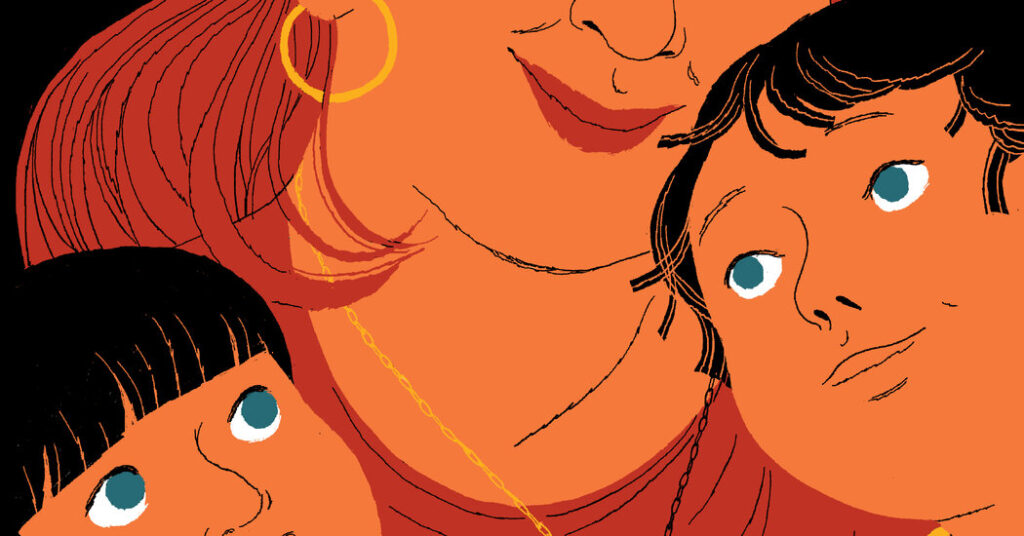
Do you ever feel as if your parents play favorites? Maybe your brother gets a pass on chores or your sister’s accomplishments get a louder cheer at the dinner table.
If you asked your parents that question, do you think they would share your answer?
If you believe your parents do play favorites, how has that unequal treatment affected you and your siblings?
In “Do Parents Have Favorite Children? Of Course They Do.,” Teddy Rosenbluth explores the taboo of parental favoritism and the profound impact that preferential treatment can have on family members:
As a child, Kara never thought of her parents as the types to play favorites.
Her youngest siblings always enjoyed extra attention and special privileges, like trips to Disneyland, but she had rationalized the behavior: The oldest children are meant to be more independent, she thought, and her parents probably had more money for vacations after she moved out.
But as she and her siblings grew up — and the special treatment continued — the evidence became glaring. Two years ago, when her parents called to say they planned to spend the holidays with her sisters, once again, and would not be flying to visit Kara and her children on Christmas, she had a moment of clarity.
“Suddenly it struck me that maybe there wasn’t a justification,” said Kara, who requested that her last name not be used to protect her family’s privacy. “Maybe those kids were always going to be the favorites.”
Kara came to resent that her parents overlooked her own children the same way they overlooked her. “Two generations of rejection,” she called it. And despite her best efforts to let go of the resentment and disappointment, the inequity affected her mental health.
“I just can’t get over the hurt,” she said.
Research from recent decades shows that versions of Kara’s experience are common for less favored siblings. In childhood, they are more likely to have poorer mental health, worse family relationships and less academic success than their siblings.
Other research shows that those family dynamics can affect mental health long past youth. One study found that whether adult children believed they were favored or disfavored was a stronger predictor of their mental health than almost any other factor measured, including marital status, employment and age. Only physical health was more closely correlated.
“You can talk to older adults and they’ll tell you what happened when they were 5,” said Laurie Kramer, who studies sibling relationships at Northeastern University. “They’re stuck on that.”
The article discusses a longitudinal study on the effects of parental favoritism conducted by J. Jill Suitor, a professor of sociology at Purdue University who has been collecting data from more than 500 mothers over the past 25 years:
The first surprising result from this data was just how pervasive the favoritism was. Based on the study’s questions, roughly two-thirds of the parents had a preferred child. And that favorite sibling often stayed the same over decades.
There was no set of qualities that guaranteed being the golden child, but the favorites tended to be daughters and younger siblings. A large analysis published earlier this year similarly found that in childhood, daughters were more likely to get preferential treatment from their parents. (Parental favoritism research often focuses on families with two children, leaving middle children once again overlooked.)
But it’s not just superficial factors like birth order and gender that make a difference. Parents tended to favor children with agreeable, conscientious personality traits, most likely because they are slightly easier to parent, said Alex Jensen, a researcher at Brigham Young University and an author of the large analysis from this year.
The article examines the effects of unequal treatment on children:
The research on the effects of parental favoritism, Dr. Jensen said, can be summed up succinctly: “Across the board, it’s not good.”
From a very young age, children closely monitor how they’re treated compared with their siblings. Those who feel they’re disfavored are more likely to have anxiety and depression, have strained family relationships and engage in risky behaviors, like drinking and smoking, as teenagers.
The author notes that being the “golden child” has its challenges, too:
There are downsides to being the favorite. While some may benefit from small amounts of inequity, they suffer when the gap between them and their siblings becomes too large. Golden children may feel guilty or undeserving when the differences in treatment are so obvious, said Susan Branje, the head of department of education and pedagogy at Utrecht University in the Netherlands.
Students, read the entire article and then tell us:
-
Do your parents ever play favorites, consciously or not? Do certain children in your family seem to enjoy extra attention or special privileges? If so, describe what that dynamic looks like and how it makes you feel.
-
What is your reaction to the article and the various studies on favoritism? Did you find anything revealing or surprising? Which details or stories, if any, resonate with your own family experiences?
-
Dr. Kramer notes that while everyone thinks about favoritism, “no one talks about these things.” Have you ever raised the topic with your parents or siblings? After reading the article, are you more likely to start an honest conversation about it?
-
Research shows that while less favored children often struggle with mental health and academic success, the golden child can suffer from guilt and pressure, too. If your parents play favorites, what effects, positive or negative, have you observed in yourself and your siblings?
-
Do you believe it is possible for parents to be truly equal or fair to all their children? Why or why not? If you become a parent in the future, how will you try to avoid the challenges of favoritism?
Students 13 and older in the United States and Britain, and 16 and older elsewhere, are invited to comment. All comments are moderated by the Learning Network staff, but please keep in mind that once your comment is accepted, it will be made public and may appear in print.
Find more Student Opinion questions here. Teachers, check out this guide to learn how you can incorporate these prompts into your classroom.
Jeremy Engle is an editor of The Learning Network who worked in teaching for more than 20 years before joining The Times.
The post Do Your Parents Ever Play Favorites? appeared first on New York Times.