Democrats are voicing growing confidence about their long-shot push to reclaim control of the Senate, identifying a narrow path to the majority in November’s midterm elections that is still strewn with obstacles.
Breaking Republicans’ 53-47 grip on the chamber was once seen as an almost impossible goal for the party, with nearly two-thirds of the seats on the ballot coming in states that President Donald Trump won in 2024. While it remains a steep climb, a string of recruiting wins, persistent voter concerns about the cost of living and a backlash to much of the Trump administration’s agenda have moved Democrats closer to what would be a seismic upset, according to a review of public polling and interviews with strategists, officials and nonpartisan analysts.
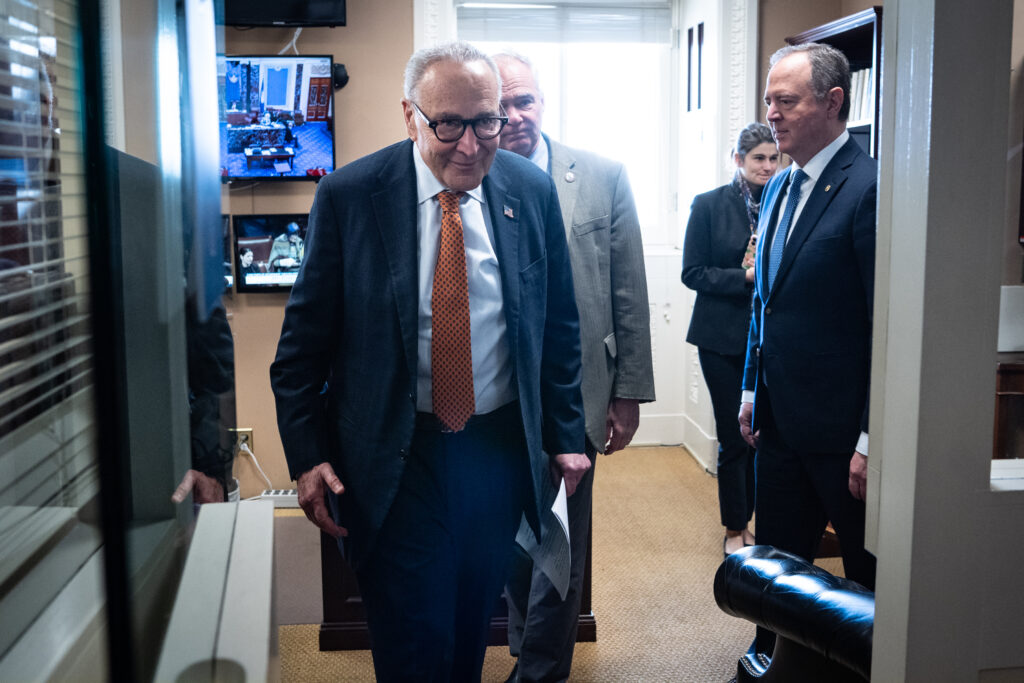
“I’m so much more confident than I was a year ago,” Senate Minority Leader Charles E. Schumer (D-New York) said in an interview this week. “If I had to bet money, I’d bet we take back the Senate.”
Still, Democrats are facing a forbidding map, on which almost everything would have to go right for them to net the four seats they need to flip the chamber. All but two of the Republican-held seats they are targeting are in states that voted for Trump in 2024 by double-digit margins. Democrats are also defending two seats of their own in states that Trump won. And they must navigate some potentially divisive and expensive primaries.
“At this time last year there was no path for the Democrats. There is a path now, but every single thing has to go right for them,” said Jessica Taylor, who analyzes Senate races for the nonpartisan Cook Political Report. “So Republicans are still favored at this point.”
Democrats are hoping to oust Sen. Susan Collins (R-Maine) — the only Republican senator who represents a state that Kamala Harris won — and pick up an open seat in North Carolina, where Trump won by three percentage points in 2024.
After that, they are eyeing four seats in states Trump won by double digits: Alaska, Ohio, Texas and Iowa. In the interview, Schumer identified Alaska and Ohio as the most promising of the four.
But Democrats are also playing defense in Michigan and Georgia, both of which Trump won in 2024. And they are defending an open seat in New Hampshire, a state Harris won by less than three points.
National Republican Senatorial Committee spokeswoman Joanna Rodriguez described Schumer’s recruits as “failed career politicians no longer aligned with the values of their states.” Alex Latcham, who runs Senate Leadership Fund, the flagship Senate GOP super PAC, said he was confident Republicans would hold the majority — even though he’s taking no race that Schumer is targeting for granted.
“If his path to the majority is dependent on winning every single battleground seat plus holding every single defensive race, then I think that’s a very tall task for him,” Latcham said in an interview.
Here’s a closer look at where the battle for the Senate stands:
Democrats playing defense | Georgia, Michigan, New Hampshire
Even as Democrats aim to flip seats, they will need to hold their own, which is no easy task. In Georgia, a purple state that has swung back and forth in recent election cycles, Sen. Jon Ossoff (D) is expected to face a challenging reelection fight. Republicans have attacked him for voting against Trump’s tax and spending bill, and Ossoff is running on issues such as protecting access to health care, which he hopes will cut across party lines.
The competitive and contentious May Republican primary will include Reps. Buddy Carter and Mike Collins — who have each pitched themselves as strong Trump allies — and former University of Tennessee football coach Derek Dooley, who has the backing of Brian Kemp, Georgia’s popular Republican governor.
“We definitely have seen Democratic energy and we’ve seen independents who normally lean Republican more often than not voting Democrat,” said Georgia Republican strategist Brian Robinson. It doesn’t help, he said, that Ossoff can stockpile money while Republicans fight it out for the nomination.
In Michigan, the Democratic field is unsettled after Sen. Gary Peters (D) decided not to seek reelection. Rep. Haley Stevens, state Sen. Mallory McMorrow and Abdul El-Sayed, a former Wayne County public health official, are vying for the Democratic nomination.
Already, Stevens, seen as the establishment preference, has attacked her opponents for supporting policies that she said hurt Michigan’s manufacturing industry, suggesting a contentious race to come.
Republicans have rallied around former congressman Mike Rogers, who also ran for Senate in 2024. Some Democrats in the state worry that none of their contenders have the political chops of Sen. Elissa Slotkin, who defeated Rogers two years ago by about 20,000 votes.
A recent Detroit News/WDIV poll showed some warning signs for Democrats in head-to-head matchups between their candidates and Rogers. Peters said he was not surprised by the polling showing an essentially tied race between Rogers and Stevens, which he said reflects voters’ greater familiarity with Rogers after his 2024 campaign.
“Whoever our Democratic nominee is is going to be a lot better known [by November] — is going to be extremely well-known,” he said.
The New Hampshire race is seen as a surer bet for Democrats. There are primaries on both sides, but for the Democrats, it’s considered a lock for Rep. Chris Pappas, a four-term congressman. For Republicans, it’s a bit less certain. Former senator John Sununu is aiming to win back a seat he held for one term before losing it in 2008 to Democrat Jeanne Shaheen, who is retiring this year. But first he has to beat former senator and ambassador Scott Brown, who represented Massachusetts from 2010 to 2013, in the primary.
Sununu, because of his famous political family in New Hampshire, is considered by many in the party to be Republicans’ best shot at flipping the seat.
Top Democratic pickup targets | Maine and North Carolina
Democrats spent tens of millions of dollars trying to defeat Collins in 2020. But the moderate Republican, who has forged a singular political brand in Maine, won by nearly nine points even as Joe Biden carried her state by a similar margin.
Schumer is optimistic about beating Collins this year — but Democrats cannot turn their full attention to defeating her until after what could be a fractious primary that pits Gov. Janet Mills against Graham Platner, an oyster farmer backed by Sen. Bernie Sanders (I-Vermont).
Schumer is backing Mills, but Platner has ridden a surge of populist enthusiasm. He also has a trail of controversial online postings from his past, including responding dismissively to a cartoon about sexual assault in the military in 2013. The Marine Corps veteran also changed a tattoo that was criticized for resembling a Nazi symbol.
The Democrats are also split by age: Platner is 41, while Mills is 78 and would be the oldest freshman ever elected to the Senate if she wins the primary and defeats Collins.
Democrats don’t need to worry about a primary in North Carolina, where Schumer persuaded former governor Roy Cooper to run for the seat that Republican Sen. Thom Tillis is vacating. He is likely to face Michael Whatley, a former Republican National Committee chairman. Cooper was a top recruit for Democrats, who believe his time as a popular governor will help them win a Senate seat in the state for the first time since 2008.
Tillis won his races in 2014 and 2020 by less than two points and said the race to succeed him this year could be even tougher for Republicans.
“It’s going to be a real challenge,” Tillis said.
Reach states for Democrats | Alaska, Ohio, Iowa and Texas
In Alaska, Schumer persuaded former congresswoman Mary Peltola to challenge Sen. Dan Sullivan (R), and in Ohio he recruited former senator Sherrod Brown to run against Sen. Jon Husted (R). Peltola and Brown lost their seats in 2024, though both of them ran ahead of Harris.
Early polling indicates each race is competitive.
An Alaska Survey Research poll conducted this month right before Peltola entered the race found her at 48 percent to Sullivan’s 46 percent. A Bowling Green State University pollconducted in October found Brown at 49 percent and Husted at 48 percent among registered voters.
Democrats haven’t won a Senate race in Alaska since 2008, when Mark Begich narrowly defeated Republican Sen. Ted Stevens. Begich lost his seat to Sullivan six years later.
Former Democratic congressman Tim Ryan, who lost the 2022 Senate race in Ohio to now-Vice President JD Vance, said he thought Brown and other Democrats would need to separate themselves from Schumer and the rest of the national party to win.
“There’s going to be probably a significant effort to tie our candidates to him,” Ryan said, referring to Schumer. “That’s still an Achilles’ heel for Democrats.”
Sen. Bernie Moreno (R-Ohio), who defeated Brown in 2024, said he was confident that Husted would beat him, too.
“I thought I had permanently retired the old b——, but I guess not,” Moreno told reporters.
Democrats are eyeing two other races: One in Iowa, where Sen. Joni Ernst (R) is not running for reelection, and another in Texas, where Sen. John Cornyn (R) is facing two primary challengers.
Schumer said he could describe why Democrats have a shot in Iowa in one word: soybeans. Iowa is a major soybean exporter, and those exports have been hurt by Trump’s tariffs.
But Democrats have not won a Senate race in Iowa since 2008, and their candidates are in a competitive primary there, while Republicans have rallied around Rep. Ashley Hinson.
Democrats are also facing a primary in Texas, where Rep. Jasmine Crockett is running against state Rep. James Talarico. Democrats believe their chances depend more on who wins the Republican primary, in which Cornyn is facing state Attorney General Ken Paxton and Rep. Wesley Hunt. Paxton has faced an impeachment trial in the state Senate in which he was acquitted and allegations of infidelity, among other controversies.
Senate Majority Leader John Thune (R-South Dakota) said he and other Republicans have tried to persuade Trump to endorse Cornyn without success. Without the president’s endorsement, GOP strategists say no Republican is likely to win a majority of the vote in the March 3 primary, forcing a runoff on May 26.
“That’s 10 weeks of spending in a state where it’s $8 million a week on television and 22 media markets,” Thune said.
Republicans will need to take the race seriously if Paxton wins the primary, Latcham said. While Democrats haven’t won a Senate race in Texas since 1988, former congressman Beto O’Rourke came within three points of defeating Sen. Ted Cruz (R-Texas) in 2018.
“Ted Cruz is a far stronger, far more talented candidate than Ken Paxton,” Latcham said.
The post Democrats chart long-shot path to retake Senate through these states appeared first on Washington Post.