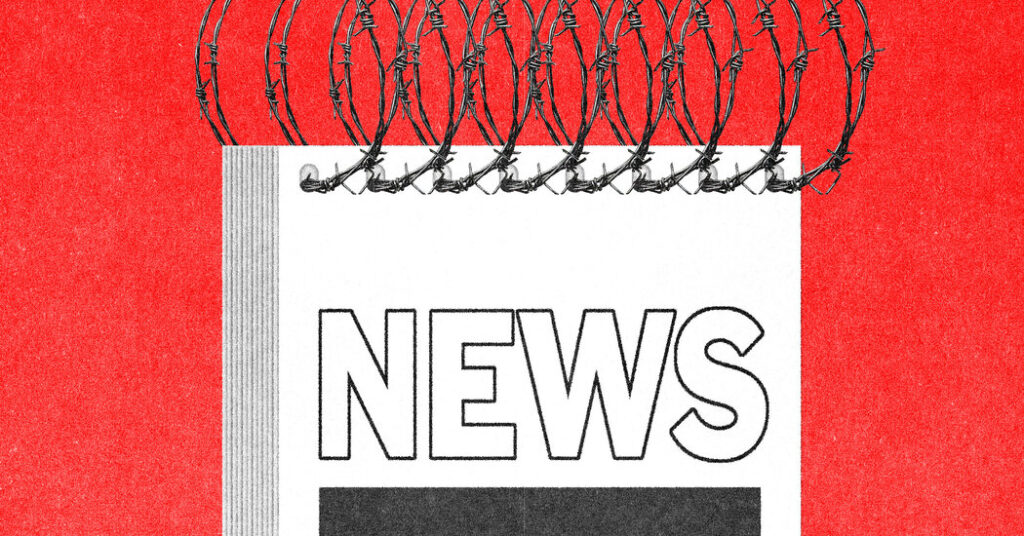
The F.B.I. raid on the home of a Washington Post reporter on Wednesday took the Trump administration’s attacks on press freedoms to a troubling new level. Attorney General Pam Bondi defended the raid as a necessary part of an investigation into a violation of the Espionage Act, which outlaws the unauthorized possessing or disclosing of “information relating to the national defense” that could harm the United States.
But invoking national security to seize the notes of a reporter who was actively working with hundreds of confidential government sources — many of whom do not work in areas related to national security — is an alarming overreach.
The First Amendment guarantees the freedom of the press independently of the freedom of speech. It does this because those who wrote our Constitution understood that an informed public requires not only free communication but also the facts necessary for meaningful communication. Knowing what the government is up to is essential for democracy to work. Any government action that strips away press freedom is tolerable only when a critical governmental concern demands it.
Protecting national security is certainly a critical governmental concern. That is why federal laws protecting the confidentiality of reporters’ work all contain exceptions when the government asserts a national security need. But reporting on national defense issues is also critically important. Indeed, informed public opinion may be “the only effective restraint” on executive power (as Justice Potter Stewart of the Supreme Court asserted in allowing the publication of the Pentagon Papers), given the president’s broad constitutional authority over national defense. History is full of examples of whistle-blowers who were able to inform the public of misconduct, illegality and abuse only through reporters who could guarantee them confidentiality and could publish free of government interference.
Wednesday’s raid is not the first time the government has seized a reporter’s records in an Espionage Act investigation. But such actions have typically been rare, always met with public condemnation and often led to greater legal restraints against such actions. In 2010, during the Obama administration, the Justice Department secretly seized the email of a Fox News reporter in an investigation into a leak of classified information about North Korea, and three years later, it secretly seized phone records of The Associated Press in a leak investigation concerning a foiled Al Qaeda plot in Yemen.
Then, as now, when those actions became public, the attorney general at the time defended them as legally justified by major security threats. But President Barack Obama was worried that these investigations might impede journalists’ work, and ordered the Justice Department to review the rules that permit such investigations. The rules were tightened.
Later, after it became public knowledge in 2021 that President Trump’s Justice Department had secretly seized reporters’ records despite the stricter rules, Merrick Garland, President Joe Biden’s attorney general, banned the Justice Department from ever seeking a reporter’s confidential work to aid a criminal investigation.
After taking office in the second Trump administration, Ms. Bondi promptly erased that ban. Her action was troubling enough when it was announced. The F.B.I. raid on Wednesday raises concern that the administration may be using the Espionage Act to silence critics by portraying reporters as criminals. The act is so broad and vague — it never defines the term “national defense” — that an investigation can be opened into the possession of nearly any confidential information, even when protecting that information is clearly a pretext.
There may be reason to believe that the Washington Post reporter possessed classified information, but that hardly makes her exceptional. So much classified information is leaked so regularly to reporters to advance policy agendas that lawyers who regularly deal with confidential sources consider leaking a natural part of modern democratic governance. Using a national security investigation to target the home of a reporter who had made known she was working confidentially with more than 1,000 current or former federal employees to expose wrongdoing raises questions about the government’s actual intent — particularly given the chilling effect the action will have on sources and reporters alike.
The Trump administration appears determined to stifle criticism and dissent. The president has long sought to portray unfavorable reporting as disloyal to the nation, labeling the press the “enemy of the people.” During the 2024 campaign, Mr. Trump’s future F.B.I. director, Kash Patel, called for a collective effort to bring to heel “the most powerful enemy that the United States had ever seen” — which he identified as “the mainstream media” — while Mr. Trump promised “retribution” against anyone who had criticized, investigated or resisted him. In office, Mr. Trump has made good on that promise through leak investigations, lawsuits, clearance revocations and access restrictions aimed at the media.
Within months of Pete Hegseth being installed as defense secretary, the Pentagon adopted a new press policy that says soliciting information from military personnel is tantamount to asking them to commit a crime, which is a not-so-veiled threat of Espionage Act prosecutions of reporters who do so. The F.B.I. raid this week makes that threat disturbingly real. (The New York Times has accused the Pentagon in a lawsuit of infringing on the constitutional rights of journalists with the new policy. I represent an organization that has filed an amicus brief in support of The Times.)
In response to public outrage, the government in the past ended up changing policy so as to not interfere with the press. Today, with the Trump administration taking so many extraordinary measures in the name of national security, both internationally and domestically, the corrosion of press freedom may seem like a small story. But this week’s raid on the Washington Post reporter will long reverberate through the government and the press in ways likely to limit what the American public knows about its government.
David Schulz is the director of the Media Freedom and Information Access Clinic at Yale Law School, where he serves as a clinical lecturer and a senior research scholar.
The Times is committed to publishing a diversity of letters to the editor. We’d like to hear what you think about this or any of our articles. Here are some tips. And here’s our email: [email protected].
Follow the New York Times Opinion section on Facebook, Instagram, TikTok, Bluesky, WhatsApp and Threads.
The post By Raiding a Reporter’s Home, Is the F.B.I. Weaponizing National Security? appeared first on New York Times.