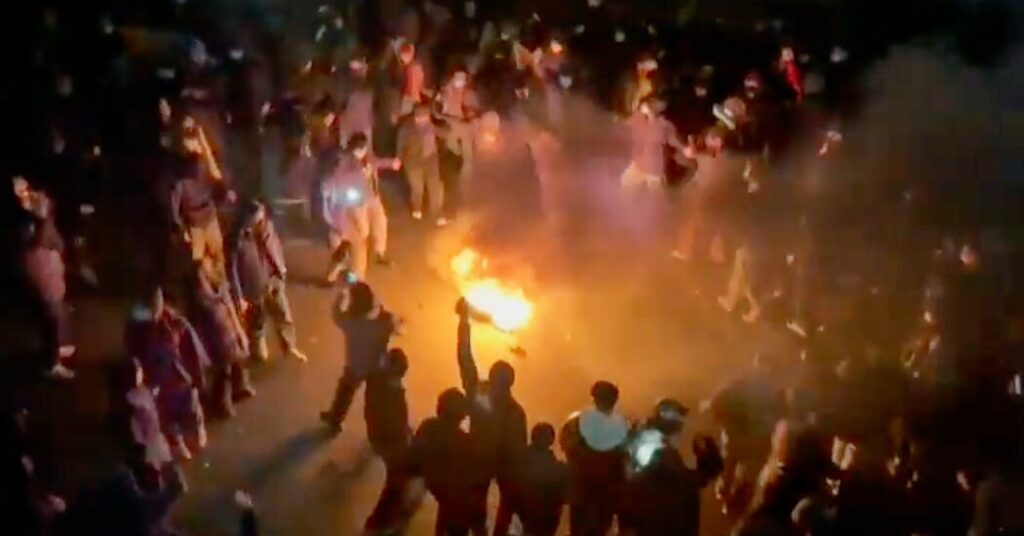
The internet blackout in Iran has stanched the flow of reliable information about the political unrest roiling the country. Filling the void has been a deluge of propaganda, disinformation and influence campaigns from countries or parties trying to shape the outcome of the conflict.
Inauthentic accounts online — also known as bots — have spread false and conflicting narratives on X, Instagram and other social media platforms in recent days, according to several experts in disinformation flow and the Iranian information ecosystem. The bots have shared misleading or artificially generated photographs and videos, further muddling what is actually happening on the ground.
Much of the content disseminated by inauthentic accounts has sought to bolster Iran’s opposition, including by championing Reza Pahlavi, the son of the shah of Iran toppled by the Islamic revolution in 1979. Others have echoed Iran’s claims that the unrest was orchestrated by its enemies, especially the United States and Israel — a view that allies like Russia have amplified in their own state media.
Researchers have identified multiple coordinated information campaigns online, though they cannot always identify those behind them with certainty.
Much of the content of the campaigns seems intended to sway the global court of public opinion, though it also reflects divisions among Iranians at home. The impact, though, has been more disorientation in an already murky situation.
Iran has long been a contested information battleground, with the Islamic government pitted against its critics in a perpetual struggle for public opinion. The 12-day conflict between Iran and Israel last year — punctuated by air and missile strikes by the United States — ushered in a new era of information warfare. The latest protests have reignited the discord.
“The conditions are ideal for actors attempting to exploit the internet shutdown to reshape narratives and public opinion concerning Iran,” said Layla Mashkoor, deputy director of research for the Atlantic Council’s Digital Forensic Research Lab in Washington, which has analyzed activity online surrounding the protests.
The swirl of content has included old videos of American Special Forces in Iraq’s Kurdistan, repurposed as evidence of new preparations for an American intervention, as well as deceptive images — identified by disinformation experts as generated by A.I. — purporting to show popular support for the government.
Other reports in Iranian state media or social media accounts have used images of American protests against U.S. Immigration and Customs Enforcement officers as justification for Iran’s efforts to crack down on protesters at home. Amir-Saeid Iravani, Iran’s representative to the United Nations, did not respond to a request for comment.
“The whataboutism deflection aims to normalize Iran’s use of force and portray repression as universal,” Alethea, a digital risk analysis company, wrote in a research note this week. “To Western audiences, it seeks to undermine U.S. moral authority by highlighting perceived American hypocrisy.”
Experts stopped short of attributing the covert information campaigns online to governments or factions beyond Tehran, saying the evidence remains unclear for now.
In a social media post on Tuesday, President Trump told Iranians demonstrating against their government that “help is on its way” (though on Thursday, Israel and several of Washington’s Arab allies urged Mr. Trump not to intervene).
It is not clear whether that help has included any information operations, though they have been identified since at least 2016 as “a top priority” of the Pentagon’s military strategy that “may be used to promote the messages of moderates in order to counter the radical ideologies that fuel much of the conflict and instability” in the region.
Comments like Mr. Trump’s have provided fodder for accusations by Russia that the United States, along with Israel, has had a hand in fomenting violence against Iran’s government.
Israel has long been engaged in influence operations against Iran, which the Israeli government views as an existential threat, analysts said.
A report published in October by the Citizen Lab, a cybersecurity watchdog group, concluded that a network of more than 50 inauthentic profiles on X, the social media platform, was organized by the Israeli government or a closely supervised subcontractor. The network, according to researchers, started ramping up its use of artificial intelligence early last year to spread narratives encouraging Iranians to revolt.
After a wave of protests in 2022, the National Iranian American Council commissioned a report about state-sponsored manipulation of social media. The report found “a coordinated campaign to manipulate social media algorithms and overwhelm targeted voices with disinformation, smears and threats” by using a large network of inauthentic accounts. The researchers said much of the activity then was most likely attributable to the Israeli government.
The online activity surrounding the current protests extends a yearslong “competition for who is going to be the dominant voice in the diaspora,” Jamal Abdi, the council’s president, said.
Golden Owl, a digital threat intelligence company in Spain, reported that it had uncovered two Iranian campaigns on X with more than 4,700 accounts pushing pro-government content.
A separate campaign on X has sought to bolster support for Mr. Pahlavi, the scion of the dynasty that once ruled Iran, according to Philip Mai, senior researcher of the Social Media Lab at Toronto Metropolitan University. (Other researchers and journalists have recently linked Israeli influence operations to online content that is written in Persian and supportive of Mr. Pahlavi, a figure known to have close ties with Israel.)
Many of the accounts on X, he said, are old but newly reactivated in recent months — often a sign of coordinated inauthentic activity in information operations.
“Someone is working very hard online, especially on X, to build up Reza Pahlavi as the man of the hour, a singular voice and face of the opposition,” Mr. Mai said in an email. “A few of the accounts we have seen are directing their message to an audience of one: the president of the United States, to convince him to take action against Iran and to back Reza Pahlavi.”
Other experts found evidence of online activity supporting the existing regime while accusing Mr. Pahlavi, the United States and Israel of mounting a coup. John Hultquist, the chief analyst of Google Threat Intelligence Group, said in a statement that his team was “seeing Iranian information operations associated with the unrest” and that some narratives had blamed the Mossad, Israel’s spy agency, for bombing a mosque and using agents on the ground in Iran to stir up trouble.
Representatives of the Israeli government did not respond to multiple requests for comment.
Iran’s shutdown of the internet and cellular communications since Jan. 8 appeared to be an effort to shield Iranians from such content — and to suppress accurate reporting of what appears to be intensifying bloodshed that by some accounts has resulted in thousands of deaths.
“I think the goal really here is to overwhelm, confuse and intimidate the resistance,” McKenzie Sadeghi, a principal analyst at Alethea, said.
It remains to be seen whether Iran’s efforts to choke off information about public discontent will succeed in defusing the crisis.
Ms. Sadeghi noted that the blackout also silenced Iran’s own well-established information operations, including one influence campaign that relied on ChatGPT, which OpenAI had identified in 2024. The Telegraph reported that accounts promoting Scottish independence, which were thought to be linked to Tehran, suddenly went quiet after the Iranian internet shut off.
Iranians do have one last connection to the outside world: satellite television.
Because many Iranians shun state media, one of the most popular channels for getting news in Persian has become Iran International — a channel that often shows support for Mr. Pahlavi. The channel has distributed many of his recent speeches to the people to take to the streets. Last year, it also was the platform through which Mr. Pahlavi distributed a QR code and asked security forces who wanted to defect to enlist to work with him.
Omid Memarian, an Iranian human rights expert and senior fellow at DAWN, a Washington-based organization focused on the Middle East, said the forces behind information warfare in Iran “are not only persistent but continually expanding.”
“Both the Islamic republic and its organized opposition,” he said, “understand that social media audiences are critical to advancing their goals.”
Erika Solomon contributed reporting.
Steven Lee Myers covers misinformation and disinformation from San Francisco. Since joining The Times in 1989, he has reported from around the world, including Moscow, Baghdad, Beijing and Seoul.
The post Battles Over Truth Rage Online Amid Iran’s Internet Blackout appeared first on New York Times.