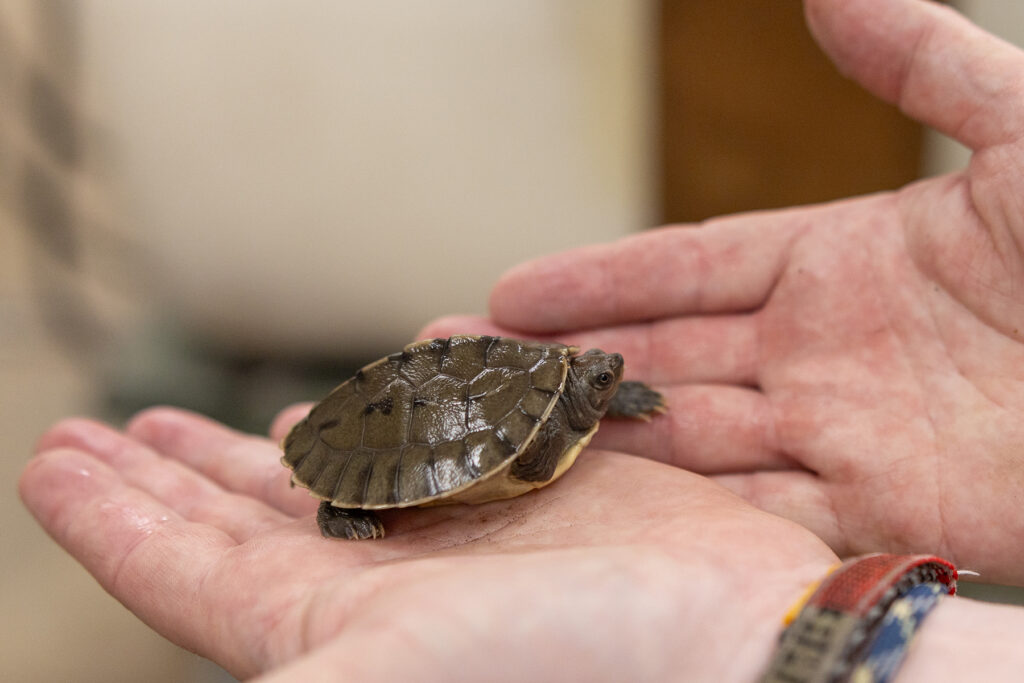
About the size of a half-dollar, the tiny painted river terrapin hatchling — a critically endangered species — at the Smithsonian’s National Zoo in D.C. should get an Olympic gold medal.
Unbeknownst to the keepers, it hatched from an egg that its mama had made in a camouflaged nest in the sand in a corner of the enclosure. Then it made its way through what keepers said was a tough obstacle course for a little critter that weighs about as much as two nickels. It journeyed about five feet, around a log, up and down sand dunes, carefully past a 12-foot-long tomistoma — a type of crocodile that could have easily eaten it — and then over the lip of a three-foot-deep pond and swam.
Zookeepers discovered the baby terrapin a day or two after it hatched. The hatchling still had its egg tooth, which it uses to get out of the shell, when they found it.
Matt Evans, the zoo’s assistant curator of herpetology, said one of his colleagues grabbed him and said he should come look. The colleague told him, “You’re not going to believe this,” recalled Evans. “And there it was. We saw it, in the corner of the large pool, a hatchling. … It looked beautiful.”
The birth, experts said, is a major milestone because it’s the first time a painted river terrapin has successfully bred at the D.C. zoo.
“This is a big deal for us,” Evans said. “We didn’t know what day to expect the hatchling. … It’s no easy feat for such a tiny turtle to be born and get to water. … Seeing it swim around and having it be healthy, it made us pretty happy.”
Although the new terrapin hatched last summer, zoo officials waited until last week to share the news on the zoo’s social media account; they often hold off a few weeks or months to make sure a newborn animal survives. The federal government shutdown last year also held up the birth announcement.
Painted river terrapins are native to mangrove swamps and river estuaries in Indonesia and Malaysia. Their population has dwindled because they get caught in fishermen’s nets and are sold as pets or for traditional medicines in the illegal wildlife trade. Their habitats have been harmed by companies that mine sand where they make their nests, experts said.
With upturned snouts and ridges on their shells, they look distinctly different from other turtles. Females weigh up to 50 pounds, and males roughly half that. They eat dark, leafy greens; carrots; apples; and grapes. It takes several years before they reach sexual maturity, and in captivity, painted river terrapins live 50 to 80 years.
The D.C. zoo has had its four terrapins for about a decade. Its two females are related to each other and came from the Fort Worth Zoo in Texas; the two males, also related to each other, came from the Henry Doorly Zoo in Omaha. To help boost the species’s population and keep it genetically diverse, the zoo planned to breed them after a recommendation from the Association of Zoos and Aquariums’ Species Survival Plan.
The terrapin is one of nearly 60 endangered species at the National Zoo and its conservation campus in Front Royal, Virginia. Last year, experts had notable success breeding species that are either endangered or extinct in the wild, including a red panda cub, several black-footed ferrets, a Przewalski’s horse and two Guam kingfishers.
In the fall, zookeepers noticed their male terrapins changing colors — a common characteristic of the species that happens in breeding season. Their heads turn from an olive-gray color to white with a bright red stripe on top. Their shells become streaked with green, white and black stripes, looking almost like a watermelon, experts said.
Then the males “danced” and swam around the females, rubbing their front legs and tails — all signs of courtship, Evans said. “There’s a cuteness to it. You’ll see males take their fingernails and stroke the female’s face.”
In the past, Evans said, the females didn’t seem interested. But last year as they matured and grew, they were more receptive.
“When they arrived, the females were smaller and younger than the males, so it’s taken them a number of years to get on the same page as the males,” he said.
Still, because terrapins breed a few feet below the water’s surface, it’s hard for keepers to know — much less see — exactly when it happens. They didn’t notice that one of the females had made a nest and laid eggs in a spot where there’s an infrared heated area that Pip, the tomistoma, favors because it’s warm and private.
Usually, the eggs would have been scooped up for a 60- to 90-day gestation period and hatched in an incubator.
Keepers later found about 20 other eggs in the nest but don’t know why they didn’t hatch. Experts said some of the eggs may have been infertile or didn’t fully develop for unknown reasons.
It’s a mystery as to which of the adult terrapins are the parents.
“Normally, males try to breed with the largest females,” Evans said, “but both our females are about equal in size. The males pursued both females, so the parents could be any combination of moms and dads.”
Evans said they took the hatchling out of the adult enclosure so experts can monitor it and make sure it’s eating and growing.
At roughly 5 months old now, the hatchling is doing well in its own digs — behind the scenes and not on display for visitors — with a smaller, four-inch-deep pond and UV lights for basking, Evans said. The hatchling, like the adults, comes out of the water in the evenings and basks on pieces of cork bark and rocks.
“It’s doing everything I would have wanted and hoped for,” Evans said.
It can take several years for experts to figure out a painted river terrapin’s gender. Evans said he and his teammates are hoping the adults reproduce more.
“The fact that our animals are breeding and producing healthy offspring is a good barometer that we’re meeting their needs.”
The post A surprise at the National Zoo: An endangered terrapin hatchling appeared first on Washington Post.