It’s the oldest, creakiest trope in the zombie-movie storybook: You know who’s scarier than decaying, flesh-eating monsters? The people they’re chasing! Every legendary entry in the genre, be it Night of the Living Dead or the never-ending Walking Dead franchise, has dug into this concept at some point. After all, it’s just as terrifying to imagine how the survivors of societal collapse might behave toward one another as it is to envision them beheading the undead. So it’s especially impressive when a movie about the undead somehow finds a new angle on such a well-worn premise. 28 Years Later: The Bone Temple, in theaters this week, does just that, finding a reason to be hopeful, rather than fearful, for postapocalyptic humanity.
This kind of reinvention is perhaps unsurprising for an entry in the 28 Days Later saga, which has been innovative from the jump. With the first film in the series, released in 2002, the director Danny Boyle offered an aesthetic twist on the zombie film: Instead of the archetypal shuffle, these decomposing villains, dubbed “the infected,” had the power to dash around at top speed. But 28 Days Later’s final act still felt familiar, as the film’s human protagonists confronted a unit of soldiers who had decided, in the grimmest ways possible, to take the law into their own hands.
Last year’s 28 Years Later, Boyle’s inventive sequel, revisited that world in a distant future, with Britain (the site of the “infection,” a virus that emerged from a lab leak) quarantined from the rest of the planet. The few survivors either huddled to tiny communities or began to stalk the island’s overgrown remains, looking for resources. Although I loved 28 Years Later, I worried about the cliff-hanger ending—a jarring sequence seemingly designed by the script’s writer, Alex Garland, to lead straight into the next installment. In the movie’s final minutes, the plucky young hero Spike (played by Alfie Williams)—who left his local village behind to discover what exists beyond it—runs into a pack of infected but is saved by a sadistic cadre of teenagers all referring to themselves as “Jimmy,” who gleefully rip bodies apart with spears and golf clubs. Here was Garland’s apparent vision of humanity at its worst: a cult of tracksuit-clad weirdos just as gruesome as the monsters they’re dismembering.
Would focusing on such bizarre characters be enough to sustain a sequel? The answer is yes. The Bone Temple is gnarly, challenging, and an incredibly impressive swerve, with Garland’s grim worldview beautifully captured by the director Nia DaCosta. Her visual approach is less kinetic and showy than Boyle’s in the previous film, which was shot back-to-back with The Bone Temple. But that style suits the sequel’s tone—unsettling, mordant, and sometimes bitterly funny. At the fore are the weird ways that belief and spirituality can evolve under the harshest, strangest of conditions, explored through the journey of the homicidal “Jimmys.” Yet DaCosta and Garland also offer stunning pockets of compassion, further iterating on a narrative blueprint that’s often followed the same pattern.
[Read: The lightest, fizziest Marvel movie in years]
The Bone Temple portrays its central figures as the scum of the earth. The adolescent “Jimmys” are led by a mellifluous adult who calls himself Sir Lord Jimmy Crystal (Jack O’Connell). Jimmy Crystal and his crones’ costumes, which include peroxide-blond wigs, are modeled after the British TV personality Jimmy Savile—one of the eeriest, most visually troubling ideas Garland has cooked up. Savile, who died in 2011, is best-known these days for the horrifying child-sexual-abuse allegations that emerged against him after his death. But in the world of the film, everything came to a halt in 2002, when the public was unaware of Savile’s predatory behavior; to Jimmy Crystal, Savile was just a beloved entertainer famous for his charity work helping children. Jimmy Crystal was a child when the infection spread, and his crew reflects the mind of someone raised on the TV of that moment: They do Teletubby dances and wield Tamagotchi toys. At the same time, they’re Satan worshippers who wear inverted crosses and are fond of torturing anyone they come across.
The story begins with Spike’s induction into the gang, and what follows is sometimes very tough to watch. The Bone Temple is disquieting even within the bounds of a gory horror movie because of how young the Jimmys are; if the entire movie just depicted their terrible exploits, and Spike’s efforts to escape the group, it would probably be too much to take. O’Connell’s layered performance helps keep the events from becoming overwhelming, making clear that Jimmy Crystal’s response to the end of the world adheres to a twisted sort of juvenile logic. He’s not only a lawless, evil being, but a sad and childlike one too.
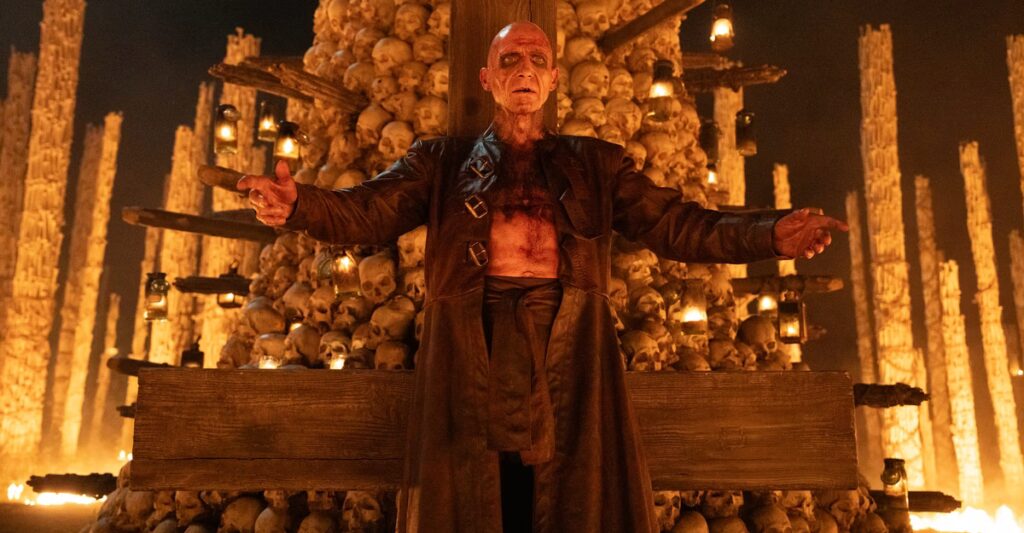
The Jimmys’ harrowing travails are further balanced out by The Bone Temple’s other plotline, which is optimistic, humorous, and oddly sweet. Also returning from the previous entry is Dr. Ian Kelson (Ralph Fiennes), a former general practitioner with the National Health Services; he has devoted his postapocalyptic life to building a giant memorial to the victims of the epidemic out of their bones. Kelson is both a strange creature and an aspirational ideal: someone who has managed to endure society’s complete dissolution with his morals intact. Kelson is primarily interested in healing Samson (Chi Lewis-Parry), a hulking mega-infected with whom he has formed a strange bond. The notion of reversing the virus’s effects is highly unorthodox by zombie-film rules, but Garland manages to make some sense out of this risky direction.
The Bone Temple is, on the whole, much heavier on rumination than Boyle’s thrill-fest. But the film is never lacking for tension. Although DaCosta doesn’t employ the same kind of flashy camera business that Boyle is so fond of (he shot much of 28 Years Later with iPhones), she creates a gorgeous and moody atmosphere, building to an outstanding climactic set piece that should prompt wild cheering from any audience. This may be another zombie movie about the inhumanity of man, but it’s also deeply, triumphantly humane.
The post Zombie Movies Should Always Be This Hopeful appeared first on The Atlantic.