A fruit puesto on a street in Mexico, or a fruitería local in a Latino neighborhood of L.A., is a magical establishment that is usually teeming with piles of fruits and leafy greens. Palm fronds might dangle from somewhere, and the whole place will smell like ripe oranges and guavas. These fruit spots just emote natural abundance.
Some of the best might be under an overpass in Iztapalapa, Mexico City, or off a quaint plaza in Oaxaca City or Puebla. Everyday people walk up and chat with a vendor while asking for a liter of orange juice, squeezed to order. Or a vampiro, a biting 1:1:1 concoction of orange, beet and carrot. Or my favorite, a jugo verde, a blended drink that is frothy, grassy and green-apple green.
The Mexican green juice is considered a folk supplement by people confronting a serious ailment or medical treatment, or for those simply seeking a potent dose of greens and fruits in gulpable form. The blended jugo is composed of a few core green ingredients mixed with an infinite list of possible variations.
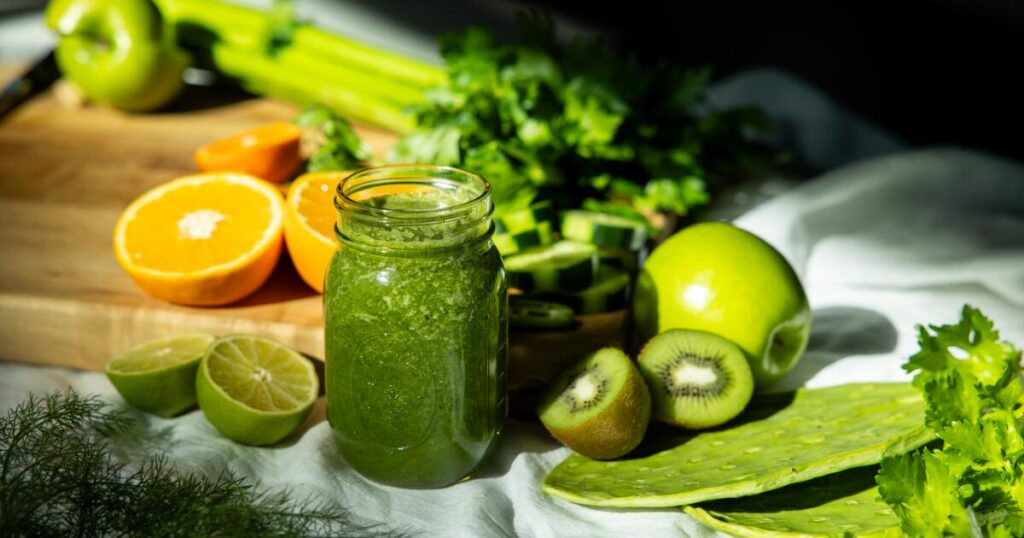
The core usually is parsley, celery, cucumber and fresh orange juice or squeezed limes. To these, fruteros might mix in green apple, pineapple, mint, spinach, guava or nopal. This last ingredient is a fascinating addition that could only emerge from the Mexican palate. It lends a jugo verde its deepest note of earthy healthfulness.
Every morning for the last 10 or 12 years, I’ve woken up and had a green juice with nopal before breakfast. It is a ritual for me. I travel with jars of my jugo in a cooler backpack on short weekend trips. I’ll serve it to any house guest along with their coffee, insisting you try my distinct take, which amps up the intensity level with ginger and mint. The drink gives me big swigs of vitamins, minerals, fibers and antioxidants. Occasionally I make it flat-out spicy, creating a green-green-green flavor bomb.
It’s worth noting that among health experts there is no concrete evidence juicing or blending greens is better for you than consuming whole raw vegetables and fruits. And everyone knows that orange juice is loaded with sugars.
But for me, and many others who hold the same practice, the Mexican green juice translates into a happy digestive system, into energy and focus, and lends the subtlest little pep in the step throughout the day. Its ubiquity in Southern California merges naturally with the L.A. cold-pressed juice boom.
In Highland Park, I was devoted to the jugo verde at Jugos Azteca. When I lived in Mid-City, I’d go for my fix at Mateo’s Ice Cream, which serves wholesome juices along with the best paletas in town. Oscar Mateo, whose dad Priciliano Mateo founded the family-run enterprise, said his father loved the jugo verde, also called a dietético.
“We travel a lot to Oaxaca, and every time we go out there, in all the juice places, they usually have the dietético,” Oscar said. “It’s a popular jugo verde in Oaxaca.”
He listed the ingredients in Spanish with a hint of pride, and said his family’s green juices sell particularly well amid people watching their diets.
“It comes with the nopal, perejil [parsley], apio [celery] and toronja [grapefruit],” he said. “A lot of Hispanics are familiar with that green juice, so that’s why it’s very popular.”
When I make this juice at home, I find the nopal to be essential. It just doesn’t taste like a “Mexican health food” without it.
Cactus forever
With its earthiness and fleshy texture, like eggplant or okra, nopal is a prized ingredient across a range of dishes in Mexico, mostly savory. Healthful mucilage gives its characteristic gooeyness, a texture that I love. People throw it on grills, beat it into eggs or chop it into salads with sliced onion and crumbly queso fresco.
The Opuntia cacti, or prickly pear cactus, grows abundantly across Mexico and here in Southern California. In the late summer, it is crowned with fluorescent fuchsia bulbs called tuna, also edible, also delicious. If you have a prickly pear cactus in your yard, you’re lucky.
As a food, nopal is appearing more in produce aisles lately in Southern California. You can easily get it at a Northgate or Vallarta supermarket, and other local chains, as well as mom-and-pop tiendas with produce and carnicerías for the crowd who likes grilling it.
The paddles should be de-thorned, bright green and firm. Most baggies come with four or five paddles. If yours start to brown at the edges before using, simply trim off and toss the browning portions. Never use pickled or cooked cactus in a green juice. It must be raw and organic, like every other ingredient in this recipe.
But is it really healthy?
Carolina Herrera-Park, a dietitian and nutritionist who grew up in the San Fernando Valley, recalls her Mexican immigrant household drank green juices in her home and community. She said their growing attractiveness in Southern California makes sense, but cautioned against overstating their health benefits.
“The way I see the jugo verde is they play several roles, and one certainly is cultural,” Herrera-Park said. “A lot of folks see this as a health food, because there are lots of plants in it, fruits, vegetables, herbs. And as I’ve grown as a professional, I’ve also learned about some of the considerations.”
These considerations, she said, include the high sugar content of staple ingredients such as orange, apple or pineapple. People watching their blood sugar should not generally drink citrus-heavy juices, she said, echoing widely held medical knowledge. The cold-pressed method eliminates the fibers involved, Herrera-Park also noted, which are useful for digestion. Blending retains them.
“Certainly it can be a source of nutrients. It can be seen as really easy to get our fruits and vegetables in one go,” she said. “Making it a smoothie, you’re keeping that fiber, which is a good thing. But is there an opportunity to make my meal more complete?
“Ultimately, I invite folks to choose whole fruits and vegetables, because there you’re getting the full spectrum of the intact fiber,” she said. “We’re using our teeth. Our stomach still has to do work. And so all of this means that that fruit or vegetable stays in our stomach longer, meaning we stay fuller for a longer period of time.”
Yet the appeal of a tangy, convenient jugo verde in L.A. remains strong. Whether at home or on the go, it’s pretty much the only healthy eating habit that I actually keep daily.
Over time, I’ve dropped the parsley for my recipe and now use mostly celery stalk and celery leaves, which are packed with great fibers. I began experimenting by adding mint and ginger during one gloomy morning at the start of the 2020 pandemic shutdowns. One day I asked myself, what might happen if I added a bit of serrano? So I did. The effect was just what I wanted: bold, potent, regenerative. Give it a try — if you’re in a daring mood.
There are other tricks to this drink that I have learned along the way. Do not substitute any lettuce, even in desperation — this isn’t a salad. And although some people might swear by a kale or spinach incorporation here, I advise against it. The darker, tougher greens are just too much body, and a darker kind of green.
Yes, I must also insist on another simple, rather stupid-sounding rule for this jugo verde: Every green ingredient here should be about the same tone of green (minus the citrus). That is, everything should be limey green, celery-stalk green … green green.
When fun things are in season or hanging around, throw them in. Guavas are great in the winter; their yellow or pink flesh dissolves away into the greens. A neighbor has finger limes, a hilarious fruit I was unfamiliar with before; I squeeze its sour little inner pearls right into the blender.
Combined with the tartness of the green apple and kiwi, and the fresh-squeezed citrus, this recipe becomes an eye-popping greens bomb that will amp you up naturally for the day ahead. Your nose should slightly flare at first gulp.
Get the recipe
The post Your green juice is missing this prized Mexican ingredient appeared first on Los Angeles Times.