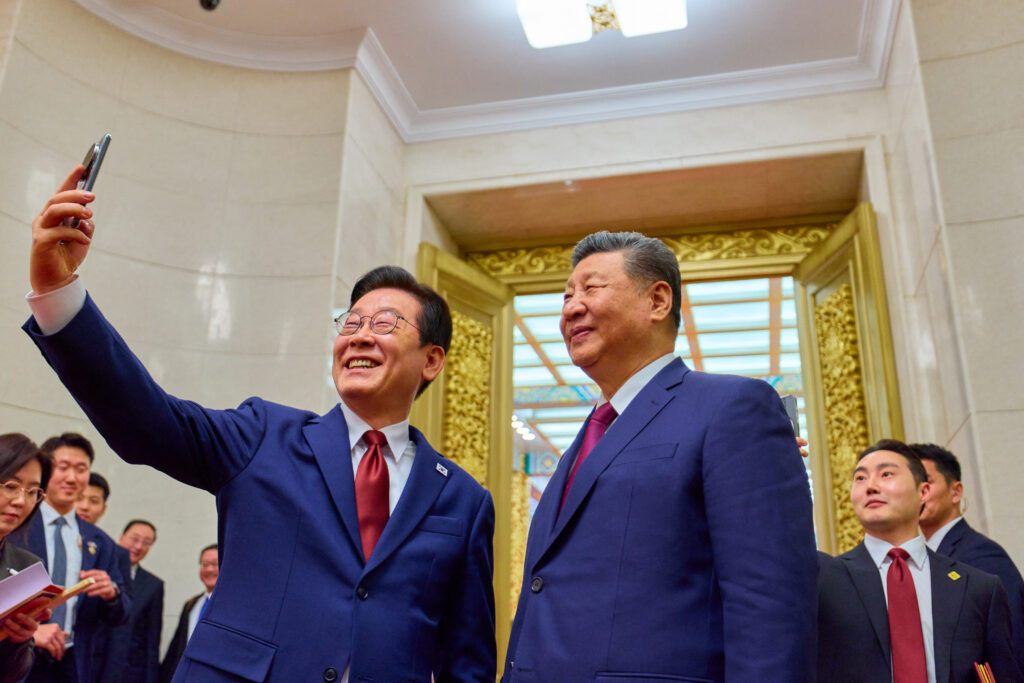
SEOUL — South Korean President Lee Jae Myung is finding himself the center of attention in the region: Japanese Prime Minister Sanae Takaichi this week invited him to join an impromptu drum jam session to K-pop songs. Last week, it was Chinese leader Xi Jinping who was — uncharacteristically — all smiles as Lee took selfies of them on the Chinese cellphone Xi gave him last year.
Japan and China are waging fullcourt charm offensives to woo South Korea, as relations between Tokyo and Beijing deteriorate and both capitals look to support from its small but strategically important Asian neighbor.
Lee’s back-to-back summits underscore the diplomatic tightrope he walks, trying to avoid taking sides as he balances South Korea’s security interests with the United States and fellow American ally Japan while smoothing out tensions with China, Seoul’s biggest trading partner.
“He’s managing an incredibly perilous diplomatic situation,” said Daniel Sneider, an East Asia policy expert at Stanford University. “He’s got to improve relations with both countries at the same time he’s also making sure he doesn’t do anything to tick off” the United States.
The relationship between Japan and China has soured in recent months, since Takaichi suggested Japan could intervene militarily if Beijing invades Taiwan, a self-governing island that the Chinese Communist Party claims as its territory.
China retaliated with military saber-rattling and economic coercion, including restricting critical mineral exports to Japan and advising Chinese citizens against visiting Japan for tourism. Takaichi, a pro-Taiwan military hawk, has refused to take back her remarks, but she and other Japanese officials have been trying to keep the conflict from escalating.
Takaichi, who rose to power after an internal party vote, has enjoyed a boost in popularity after standing up to China and is expected to soon call an early election to win a broader mandate.
Beijing now sees Seoul as a potential partner to take collective action against Japan, experts say, as China reminds South Korea they were both victims of the Japanese Empire’s aggression. Japan invaded and occupied parts of China in a brutal military campaign from the 1930s until the end of World War II, and colonized Korea from 1910 to 1945.
“Both countries, with broad common interests, should stand firmly on the right side of history and make correct strategic choices,” read the official Chinese readout of Xi’s meeting with Lee. “… Today, it is all the more important for the two sides to join hands to defend the victorious outcomes of World War II, and safeguard peace and stability of Northeast Asia.”
Meanwhile, Japan wants a stronger relationship with South Korea, based in part on countering China’s economic dominance and shoring up a neighboring country’s support while China retaliates against Tokyo for Takaichi’s remarks. Japan and South Korea, both U.S. allies, are also looking to band together as they face a volatile U.S. administration that has questioned the value of alliances and hit both with tariffs on key industries.
For its part, South Korea is trying to stay out of the fight.
“From the perspective of peace and stability in Northeast Asia, such confrontation and conflict between China and Japan are not desirable, so I hope that these issues will be resolved smoothly through dialogue between the two countries,” Lee said ahead of his Japan visit.
But that didn’t stop Xi and Takaichi from trying to make Lee feel like a special friend.
On the agenda: Noodles and North Korea
Lee visited China last week for a summit with Xi, becoming the first South Korean president to make such a trip since 2019. He brought a delegation of more than 200 South Korean business leaders, highlighting China’s importance as Seoul’s largest trading partner. Lee took office vowing to restore relations with China, which deteriorated under his predecessor.
Lee was greeted by an honor guard, a performance by a military band and a 21-gun salute in Tiananmen Square. Xi and his wife hosted a welcome banquet for Lee and his wife, and the two leaders shared friendly observations about a black bean noodle dish enjoyed in both countries.
Xi’s efforts to keep Seoul close comes against the backdrop of geopolitical uncertainty, including U.S. President Donald Trump’s unpredictable leadership and talk of a world splintering into spheres of influence, especially after the U.S. military actions in Venezuela, according to Sneider, of Stanford.
China wants to diminish the U.S. security alliance system in East Asia and drive a wedge between the U.S., South Korea and Japan, impeding them from forming a trilateral bloc to contain Beijing’s influence, experts say.
“That’s part of China’s long-term aspirations to be the hegemonic power in East Asia,” Sneider said.
This was evidenced by Xi’s remarks ahead of his meeting with Lee, referencing Trump’s “America First” policy: “South Korea and China should jointly oppose protectionism and practice true multilateralism to contribute to promoting a peaceful and orderly global multipolarity and inclusive economic globalization.”
For China, it’s important to create a more friendly atmosphere toward South Korea, especially given the rise in anti-China sentiment among the South Korean public, said Ryu Yongwook, an expert on East Asia relations at the Lee Kuan Yew School of Public Policy at the National University of Singapore.
“China wants to make sure that South Korea can maintain a more neutral stance when it comes to the U.S.-China rivalry, and therefore, it covets South Korea,” Ryu said.
South Korea also wants to smooth out relations with Beijing in hopes that China will help convince North Korea to engage in diplomatic talks with the South and give up its nuclear weapons. But Xi did not make any commitments during the meeting, Lee told reporters, adding that Xi told Lee that “patience is needed” in dealing with Pyongyang.
Walking to the same beat
Then this week, Lee traveled to Nara, Takaichi’s hometown, for a two-day visit. The Japanese leader switched things up by personally greeting Lee and his wife outside their hotel, ripping up the plans for hotel staff to do so.
“If you welcome us by breaking protocol like this, we hardly know where to put ourselves,” Lee told Takaichi.
That wasn’t the only surprise Takaichi had in store.
The prime minister, who was once a drummer in a heavy metal band, presented Lee with the opportunity to play drums with her — in matching sweatsuits with their names emblazoned across the front, no less. Takaichi and Lee jammed to a song by the K-pop boy band BTS and to “Golden,” the Grammy Award-winning song from the animated movie “KPop Demon Hunters.”
It was a nod to a throwaway comment Lee made during their first meeting at an economic conference in South Korea late last year, where Lee said playing drums was his childhood dream. The next day, the two leaders toured the Horyuji Temple, a UNESCO World Heritage site known for preserving remnants of Japan’s cultural exchanges with Korea in the 7th century.
The friendly rapport between the two leaders is unusual, given Takaichi’s nationalist views and Lee’s long track record of criticizing Japan over lingering animosities stemming from the Japanese occupation. But the two shoved those historical tensions aside for a show of camaraderie instead.
That approach underscores how strategically important Japan views South Korea as while dealing with the U.S. and China, said Yasuyo Sakata, an international relations professor at the Kanda University of International Studies in Japan, who specializes in Japan-South Korea relations.
In its relationship with South Korea, Japan is looking for stability and keeping the relationship focused on the future, rather than dredging up historical tensions, Sakata said.
“Why? Because Japan wants to keep South Korea as a partner in the Indo-Pacific, in the world, vis-à-vis China, and … to weather the big Trump wave,” Sakata said.
South Korea also has an interest in drawing close to Japan due to similar concerns about Chinese economic dominance and the Trump administration’s unpredictability. South Korea could even try to mediate between Japan and China, said Ryu, given that Chinese controls on rare earth exports to Japan could have knock-on effects for South Korea’s economy.
“The real test has yet to come” for South Korea’s Lee, he said, because “when the hard interests clash … that’s when his foreign policy will be tested.”
For example, Lee has avoided taking a position on Chinese military action against Taiwan, which could risk angering Beijing. And the rapprochement between Japan and South Korea is vulnerable to thorny historical issues, such as whether Japanese companies will compensate the families of Koreans who were forced to work for them during the occupation.
During the summit this week, the two leaders avoided directly mentioning those unresolved problems.
“When these historical issues arise, they will come to haunt the bilateral relationship between South Korea and Japan,” Ryu said.
The post With smiling selfies and K-pop jam session, Japan and China woo South Korea appeared first on Washington Post.