Like an action movie or an old-fashioned sitcom, the first year of the second Trump administration has spawned a catchphrase, a scrap of language that is all but impossible to avoid.
Thank you for your attention to this matter.
Sometimes trailed by multiple exclamation points, this sentence most often appears at the end of one of the president’s posts on his Truth Social platform. In mid-December, The Washington Post calculated that, since his re-election, Mr. Trump had expressed gratitude for your attention at least 190 times. He has hardly slowed down this year. In the past week, Mr. Trump has used the phrase at least half a dozen times, including in messages about Greenland, credit card interest rates, congestion pricing and the political situation in Venezuela.
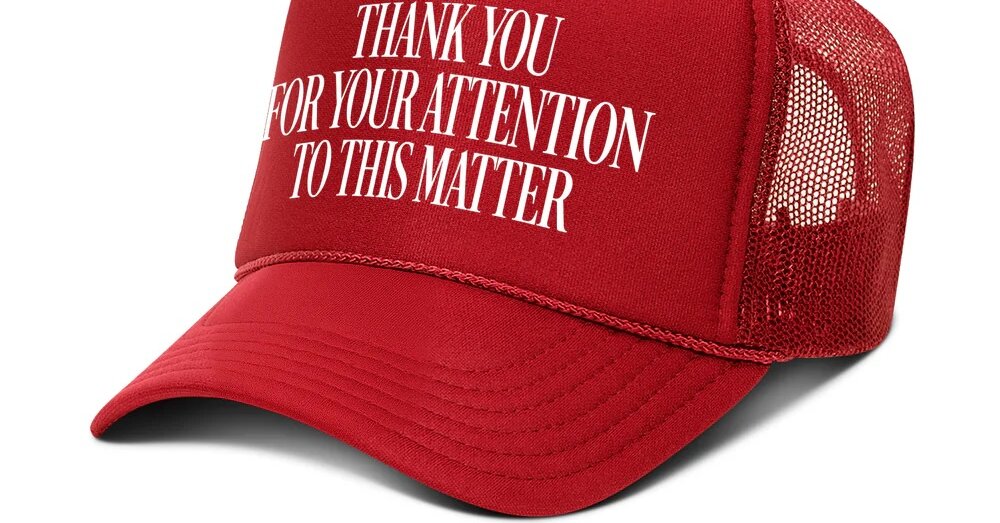
Anti-Trumpers — including Gov. Gavin Newsom of California — have mocked this expression. Supporters have embraced it. Steven Cheung, the White House communications director, told The Post that when the president “ends a message with that phrase, it is final and forceful.” A red foam cap sporting those eight words in an uppercase font is available for purchase at MAGA.com.
But what does it mean? “Thank you for your attention to this matter” (hereafter TYFYATTM) goes against the familiar elements of Trumpian style. Saying “thank you” in advance is uncharacteristically passive-aggressive for someone who doesn’t usually bother with the “passive” part. The stilted formality departs from the loose, free-associative approach to language that the president himself has described as his “weave.”
By this logic, it’s tempting to dismiss TYFYATTM as a semantically empty linguistic tag. But another possibility is that Mr. Trump uses these words so frequently precisely because he means them, and they offer a succinct statement of his political philosophy.
To thank someone for their attention to a pressing matter is to speak the language of executive authority. For the recipient of those words, immediate cooperation is expected. You typically encounter them when an unpaid bill has been referred to a collection agency; when your boss needs something done yesterday; when a lawyer is threatening you with a suit. The upshot is always the same: Whatever else you may be doing or thinking about, you need to reorder your priorities.
This is an idiom that comes naturally to Mr. Trump, and his deployment of it is a sign of how he has altered the conventions of American politics.
Before he ran for office, he was a fixture of the notoriously litigious, theatrically belligerent world of commercial real estate development, and then a reality TV boss. His catchphrase on “The Apprentice” — “You’re fired!” — named a possible consequence of not paying attention to the right matter.
The workplace on that show was not only a scene of Darwinian competition among ambitious employees; it was also a domain of individual command. The niceties and buzzwords of modern corporate life — team-building; human resources; concern about office culture — were stripped away in favor of hierarchy that was simple, brutal and unambiguous. Whatever scheming or committee work happened behind the scenes, what viewers saw was clear and dramatic. Mr. Trump was in charge.
After the chaos and factionalism of the first Trump term, the second term has rewritten the old “Apprentice” rules. This is not just a matter of personnel or White House management style. In the courts, in Congress and in conservative media, the administration and its supporters have promoted a theory of executive authority that concentrates power in the office of the presidency and in the person of the president.
The president himself isn’t carrying out this theory so much as unselfconsciously embodying it. TYFYATTM doesn’t speak the traditional language of public service or democratic leadership. It assumes compliance and compels obedience.
But whose? The “you” in conventional uses of the phrase is a recalcitrant employee or a deadbeat customer who is being asked to do something under duress. “Attention,” in this sense, is a euphemism for action. In Mr. Trump’s version, though, attention is all the action that seems to be required. That is, his TYFYATTM posts aren’t usually aimed at the people or institutions — elected officials, banks, foreign governments — who might be able to implement the policy or address the complaint preoccupying the president at the moment. They are directed at, well, everyone.
Or at least whoever happens to be reading, which in principle may amount to the same thing. “Attention” is, after all, something of a catchphrase all by itself, the elusive entity that is supposed to explain the way we live now. In the modern cultural economy, attention is both commodity and currency. Each of ours is coveted and competed for by digital platforms, legacy media, podcasters, influencers and, of course, politicians.
Mr. Trump, his fans and critics agree, has an unmatched ability to galvanize attention, to insert himself into public consciousness at will. His preferred Truth Social tagline is an acknowledgment and assertion of that talent, a tautology and self-fulfilling prophecy. Attention is what the world has already paid him — we read the post, didn’t we? — and also what he insists we still owe him.
A.O. Scott is a critic at large for The Times’s Book Review, writing about literature and ideas. He joined The Times in 2000 and was a film critic until early 2023.
The post Why Trump Always Thanks You ‘For Your Attention to This Matter’ appeared first on New York Times.