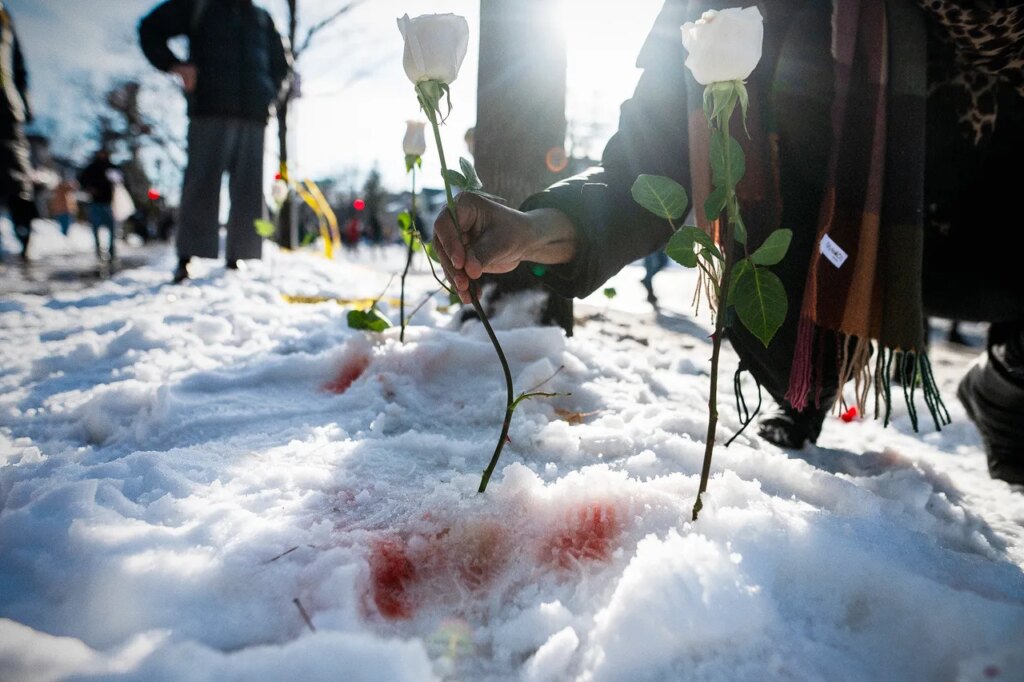
When Jonathan Ross shot and killed Renee Nicole Good last Wednesday morning in Minneapolis, the 37-year-old mother became one of at least 25 people killed by an Immigration and Customs Enforcement agent shooting since 2015.
In the days after Ross fired at Good multiple times from the front and side of Good’s car, visual investigations from outlets like The New York Times and The Washington Post have reconstructed the event, which unfolded in a matter of seconds, combing through a series of videos that emerged from various angles. These present apparent contradictions between the narrative presented by the White House and Department of Homeland Security, which claims Ross acted in self-defense, and what actually happened.
But similar contradictions haven’t previously led to criminal indictments in ICE agent shootings. In fact, there does not appear to have ever been a criminal indictment stemming from an ICE shooting at all.
I spent four years investigating ICE shootings that occurred from 2015 to 2021, over the course of three presidential administrations. I sued ICE for the logs of all of these shootings—a lawsuit that took two years to be settled—and cross-analyzed them with media reports, lawsuits, over 40 interviews with experts, shooting victims, families, and lawyers, and 20 other Freedom of Information Act requests for law enforcement investigation reports across the United States to piece together what happened and what patterns they revealed.
Not counting the Good shooting, ICE agent shootings have involved moving vehicles at least 19 times—which are connected to at least 10 deaths and six injuries. Task forces including ICE agents have shot at least three other US citizens. They have shot in public areas with bystanders 22 times. And in at least seven cases, the person shot by an ICE officer was not the target of the enforcement action.
The Same Defense
The self-defense claim ICE, its agents, or their lawyers have made after shootings has historically been proven impossible to refute. An agent using deadly force does so justifiably when it is “objectively reasonable and necessary,” ICE spokesperson Mike Alvarez told me in an email in 2024.
“A law enforcement officer placing himself or herself in front of a motor vehicle to prevent a suspect’s potential avenue of escape is a dangerous tactic and a potential violation of policy,” Mike German, a former federal law enforcement agent, tells WIRED. “But I don’t think that would be likely to impact a prosecutor’s evaluation of whether the officer has a reasonable fear at the time he pulled the trigger that he was in a life-threatening situation justifying deadly force.”
This reasonableness standard is what a city, state, or federal agency would assess when deciding whether to indict an agent for any criminal activity, and it’s evaluated from the perspective of a law enforcement official, not a layperson, German explains.
“Prosecutors and judges tend to be very deferential to law enforcement agents involved in shootings,” German says. “Typically, an agent’s subjective belief that deadly force was necessary to protect themselves, or the safety of another person, from serious bodily harm is enough to avoid criminal charges, or conviction if charged.”
Sometimes suspects were seen to have guns, according to the ICE logs I obtained, particularly in the course of Homeland Security Investigations. But three times, ICE documented a suspect’s body, described as “hands/feet/body,” as a weapon.
And in at least a dozen cases, I uncovered evidence suggesting that the shooting victims were unarmed.
Federal agent-involved shooting investigations conducted by the Justice Department rarely result in criminal charges, and the results are rarely released publicly, German says. “The bottom line is that these shooting investigations very rarely find the agent in violation of law or policy.”
Besides self-defense, ICE agents, like all federal agents, are largely protected by qualified immunity, a legal doctrine that protects them from civil lawsuits for constitutional violations committed in the course of the duty. In recent years, two Supreme Court cases involving an immigration agent shooting and physical injury, Mesa v. Hernandez (2020) and Egbert v. Boule (2022), further cemented any private citizen’s inability to sue federal agents for harm.
The All-Clear
Determining whether criminal charges are warranted is the responsibility of a state or local law enforcement agency—most often the state attorney general’s office—and/or from a federal agency investigating, like the FBI. Both federal and municipal bodies can prosecute separately, at the same time, according to their own policies, and do not have to defer to one another.
But on Thursday, just one day after Ross shot Good, Minnesota’s Bureau of Criminal Apprehension (BCA) “reluctantly” withdrew from the joint investigation with the FBI after the US Attorney’s Office said the FBI would be the sole investigator and would no longer grant the BCA access to the case materials, scene evidence, or investigative interviews.
The US attorney general pushing the BCA out of the joint investigation, though, doesn’t prevent the Minnesota Attorney General or the Hennepin County Attorney’s office from conducting their own homicide investigation.
In a press conference on January 9, both offices asked residents and witnesses to submit evidence in the Hennepin County Attorney evidence submission portal. The county attorney, Mary Moriarty, said the office has received hundreds of calls and emails to open an independent investigation. Across its social pages, the county attorney’s office didn’t confirm that it would do that and instead said the office “stands ready” to assist the FBI.
Meanwhile, Minnesota governor Tim Walz encouraged residents to use the tools available to them to hold ICE agents accountable. “So carry your phone with you at all times. And if you see ICE in your neighborhood, take that phone out and record,” Walz said in Wednesday’s address. “Help us create a database of the atrocities against Minnesotans—not just to establish a record for posterity but to bank evidence for future prosecution.”
The Hennepin County Attorney’s office didn’t respond to an email asking whether it plans to open an investigation.
Local agencies backing out has precedent. There have been shootings in the past that may have gone uninvestigated due to alleged confusion on jurisdiction between state and federal agencies.
In a February 2018 shooting in Dumfries, Virginia, an ICE agent who was a member of a US Marshals fugitive task force killed an unarmed man by shooting him in the back as he was fleeing arrest. The commonwealth’s attorney’s office began to investigate but stopped before it finished, saying it lacked jurisdiction over federal agents. But even though it didn’t weigh in on an indictment, the office wrote in an opinion that the federal agent enjoyed immunity from state prosecution.
Like in Minneapolis last week, the case was solely in the FBI’s hands, and the commonwealth’s attorney’s office confirmed that it gave the bureau its collected investigative material. But the FBI neither confirmed nor denied my query about whether that investigation took place.
An FBI investigation into an ICE agent shooting a driver pulling away from a parking spot has been slow-walked in the past.
In September 2019 in Nashville, Tennessee, a deportation agent shot at a man through the window of his truck twice as he pulled out of a grocery store parking lot at around 7 am local time. An ICE spokesperson told reporters the man behind the wheel drove toward the agents. But video footage obtained by a local TV station showed that the truck was parked when the ICE agents drove up and that the agent raised his hand—presumably with a gun—and chased the truck pulling away. The FBI was tasked with investigating the ICE’s agent’s allegation that the driver assaulted him. The driver, who surrendered to the FBI and was later arrested by ICE, was later released from custody.
The results of the inquiry by the FBI, the sole investigating agency in the case, were never made public.
“The problem is that these federal shooting investigations often take a long, long time and are rarely publicly reported when they conclude, so the passage of time dampens the public demand for accountability,” German, the former federal law enforcement agent says.
State and local law enforcement agencies have consistently cleared agents of wrongdoing after shootings even when they have hindered investigations, which happened three times across Arizona and California between 2015 and 2021.
In 2018 in Scottsdale, Arizona, an ICE investigator shot a man multiple times—the last bullet was fired after the man was already on the ground—and the Maricopa County Attorney’s Office found that he disregarded protocol by not remaining on the scene to give a statement. (He eventually gave one six days later.) That he fired his gun violated other protocols, and prosecutors found that his conduct could “justify further investigatory steps” but still cleared him.
In 2016 in Chula Vista, California, an ICE agent advised a colleague who killed a 22-year-old by shooting him four times within 10 seconds not to cooperate with the investigation, according to a transcript of the body-wire recording obtained by the victim’s family and published as part of a lawsuit. “Don’t worry about it,” he told him. “Remember … no statements. None of that shit.”
The lawyer who represented the family in a lawsuit that was dismissed said the agents were questioned, but the Chula Vista Police Department report did not include any details of the investigation. The agents’ lawyers did not respond to WIRED’s queries about the case.
Out of Sight
If an incident is potentially criminal, the DHS Inspector General’s Office might review it. But ICE’s Office of Professional Responsibility will always investigate a shooting for policy violations, and, lacking authority to issue discipline, will make disciplinary recommendations if it deems them necessary, according to a 2023 Government Accountability Report looking into DHS use-of-force policies.
Any suggestion on disciplinary measures goes back to the agent’s supervisor, who can decide whether to administer it. And even when disciplinary action is applied, an ICE officer can appeal that decision. It can take years for discipline to actually be issued, if it ever is.
Gretta Goodwin, the author of the GAO report, found that ICE’s data collection lacked any path forward for review. In some use-of-force reviews, she said in an interview in 2023, ICE documented incidents but didn’t document whether they were in accordance with policy.
“They wrote it down, but as far as we know they did no follow up,” Goodwin said.
As for the outcome, Goodwin said she saw some disciplinary actions but didn’t learn the frequency of them.
“We did see that people were reprimanded, suspended,” she said. “I don’t know if anyone got fired.”
The GAO reviewed the DHS use-of-force practices in 2023 as part of a 2022 Executive Order on police reform for federal law enforcement bodies.
For more than a decade, ICE agents operated under an interim use-of-force policy from 2004, which the DHS Inspector General’s Office said was outdated and didn’t incorporate lessons learned since its establishment.
ICE confirmed that it had created a new use-of-firearms and use-of-force policy in 2023, which appear to be the most recent guidelines, following the executive order. But it refused to release it when I had requested it in 2024, telling me in an email that the policies had “not been published for public view.” ICE later published it with everything except the “purpose” redacted.
Like its use-of-force policies, the results of ICE’s internal investigations are not made public.
ICE did not respond to queries about whether the policy has since been updated, nor to release an unredacted version, nor to confirm the number of deaths by shootings.
Presidential Protection
Homeland Security secretary Kristi Noem said Good was involved in an act of “domestic terrorism,” but J. Wells Dixon, a senior attorney at the Center for Constitutional Rights, calls the claim “baseless” and believes that this allegation doesn’t hold any weight in an investigation or prosecution.
“The Constitution applies to and constrains the application of all state and federal criminal statutes,” Dixon tells WIRED.
Dixon is of the opinion that “Secretary Noem obviously lied when she claimed Renee Good was a ‘domestic terrorist’ in order to denigrate her and suggest—falsely—that she somehow deserved to be murdered by a masked ICE agent.”
Plans to shield ICE agents are ongoing in the Trump administration. According to recent reporting by Zeteo, President Trump had instructed officials in his administration as early as last year to protect ICE agents, including 12,000 new recruits, accused of crimes.
During a White House press briefing on January 8, Vice President JD Vance said agents have “absolute immunity,” a new term with no legal background.
The post Why ICE Can Kill With Impunity appeared first on Wired.