VO2 max is an intimidating word for an easy-to-understand biometric: It’s how well your body uses oxygen when you push yourself. Short for “maximal oxygen uptake,” it’s been the gold standard for assessing cardiorespiratory fitness since the 1950s. Until recently, it’s mostly lived in research labs and elite training centers, helping coaches squeeze every last drop of performance out of elite skiers, runners, and cyclists. Today, VO2 max has escaped the lab and gone mainstream, landing on fitness trackers, longevity podcasts, and wellness clinics that promise to put a number on how fit you are.
I tested mine last year at Canyon Ranch’s Performance Lab Center, where they fitted me with a heart rate monitor and a tight, Darth Vader-esque mask at 8 am. After a night of little sleep and zero food, the lab technician put me on a treadmill and ramped up the speed and incline until I couldn’t keep going. No music. No hyper-caffeinated instructor yelling positive affirmations. Every few moments, the technician would ask me to rate my suffering how close I was to maxing out on a scale of 1 to 10.
The test is simple, if mildly sadistic: As the workout intensifies, your oxygen consumption rises until it doesn’t. That plateau marks your VO2 max, the upper limit of your aerobic capacity. When my test ended (right around the moment my patience did), I was told my results would arrive the next day. Still gasping, my first thought was that I could’ve gone longer. That lingering doubt is part of what makes VO2 max such a maddening and compelling metric.
Jump ToLargeChevron
- VO2 Max, Explained
- Measuring VO2 Max
- Measuring Outside the Lab
- The Limits of VO2 Max Testing
- How Can I Improve My VO2 Max?
- Meet the Experts
VO2 Max, Explained
“VO2 max is an objective measure of how a human energy system can take in oxygen and utilize it during exercise,” says Elizabeth Gardner, an associate professor of orthopedic surgery at Yale University School of Medicine.
Your body is always consuming oxygen to produce energy, but VO2 max captures the maximum amount of oxygen your system can use at peak effort. It’s essentially what happens when you’re working as hard as you possibly can. A high VO2 max means your heart and lungs are more efficient at delivering blood to your muscles, and your muscles are better at extracting oxygen from your blood to generate adenosine triphosphate (ATP).
“It’s the best predictor we currently have for premature mortality,” says Malene Lindholm, an exercise physiologist and senior research engineer at Stanford Cardiovascular Medicine. Higher VO2 max levels correlate with a lower risk of cardiovascular disease, type 2 diabetes, stroke, and certain cancers. Beyond disease prevention, stronger cardiovascular fitness is also linked to better sleep, improved mood, and a higher overall quality of life.
“It’s especially useful for anyone serious about peak performance and endurance sports,” says Tyler McQuality, associate director of the Center for Sports Innovation at Illinois Tech University. “There are certain intervals you can run based on VO2 max pacing and effort.”
Several factors influence VO2 max, including but not limited to genetics, sex, and body composition. It also drops naturally with age, often cited at roughly 2 percent per year after age 30. But the good news is that VO2 max is also highly trainable. Regular endurance training and high-intensity interval exercises can boost your VO2 max and slow its age-related decline.
The metric itself is quantified in milliliters of oxygen per kilogram of body weight per minute of exercise (mL/kg/min). “We measure it relative to body weight because it’s our own bodies that have to produce energy to move around,” explains Lindholm.
Measuring VO2 Max
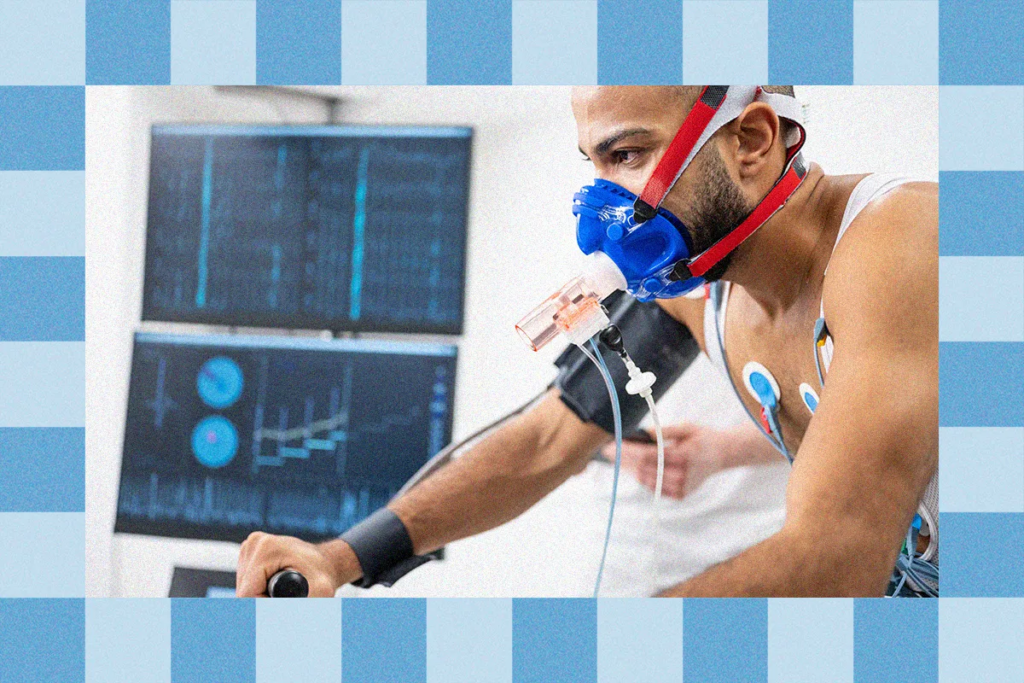
The most accurate way to measure VO2 max is in a performance lab. In a clinical setting, the test is supervised and designed to push you to maximal effort. You wear a heart rate monitor and a mask that analyzes the oxygen you inhale and the carbon dioxide you exhale while working out, usually on a treadmill or stationary bike. After a brief warm-up, the speed and incline (or resistance if a bike) increase in stages until you can no longer continue.
“Most people prefer the treadmill because it’s usually easier to push yourself to the max,” says Lindholm. Running engages more muscle groups than cycling, which can produce slightly higher VO2 max values. For athletes, protocols are often sport-specific: rowers, for example, may use indoor rowing ergometers, while cross-country skiers often test on rollerski treadmills.
As the test progresses, each breath is analyzed to calculate oxygen consumption (VO2) and carbon dioxide output (VCO2). When oxygen consumption plateaus despite increasing effort, you’ve hit your VO2 max. In practice, that moment feels unmistakable: breathing becomes rapid, your legs burn, and speaking more than a word or two feels nearly impossible. Labs often use additional criteria, like heart rate approaching its predicted maximum or a high respiratory exchange ratio, to confirm the result.
Lab testing isn’t always accessible, though. Out-of-pocket costs typically range from a couple hundred dollars to $400 or more, depending on the facility and whether additional metrics are included. Some university labs, community clinics, and research studies offer lower-cost or free testing in the name of science.
Measuring Outside the Lab
If lab testing isn’t a realistic option, validated field tests can still provide useful estimates:
- Rockport One-Mile Walk Test: Walk one mile on flat ground as fast as possible without running, record your finishing heart rate, and use an online calculator to estimate VO2 max. You can compare your results against age- and sex-based charts.
- Cooper 12-Minute Run Test: Measure the distance you can cover in 12 minutes, then plug it into a standardized formula that can also be compared against norms. This test won’t give you a precise number, but it’s usually sufficient for ranking cardiovascular fitness as excellent, good, average, fair, or poor.
Wearables, such as Garmin and Whoop, also estimate VO2 max using heart rate data, movement patterns, and demographic information. It’s important to note that this is an estimate, so the measurement itself might be a little inaccurate. But per individual, the variables stay fairly consistent, making the measurement useful for obtaining a baseline and tracking over time.
“My Oura ring probably doesn’t give me an accurate VO2 max compared to lab-based tests, but as a way of tracking my own progress—say I start a new workout regimen or want to counteract age-related changes—it does a pretty good job,“ says Gardner. “For most people, there’s real value there, and if you reach a point where you need advanced testing, it’s available.”
The Limits of VO2 Max Testing
Reaching your true VO2 max is more difficult than most people realize. “It’s not always easy for someone who’s not an athlete to reach their max,” says Lindholm. In research settings, scientists often report VO2 peak instead, which is the highest value recorded during a submaximal exercise test.
“There are a lot of different criteria you have to meet for it to be considered your actual VO2 max,” Lindholm says, referring to markers like a plateau in oxygen consumption despite increasing workload, near-maximal heart rate, and extreme perceived exertion. Without those indicators, the number may say more about how hard someone was willing to push than about their physiological ceiling.
Test administration matters too. “It depends on who’s giving the test and in what context,” says Lindholm. A skilled technician who knows how (and when) to push someone safely can elicit a higher effort than a self-guided test or a minimally supervised protocol. During my VO2 max assessment, the technician attempted small talk, asking (among other things) whether I use ChatGPT to write stories. Not exactly ideal when you’re trying to measure how hard I can fight for my life.
Day-to-day variables can also affect results. Sleep, nutrition, hydration, recovery, and even equipment can influence how well someone performs on test day. “The thing about endurance sports is that what you put in is what you get out,” says McQuality. In lab testing, his team found that carbon-plated running shoes slightly improve VO2-related performance by increasing efficiency, allowing runners to sustain higher workloads before fatigue sets in.
Taken together, these factors help explain why VO2 max is best viewed as a context-dependent snapshot, not a fixed measure of physical fitness. It’s most useful when tracked over time, under similar conditions, and alongside other markers of performance and health.
How Can I Improve My VO2 Max?
- Do aerobic exercise. Activities that elevate heart rate and breathing—running, cycling, rowing—are the most direct way to increase VO2 max. “For people who may start with a really low exercise tolerance, walking can be an activity to increase VO2 max,” says Gardner.
- Add intensity and variety. As your aerobic fitness improves, you’ll need harder efforts to keep adapting. Interval training, including HIIT, is especially effective at pushing oxygen uptake toward its upper limit.
- Lose weight (if appropriate). Because VO2 max is calculated per kilogram of body weight, weight loss can increase your VO2 max, even if absolute aerobic capacity stays the same.
Meet the Experts
LargeChevron
- Elizabeth Gardner, MD, is an associate professor of orthopedic surgery at Yale University School of Medicine and the head team physician at Yale Athletics.
- Malene Lindholm, PhD, is a senior research engineer at Stanford Division of Cardiovascular Medicine and director of the Human Molecular Athlete Moonshot for the Wu Tsai Human Performance Alliance.
- James Tyler McQuality is an associate director of the Center for Sports Innovation at Illinois Tech University. He’s also the head coach for the university’s cross-country and track and field teams.
Power up with unlimited access to WIRED. Get best-in-class reporting and exclusive subscriber content that’s too important to ignore. Subscribe Today.
The post What Is VO2 Max? Here’s What You Need to Know About the Longevity Metric (2026) appeared first on Wired.