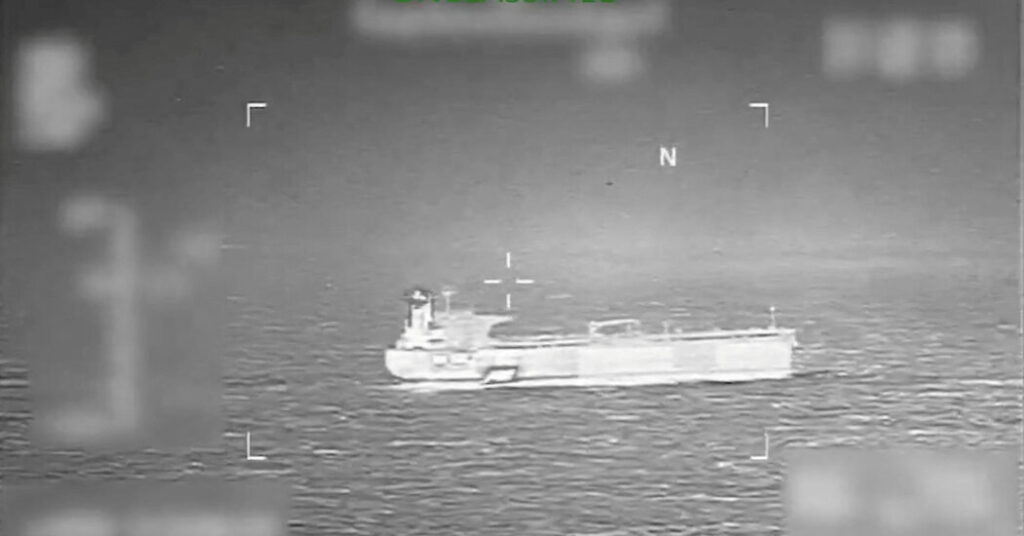
The U.S. Coast Guard said on Thursday that it had taken control of a tanker that was operating in defiance of the Trump administration’s partial blockade on sanctioned vessels transporting oil from Venezuela, the sixth ship intercepted since December.
The tanker, originally called the Veronica, was “boarded and seized” in the Caribbean Sea, according to a social media post from the Coast Guard. The post included a video of armed U.S. forces sliding down ropes onto the tanker’s deck from a helicopter.
U.S. authorities obtained a warrant to seize the vessel based on its history carrying Iranian oil, which prosecutors maintained was sold to finance terrorism, according to an American official briefed on the seizure and granted anonymity to discuss a sensitive operation.
The Veronica had officially registered as a Russian-flagged vessel last week and had been renamed the Galileo, possibly in an effort to avoid being seized by the United States. The ship also had recently claimed to be registered in Guyana, raising questions about whether it was operating under a valid flag, according to the official. The impounding of the ship could raise tensions with Russia.
The Trump administration has sought to take control of Venezuela’s oil industry since the U.S. military captured its leader, Nicolás Maduro, and brought him to the United States to face criminal charges.
The U.S. government has started to broker the sale of as many as 50 million barrels of Venezuelan oil under an agreement with Venezuela’s interim government. Officials say selling the crude will prevent Venezuela’s oil industry from collapsing and stabilize its government and economy.
The Veronica was among the vessels that left Venezuelan waters en masse after Mr. Maduro’s capture on Jan. 3. The ship was not carrying oil at the time, according to data from TankerTrackers.com and Kpler, two companies that track global oil shipments.
The United States sanctioned the ship in 2022 after Russia’s full-scale invasion of Ukraine, and it had previously transported Iranian oil on at least 15 voyages, according to the same companies. Ukraine sanctioned the vessel as well.
That same year, the tanker, then sailing under the name Lana, was detained by Greek authorities while carrying Iranian oil after officials linked it to a Russian entity under European Union sanctions. Although its ownership was later found to have shifted to a different company, Greece held the vessel for more than two months while the United States tried to seize its cargo, prompting Iran to seize two Greek tankers in retaliation.
In an effort to pressure Mr. Maduro, U.S. forces began seizing oil tankers in the Caribbean in December, including one ship that eluded the Coast Guard and sailed far into the North Atlantic before being captured. It unsuccessfully claimed Russian protection.
American officials have said they plan to keep commandeering tankers that operate without U.S. permission. The ships are part of a so-called ghost fleet that transport oil from Venezuela, Russia or Iran despite sanctions from the United States and other countries.
“As we’ve now demonstrated through multiple boardings, there is no outrunning or escaping American justice — period,” Homeland Security Secretary Kristi Noem said on social media on Thursday.
Ms. Noem said the pre-dawn operation had been carried out by Coast Guard “tactical teams.” That term could refer to one of two Coast Guard units: the Maritime Security Response Teams, or MSRT, or the Tactical Law Enforcement Teams, or TACLET. Both receive training in what the service calls “high-speed tactics” for boarding noncompliant ships.
U.S. Southern Command, which controls military operations in Latin America and the Caribbean, said in a social media post that Marines and sailors from the aircraft carrier U.S.S. Gerald R. Ford had also participated in the mission.
Note: The International Maritime Organization issues an IMO number, a permanent identification number, that remains associated with a vessel throughout its lifetime unlike a ship’s name, which can change frequently. The ship in this article is the Galileo (9256860, previously known as Pegas, Lana and Veronica).
Christiaan Triebert is a Times reporter working on the Visual Investigations team, a group that combines traditional reporting with digital sleuthing and analysis of visual evidence to verify and source facts from around the world.
The post U.S. Forces Seize Sixth Oil Tanker Linked to Venezuela appeared first on New York Times.