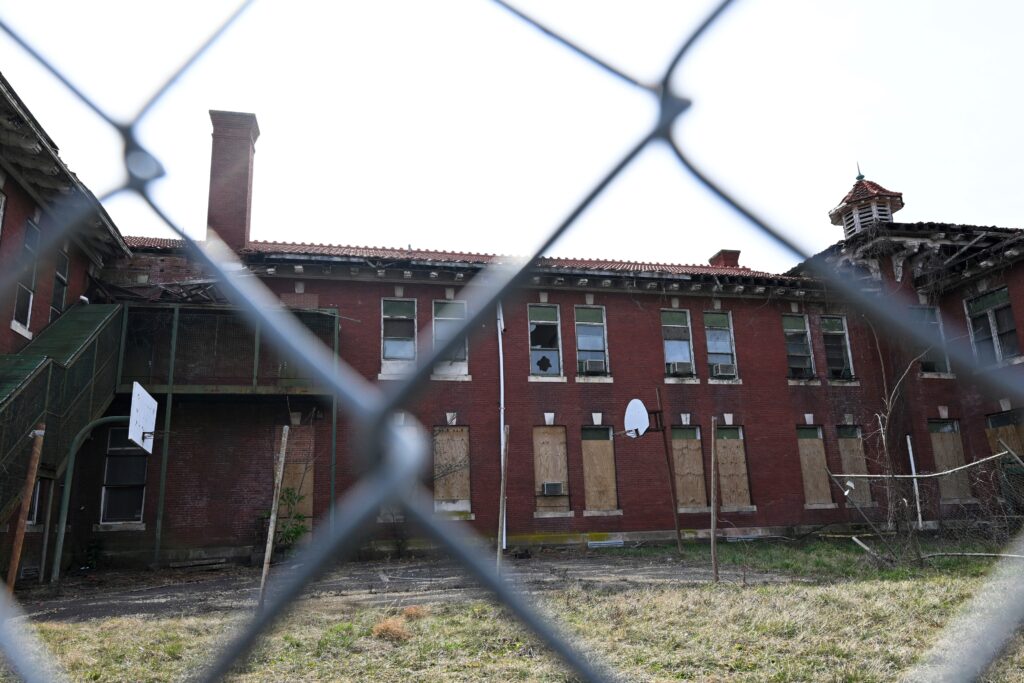
Most of the historic buildings that the Department of Homeland Security is seeking to demolish in Southeast Washington were recently assessed as viable for renovation and reuse, according to documents obtained by The Washington Post.
Homeland Security officials, citing emergency conditions, asserted last month that more than a dozen buildings on the landmark campus of St. Elizabeths should be torn down expeditiously to keep “malicious insiders” from using the sites to store weapons or stage attacks on agency leaders who are headquartered nearby.
Homeland Security officials referenced the dilapidated condition of the structures, writing in a security assessment report that “the age and deteriorating state of these buildings increase the likelihood of catastrophic collapse, endangering personnel.”
“Several vacant structures within the campus perimeter are in such deteriorated condition that they cannot be safely accessed or cleared by law enforcement or emergency responders,” DHS Secretary Kristi L. Noem wrote in a Dec. 19 memo requesting the emergency demolition.
The buildings, all at least a century old, are on St. Elizabeths’ highly fortified West Campus and have been vacant for years. A team of engineers, inspecting the 13 buildings in August for the U.S. General Services Administration, concluded that they “are generally in stable condition,” according to the documents reviewed by The Post.
The targeted sites include a former kitchen and bakery constructed in 1878 and 1883, six hospital wards erected in the 1890s where people with epilepsy and other patients were treated, and Burroughs Cottage, built in 1891 by a wealthy family for a daughter and her nursing staff.
“What looks alarming in photos represents localized repairable conditions rather than systemic structural failure,” according to a report by AECOM, a global infrastructure company that GSA hired to assess the buildings. “The core buildings remain viable for stabilization and future adaptive reuse.”
Marianne Copenhaver, a GSA spokesperson, said AECOM’s assessments “fail to capture the security-driven rationale for demolition” on the campus, which Homeland Security has been turning into its headquarters over the past 15 years.
The agency determined that the buildings “pose a significant and unacceptable risk to life and safety” on a campus that maintains the “the highest security level for a government facility,” Copenhaver said. Citing those concerns, Copenhaver, in a statement last month after The Post first reported the demolition plans, said: “It is simply a fact that we’ve seen an increase in violent attacks against DHS law enforcement personnel since the beginning of this Administration.”
Rebecca Miller, executive director of the D.C. Preservation League, which opposes the demolition, said Homeland Security has not raised potential security threats as a rationale for demolishing buildings during meetings about the campus over the years. “If these buildings were such a threat, that should have been brought up,” she said.
Invoking an emergency to expedite demolition allows federal officials to bypass review procedures and “sets a bad precedent,” Miller said. “The precedent could be devastating for sites across the country. If an agency can declare an emergency to tear down buildings, then it could happen anywhere.”
In its response to The Post’s initial story, GSA released an engineering assessment for one of the buildings, the one in the worst condition. GSA also sent photos and a video from inside that building. The agency did not respond to a request for the findings that resulted from assessments of a dozen other buildings.
Preservationists have contested President Donald Trump’s plan to demolish the East Wing and build a 90,000-square-foot ballroom. The White House presentedTrump’s $400 million vision for the ballroom to the National Capital Planning Commission last week after the demolition had taken place and a preservation group filed a lawsuit seeking to block the construction.
Originally known as the Government Hospital for the Insane, St. Elizabeths was established by Congress in the mid-19th century and was the country’s first federal care facility for people with psychiatric disorders. The campus was added to the National Register of Historic Places in 1979. Eleven years later, the federal government listed the campus as a National Historic Landmark. The ensemble of 19th-century and early 20th-century buildings contribute to that designation.
After GSA decided Homeland Security would move to the West Campus in the early 2000s, federal planners, in consultation with preservationists, reviewed and agreed to plans for new construction and the rehabilitation of more than 50 vacant buildings.
That master plan was amended in 2020, after a review by NCPC and the Commission of Fine Arts, allowing GSA to demolish four historic buildings on the campus.
Noem, by invoking an emergency in December, is seeking to tear down an additional 13 buildings without contending with a typically laborious review process.
But agency officials are required to allow preservationists, along with D.C.’s State Office of Historic Preservation, time to respond to an emergency call for demolition.
The National Trust for Historic Preservation and the D.C. Preservation League expressed opposition to the plan in a joint Dec. 31 letter to GSA and asked to be included in an on-site meeting to “assess the conditions of the structures” before work proceeds.
The groups had not received a response as of Wednesday, Miller said.
A spokesperson for D.C.’s State Historic Preservation officer, David Maloney, declined to comment.
GSA has not released a demolition schedule for the buildings. Homeland Security has also not indicated what it plans to do with the land the buildings occupy on the 176-acre campus just off Martin Luther King Avenue SE.
GSA hired AECOM to assess the condition of 29 historic buildings on the campus, including those that Homeland Security has slated for demolition. AECOM enlisted the engineering firm of Wiss, Janney, Elstner Associates, which surveyed the same buildings in 2010 and 2014.
WJE inspected the 13 buildings in August and found that a preponderance of the structures could be rehabilitated despite disrepair that included holes in roofs that allow in water and festering moisture.
The condition of the building in the worst shape — a three-story structure put up in 1861 and known as East Lodge — was classified as “severe” with a risk level of “critical,” a rating that indicates it is in “imminent danger of collapse” unless immediate repairs were made.
“Significant water infiltration at the openings in the roof have caused extensive damage to floors and floor framing,” WJE wrote. “Multiple areas are unstable and will continue to deteriorate if action is not taken.”
The surveyors also assessed the conditions of three more of the buildings’ structures as “severe.” But WJE defined risks at those sites as “high” — a ranking less urgent than “critical” — reporting that repairs are needed to stem worsening “significant structural issues or safety hazards.”
Nine other structures on DHS’s raze list have structural defects that the assessors classified as “minor” or “moderate.” One of those, for example, was a building known as Holly, a three-story structure built in 1893. “No significant structural building elements are showing signs of significant distress,” WJE wrote.
Robin Plous, a WJE spokesperson, declined to comment on DHS’s planned demolition.
AECOM did not respond to an emailed request for comment. Copenhaver, the GSA spokesperson, did not respond to two emails asking how much the federal government paid AECOM for its assessment. The company has a five-year, multimillion-dollar federal contract for work on the West Campus, records on HigherGov.com show.
In addition to the security risks associated with the vacant buildings, Copenhaver said in her statement, the sites are “functionally obsolete and wholly unnecessary.”
“There is no current or forseeable demand for their use,” she said. “Proceeding with demolition would avoid continued waste and is projected to save taxpayers tens of millions of dollars.”
Over the years, GSA has rehabilitated vacant and dilapidated buildings on the campus, including, most prominently, what is known as the Center Building, which now houses DHS executive offices.
AECOM, in its report, compiled estimates indicating that the price of renovating the existing structures is millions more than demolishing them and erecting new buildings.
In the case of the East Lodge, for example, rehabilitation would cost $23 million, as opposed to $17 million to demolish and build a new structure, according to AECOM’s report.
Asked about the expense of rehabilitating the properties, Miller said in a text, “You can’t put a price on the loss of cultural heritage.”
“The government’s years of neglect of the buildings have resulted in a higher price tag to rehab them,” she said.
The post The historic D.C. buildings Homeland Security wants to raze were deemed stable appeared first on Washington Post.