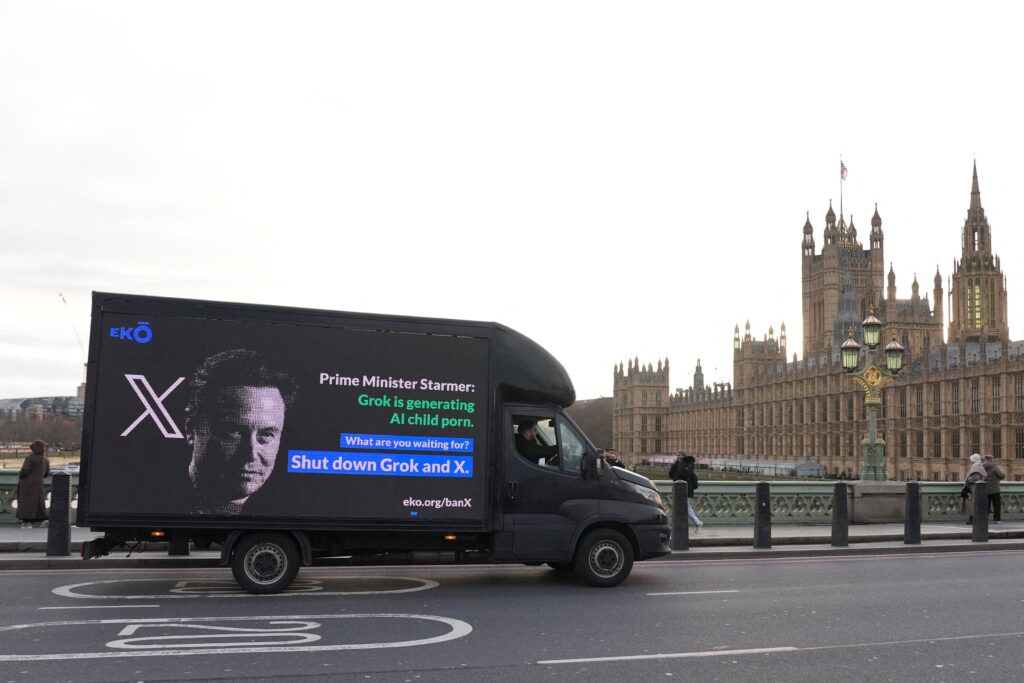
LONDON — After X announced that it had disabled, in some locations, a controversial Grok tool that allows users to digitally undress photos of real people, the tool remains functional on the stand-alone Grok app.
After outrage from governments and regulators around the world, Elon Musk’s social media platform said late Wednesday that it had stopped Grok from generating sexualized images of people without their consent “in those jurisdictions where it’s illegal.” The limitations only appear to apply to the Grok bot used from within the X app, however, and not in its separate eponymous app. It was also unclear Thursday where the tool had been disabled.
Last week, after the initial uproar, X said it would restrict the image generation tool to paying subscribers, prompting critics to accuse the company of profiting from the problem rather than solving it.
On Wednesday X said it had “implemented technological measures to prevent the Grok account from allowing the editing of images of real people in revealing clothing such as bikinis. This restriction applies to all users, including paid subscribers.”
On Thursday, Grok, via the Grok app, was still undressing photos of a Washington Post journalist when requested.
The British government, one of the most vocal critics of the AI tool, called the adjustment a “vindication” but said a probe by its communications regulator would continue.
X’s announcement late Wednesday came shortly after the California attorney general said the state would investigate the “shocking” reports of nonconsensual sexualized material generated by the AI model. Musk defended the product in an X post Wednesday, saying it only generates images “according to user requests.”
“When asked to generate images, it will refuse to produce anything illegal, as the operating principle for Grok is to obey the laws of any given country or state,” he said. “There may be times when adversarial hacking of Grok prompts does something unexpected. If that happens, we fix the bug immediately.”
Musk later said that in the United States, when users have an explicit-content setting enabled, Grok would allow for “upper body nudity of imaginary adult humans (not real ones).” The image would be consistent, he said, with what could be observed in an R-rated movie. On Thursday, the Grok app would still generate undressed images of real people.
“That is the de facto standard in America,” he said. “This will vary in other regions according to the laws on a country by country basis.”
Attorneys who work with victims of sexual cybercrime say that publishing nonconsensual sexual images would be unlawful under the federal Take It Down Act as well as multiple state laws
Several countries and regions have called for action or taken steps to respond, including Malaysia, India, Indonesia, France, Canada and the European Union.
This week in the United Kingdom, the communications regulator Ofcom announced it was launching a formal investigation into X following reports that Grok was being used to create and share “undressed images of people — which may amount to intimate image abuse or pornography — and sexualised images of children that may amount to child sexual abuse material.”
If Ofcom finds that the platform has broken the law, it can impose hefty fines — up to 10 percent of worldwide revenue or 18 million pounds ($24 million), whichever is greater. Musk, in his post defending the product, said he was “not aware of any naked underage images generated by Grok.”
Liz Kendall, Britain’s technology secretary, told Parliament this week that legislation passed last summer making it illegal to create nonconsensual intimate images in England and Wales would come into force “this week.”
An Ofcom spokesman said Thursday that while the agency “welcomed” X’s announcement, it would continue its investigation “round-the-clock to progress this and get answers into what went wrong and what’s being done to fix it.”
clarificationAfter this article was published, it and its headline were revised to make clear that while X said Wednesday that Grok would be limited in some jurisdictions from generating sexualized images of real people, that ability has not been restricted in the U.S. for those who use the Grok app directly rather than through X.
The post Standalone Grok app still undresses women after X curtails access to tool appeared first on Washington Post.