The little boy was excited to be taking off on a trip.
He had been on a train all Wednesday morning, heading east from the Bangkok suburbs. He had been looking at the scenery through the window and laid his head on the tray table to nap. Then there was a loud boom.
Saitee Katpia, his grandmother, was sitting next to him at a window seat. She said that she lost consciousness briefly.
When she came to, she said that it felt like the train car was being crushed. Her head was bleeding. The boy, 6, was on the floor and squeezed in by a chair.
“He kept saying ‘my leg hurts, my leg hurts,’” Ms. Saitee said.
Somehow, she mustered the strength to pull him out and guided him out the train car, which had derailed and had a split carved into it. On her way to safety, she heard a man cry out for help.
“I could not help him,” she said from a hospital bed on Thursday, with at least 10 stitches on her face. “He was a big guy and — me, myself — I had blood dripping on my face.”
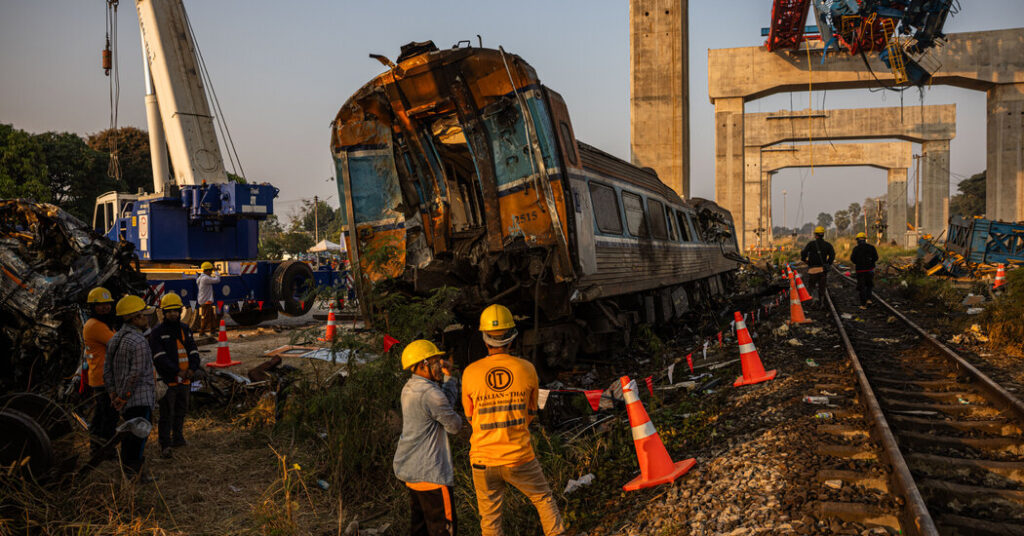
A crane had fallen on the passenger train in northeastern Nakhon Ratchasima Province on Wednesday. At least 32 people were killed and dozens of others were injured.
About 24 hours later on Thursday, another crane collapsed, this time on an expressway in Samut Sakhon Province on the southwestern outskirts of Bangkok, killing at least two people.
The episodes have raised urgent questions about construction safety in Thailand.
Both sites had the same contractor, a firm called Italian-Thai Development. It had already come under scrutiny after the collapse of a building in Bangkok last year that resulted in more than 90 deaths.
The firm said that it would take “full responsibility” for the train accident on Wednesday and “provide full compensation and medical care” to the families of the victims and the injured. It also said it would support the local authorities.
Its representatives were not reachable on Thursday.
In the wake of the tragedy on Wednesday, Prime Minister Anutin Charnvirakul called for a law to permanently blacklist companies with repeated fatal accidents from bidding on any government projects. One of his deputies, Phipat Ratchakitprakarn, said the government was moving to halt all aboveground construction.
Special Express Train No. 21, a three-car train, was carrying about 200 people between Bangkok and the eastern city of Ubon Ratchathani on Wednesday. On parts of the route, an elevated high-speed railway is being constructed, with funding from Beijing. China envisions the line connecting it with Southeast Asia.
The Thai authorities said that construction operations should not have been running while the passenger train was passing through the area. They said the crane fell on two cars, causing the train to derail and catch fire.
Not all of the victims have been identified yet.
Surachart Uintarakari said that his sister and brother-in-law, who were sitting next to each other, were among them. Rescuers found a necklace that their children identified as belonging to their mother, but DNA testing is yet to be completed, he said.
“The bodies are totally burned,” he added.
A little after 9 a.m. Wednesday, the train was about halfway through its voyage, passing by Thanon Kot Village.
There, Penporn Pumjantuek was working at her family’s food stall — whipping up an order of Thai basil stir fry served with steamed rice and a fried egg — when she heard a loud crash and metal screeching.
From the stall, she saw a mangled passenger train car.
Ms. Penporn said she helped about 20 passengers come out through a split in the car.
A resident, Somjai Duangchang, reached another car that had derailed.
“I broke the glass. The first thing I saw was dead passengers,” Mr. Somjai said. “Chairs squeezed the passengers and people were stuck, squished between chairs.”
He said he pushed chairs to free a woman and her baby, eventually helping about a handful of people out of the car.
But in a few minutes, a fire erupted.
“I saw some people were still alive but we couldn’t help them,” Ms. Penporn said, adding that they were stuck under pieces of metal.
Ms. Saitee, the grandmother, initially thought the train had crashed. It was only when she squeezed out of the car and was outside did she realize that a crane had fallen.
Her grandson, she said, suffered shattered bones in his legs and was being treated at a hospital.
Suchatvee Suwansawat, a former president of the Council of Engineers Thailand, said that the machinery that had collapsed was a launching crane that is used to position girders. He thought the cause was human error, while also questioning the quality of the crane.
The deadly accidents on Wednesday and Thursday were among thousands across Thailand that have killed hundreds of people. The country ranks 13th globally in occupational fatalities, recording 5.3 fatalities per 100,000 workers, according to the International Labor Organization, citing the most recently reported data from 2020.
There is no independent central body, like the National Transportation Safety Board in the United States, to investigate accidents transparently. So once an accident moves out of the news cycle, the government and the construction companies rarely make any of these findings public. Researchers have found that companies often pay “grease money” to inspectors to overlook safety violations or to fast-track permits without proper engineering audits.
Surachet Pravinvongvuth, an opposition politician in Parliament, has been an outspoken proponent of Thailand’s need for workplace safety reform.
“There must be due process to pin a charge on those big construction companies, but it won’t be easy,” he said.
Mr. Surachart, who is waiting for DNA testing results for the victims, questioned whether contractors adhered to any safety standards. He added of contractors, “Accidents happen repeatedly but they keep getting hired.”
Sui-Lee Wee and Kittiphum Sringammuang contributed reporting from Bangkok.
Muktita Suhartono reports on Thailand and Indonesia. She is based in Bangkok.
The post ‘Squished Between Chairs’ on a Train: How Some Passengers Survived a Crane Collapse appeared first on New York Times.