I want you to remember the name Mark Peters.
In 2009 he was on patrol in Afghanistan when he stepped on an improvised explosive device. The incident was captured on video and can be seen in a 2014 documentary series called “My War.”
The footage is horrifying. You can see the explosion, then you hear shouts of anguish and desperate calls for mine clearance so that medics can reach the wounded soldier.
When the camera reaches Peters, you can see that he’s very seriously wounded. His legs have been virtually destroyed by the explosion. His comrades quickly carry him to safety while Peters talks about his family, reciting their names in an effort to stay conscious.
You see the medevac helicopter arrive and then you watch Peters’s brothers-in-arms share their anguish and concern as they wait for word from the hospital. The news, it turned out, was good, but not entirely good. While Peters would live, his legs were ruined. Like so many soldiers, he left part of himself on the battlefield.
Mark Peters is Danish. He lost his lower legs fighting in defense of the United States. I learned about him when I read this moving account of Danish deployments by Todd Johnson, writing for War Room, a journal of the Army War College.
Denmark answered the call after the 9/11 attacks. It deployed thousands of soldiers to Afghanistan and Iraq, and it lost more soldiers, per capita, in Afghanistan than any NATO nation aside from the United States.
There is no more profound way to stand in solidarity with an ally.
“America has no permanent friends or enemies,” Henry Kissinger is often quoted as saying, “only interests.” That statement, championed by proponents of realpolitik, is true only if you emphasize the word “permanent.” Over the long sweep of time, allies can certainly become enemies, and enemies can become allies.
Consider France and England. They fought each other in a series of wars sweeping across hundreds of years. But they’ve been friends and allies for more than a century, fighting together most notably in World War I and World War II. Despite tensions, they stood watch together as NATO allies, defending Europe and the free world for the entire duration of the Cold War.
I don’t know if they are permanent friends, but they are friends — to the incalculable benefit of both nations.
The better expression, the one that accurately reflects the national interests of the United States, is that while any given friendship isn’t permanently guaranteed, our country has a permanent interest in maintaining international friendships and alliances. When we lose partners in alliances (much less the alliance itself) we are weaker and more vulnerable — no matter how much we try to bulk up our independent military and economic strength.
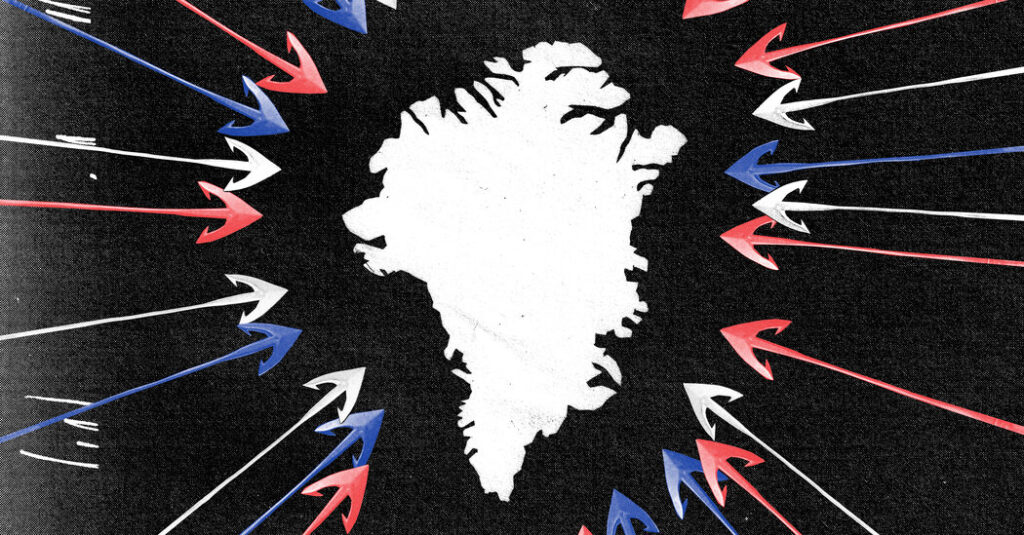
I am writing about all this because the Trump administration may be on the verge of the most catastrophic national security mistake of my lifetime. It is attempting to bully Denmark into surrendering Greenland, its semiautonomous territory, to the United States.
We’re offering to buy it, but the offer is being made at gunpoint.
On Jan. 6, for example, Karoline Leavitt, the White House press secretary, issued a statement to CNN that declared, “Acquiring Greenland is a national security priority of the United States,” and “The president and his team are discussing a range of options to pursue this important foreign policy goal, and of course, utilizing the U.S. military is always an option at the commander in chief’s disposal.”
On Jan. 9, President Trump said that if America can’t acquire Greenland “the easy way” then it would resort to the “hard way.”
“We are going to do something in Greenland, whether they like it or not,” Trump said, “because if we don’t do it, Russia or China will take over Greenland, and we’re not going to have Russia or China as a neighbor.”
On Wednesday, the foreign ministers of Denmark and Greenland met with Vice President JD Vance and Secretary of State Marco Rubio for a “frank” and “constructive” exchange that appears to have solved nothing. The United States still wants Greenland, and Denmark and Greenland refuse to capitulate.
The countries agreed to form a working group that’s designed to address America’s security concerns while preserving Danish sovereignty. At the same time, as our newsroom reported, the American delegation “did not apologize or back down from Mr. Trump’s threats.”
Trump, for his part, said Wednesday, “We need Greenland for national security. If we don’t go in, Russia is going to go in and China is going to go in. And there’s not a thing that Denmark can do about it. But we can do everything about it.”
One would be tempted to simply make a moral argument against bullying (and possibly even attacking!) Denmark. Danes are such stalwart allies that they long ago granted America sweeping access to Greenland to bolster our own defense.
As The Times explained last week, a 1951 agreement grants the United States the ability to “construct, install, maintain and operate” military bases across Greenland, “house personnel” and “control landings, takeoffs, anchorages, moorings, movements and operation of ships, aircraft and waterborne craft.”
Denmark resisted Nazi occupation in World War II. It’s a founding member of NATO, and it followed through on that commitment, as noted above, fighting by our side in Afghanistan. It even fought in Iraq, a non-NATO military mission. More recently the Danish Navy deployed a frigate to the Red Sea, where it fought alongside the U.S. Navy against Houthi rebels.
Bullying Denmark to seize Greenland would be the equivalent of threatening a friend to steal his car after he already let you borrow it. The friendly gesture is nice and all, but isn’t it better if the car is yours? Aren’t you wealthier if you can add it to your collection?
.op-aside { display: none; border-top: 1px solid var(–color-stroke-tertiary,#C7C7C7); border-bottom: 1px solid var(–color-stroke-tertiary,#C7C7C7); font-family: nyt-franklin, helvetica, sans-serif; flex-direction: row; justify-content: space-between; padding-top: 1.25rem; padding-bottom: 1.25rem; position: relative; max-width: 600px; margin: 2rem 20px; }
.op-aside p { margin: 0; font-family: nyt-franklin, helvetica, sans-serif; font-size: 1rem; line-height: 1.3rem; margin-top: 0.4rem; margin-right: 2rem; font-weight: 600; flex-grow: 1; }
.SHA_opinionPrompt_0325_1_Prompt .op-aside { display: flex; }
@media (min-width: 640px) { .op-aside { margin: 2rem auto; } }
.op-buttonWrap { visibility: hidden; display: flex; right: 42px; position: absolute; background: var(–color-background-inverseSecondary, hsla(0,0%,21.18%,1)); border-radius: 3px; height: 25px; padding: 0 10px; align-items: center; justify-content: center; top: calc((100% – 25px) / 2); }
.op-copiedText { font-size: 0.75rem; line-height: 0.75rem; color: var(–color-content-inversePrimary, #fff); white-space: pre; margin-top: 1px; }
.op-button { display: flex; border: 1px solid var(–color-stroke-tertiary, #C7C7C7); height: 2rem; width: 2rem; background: transparent; border-radius: 50%; cursor: pointer; margin: auto; padding-inline: 6px; flex-direction: column; justify-content: center; flex-shrink: 0; }
.op-button:hover { background-color: var(–color-background-tertiary, #EBEBEB); }
.op-button path { fill: var(–color-content-primary,#121212); }
Know someone who would want to read this? Share the column.
In the mercenary calculus of Donald Trump, morality is meaningless — unless it’s his morality, of course, and his morality places no constraints on his will to power and his greed.
And so it’s also necessary to oppose seizing Greenland using the words that MAGA will understand. Bullying Denmark will make the United States weaker and perhaps even poorer. It’s not just wrong to turn on our friends; it’s stupid, and that stupidity is spreading across the length and breadth of American foreign policy.
The best description I’ve read of Trump’s flawed approach comes from Kori Schake, a senior fellow and director of foreign and defense policy studies at the American Enterprise Institute. Writing in Foreign Affairs last June, she noted that “since the end of World War II, American power has been rooted mostly in cooperation, not coercion.”
“The Trump team,” she argued, “ignores that history, takes for granted all the benefits that a cooperative approach has yielded, and cannot envision a future in which other countries opt out of the existing U.S.-led international order or construct a new one that would be antagonistic to American interests.”
The history is indeed quite clear. When NATO and the Warsaw Pact faced off against each other during the Cold War, it was a confrontation between an alliance and an empire.
The alliance was a voluntary union of liberal democracies. There was nothing voluntary about the Soviet empire. Soviet troops in Warsaw Pact nations existed not just to confront the West, but also to enforce Soviet control.
Just ask the people of Hungary in 1956. Or the people of Czechoslovakia in 1968. Soviet troops crushed burgeoning democratic movements in both countries. Soviet authorities also supported Poland’s imposition of martial law in 1981, a move designed to crush Lech Walesa’s Solidarity.
But that’s the way it works with empires. They’re almost always weaker than they appear because much of their strength is diverted into domination, into maintaining a hold over people who dislike or actually reject their rule.
Although he would never put it this way, Trump favors the failed Soviet approach. The Western Hemisphere is his version of the Warsaw Pact. He wants to transform it into a region that exists under American domination, where nations conduct their foreign and even domestic policies under a watchful American eye, always mindful of the awesome power of American arms.
Our historic allies, meanwhile, are treated like actual or potential enemies. Denmark is facing overt American threats, but the administration’s ominous language extends well beyond Denmark.
In an interview last year with the news outlet UnHerd, Vice President Vance raised the possibility of Britain and France becoming enemies to the United States. “France and the U.K. have nuclear weapons,” he said. “If they allow themselves to be overwhelmed with very destructive moral ideas, then you allow nuclear weapons to fall in the hands of people who can actually cause very, very serious harm to the U.S.”
Physician, heal thyself. The United States is the most powerful nuclear-armed nation in the world, and it is already being “overwhelmed with very destructive moral ideas” — and one of those ideas is threatening to use that awesome might to extort (or attack) an ally.
What’s more, empires are expensive — more expensive than the United States can afford. Last week, Trump proposed a remarkable surge in military spending, to $1.5 trillion annually, an almost $600 billion increase over 2026. The Committee for a Responsible Federal Budget has calculated that Trump’s proposal could add $5.8 trillion to the national debt over the next decade.
When you read the administration’s National Security Strategy — or simply observe the administration’s actions in Trump’s second term — it’s easy to see why. It costs enormous sums of money to dominate North and South America, deploy the military to fight what Trump calls the “war from within,” and shore up defenses while you turn your back on your allies.
As I wrote last week, a RAND Corporation study found that the United States contributes 39 percent of the total, collective allied defense burden across the globe. If you separate yourself from allies, there is less military force available for defense, and you either have to be comfortable with the additional vulnerability or find the funds to shore up the weakness.
On Tuesday, the prime minister of Greenland, Jens-Frederik Nielsen, issued a clear and unequivocal statement rejecting the American bid to own his island. “We are now facing a geopolitical crisis,” Nielsen said. “And if we have to choose between the United States and Denmark here and now, we choose Denmark. We choose NATO. We choose the Kingdom of Denmark. We choose the E.U.”
And what was Trump’s response? “I disagree with him,” he said, “I don’t know who he is. Don’t know anything about him. But that’s going to be a big problem for him.”
Thankfully, the Mark Peters story didn’t end in Afghanistan. He recovered as well as he could from his catastrophic injuries. He learned to play wheelchair rugby, and in 2015 he joined the Danish wheelchair rugby team that made its Paralympic debut at the Tokyo Games in 2021.
There are other Danes we should remember — the soldiers who did not come home alive — men and women like Kenneth Patrick Nielsen and Martin Kristiansen and Sophia Bruun. They are three of the more than 40 Danes who died in combat in Afghanistan.
Even as an American president turns his back on their nation and their sacrifice, I hope that their families can find some solace in the notion that an overwhelming majority of Americans reject any effort to buy or seize Greenland. Only 17 percent support acquiring Greenland, and a mere 4 percent support taking it by force.
But those numbers will be cold comfort if Trump acts anyway.
It is often said that might does not make right; it is less well understood that right can make might, as Abraham Lincoln once said. Voluntary alliances of liberal democracies have proven to be the strongest military and economic forces in the world. This was true in World War I. It was true in World War II. And it was true in the Cold War.
If we break those alliances, we are smaller and weaker. If we break them for pride and power and greed, then we don’t just break an alliance, we break our own character. We diminish ourselves in every way that matters, and no amount of newly sovereign frozen ground can obscure our national shame.
Some other things I did
My Sunday column was about the Trump administration’s shameful, baseless slander of Renee Good and the way in which a reckless and unjust federal government strains the American system:
In many ways, the Trump administration is reversing the injustice of the civil rights era. Then, it was the states who violated the Constitution, and federal power offered a solution. Now, the federal government is trampling the Constitution, and many states are attempting to resist.
But they face a decisive disadvantage. Under our constitutional structure of government, the federal sovereign is supreme. That means federal power can offer a solution to state injustice. But there is no easy state solution for federal oppression. A president hellbent on oppression, reinforced by his pardon power — and effectively immune from conviction even if he is impeached — will be able to get his way, at least for a time.
This produces the kind of tension that can break a nation. When a government oppresses its citizens and cuts off access to justice, it places an unbearable strain on the system.
On Saturday, Times Opinion published a round table discussion with me and my colleagues Michelle Cottle and Carlos Lozada. We talked about the killing of Renee Good, Trump’s strike on Venezuela and his threats against Greenland. I was particularly concerned about the Trump administration’s dishonesty:
I think this is a situation where his bluster and lies — because they’re going to be so easily and immediately rebuttable — this is one of those rare instances where they might work against him. Because I think there’s a couple of ways to frame this incident that really can affect public opinion. Framing No. 1 is what the administration chose, which is: Domestic terrorist attempts to ram and kill officers.
Well, as soon as you watch the video, you’re like, what are you talking about? There is zero evidence from this tape that there is any effort to intentionally kill these officers. If, however, the framing was “confusing situation, officer had to make a tough call because it looked like a car was heading for him,” then people would look at that and say: “Oh, that was confusing. Where was the officer?”
It makes it much more difficult to analyze in a way that’s inflammatory. It makes it much more technical and legal. But by going with the domestic terrorist angle right away, going with gross lies right away, this could be one of those instances where the Trump administration actually does shoot itself in the foot through its own dishonesty.
Finally, last Monday, there was a round table conversation involving me and my colleagues M. Gessen and Stephen Stromberg. One question I tried to answer was whether the MAGA base would be displeased at Trump’s aggressive military action abroad. I said no, not as long as Trump is seen to win:
To test out this hypothesis, that this is not going to be an issue at all, I did a perusal very, very late last night through some of the Twitter feeds of the MAGA figures who had been most derisive in mocking toward people like me, for example — Reagan/Bush-era conservatives. I found them being very mocking and derisive but against anyone who is criticizing the operation in Venezuela.
This is not the Epstein files, and not even the Epstein files have really driven a true wedge between Trump and MAGA. They have opened some fissures, some very slight cracks, but this is not something that really hits at core convictions of some key members of the coalition. No, no, no. This is something else.
The foreign policy side of the MAGA fight hasn’t really been a grass-roots issue so much as a grass-tips or grass-tops issue, something driven by competing ideological factions within the Republican Party that don’t actually have much hold over the populist MAGA movement itself. But I do think the moment something like this goes poorly for Trump — when he isn’t seen as having accomplished something remarkable — that dynamic could change. This military operation appears to have been brilliantly executed, and that’s allowed Trump to adopt a victorious posture, which I think his base ultimately loves more than any particular ideology.
Thanks for reading. You will soon start to get my columns emailed to you too.
If you’re enjoying what you’re reading, please consider recommending it to others. They can sign up here.
Have feedback? Send me a note at [email protected].
You can also follow me on Threads (@davidfrenchjag).
The post Something Is Rotten in the State of America appeared first on New York Times.