The Pentagon on Thursday said it planned to commandeer Stars and Stripes, a government-funded newspaper that covers the military, and align it with official department messaging.
“We will modernize its operations, refocus its content away from woke distractions that syphon morale, and adapt it to serve a new generation of service members,” Sean Parnell, the chief Pentagon spokesman, wrote in a post on X.
“It will focus on warfighting, weapons systems, fitness, lethality, survivability, and ALL THINGS MILITARY. No more repurposed DC gossip columns; no more Associated Press reprints.”
The Pentagon’s intervention would be a stark departure from historical precedent at the publication, which describes itself as the “U.S. military’s independent news source.” The organization has long prized its latitude to make editorial decisions free from external interference, including from the Pentagon.
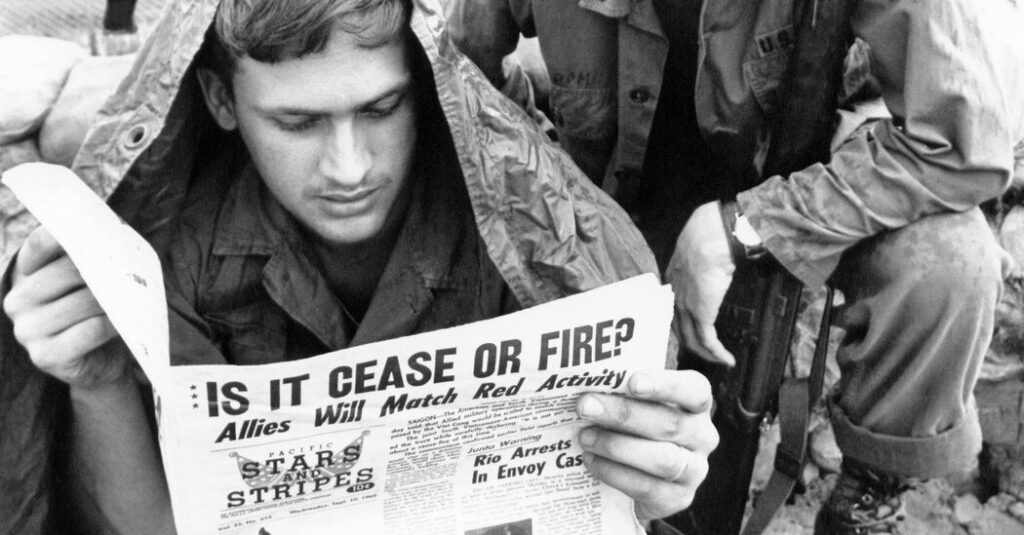
Stars and Stripes, often referred to as Stripes, has been published continuously since World War II, with daily papers for U.S. military troops overseas and up-to-the-minute news on stripes.com.
A statement on its website describes its “core values.”
“A news organization must not just cover the news but uncover it. It must follow the story wherever it leads, without allowing preconceived ideas to filter the search for facts or replace the discipline of verification.”
The Pentagon turned down a request to interview Mr. Parnell about the changes. In response to questions, a press official referred to Mr. Parnell’s statement on X.
Max D. Lederer Jr., the publisher of Stripes, said he knew nothing about the Pentagon’s directive for the publication until after Mr. Parnell’s announcement Thursday morning.
Speaking of Stripes’ tradition of operating without any meddling from the military, editor in chief Erik Slavin said, “I wouldn’t have taken this job otherwise.”
Robert Reid, a former editor in chief of Stripes, said, “You have to think small-town newspaper.”
“The mayor may object to a story, but there was no prior censorship and no direction as to what should and should not be covered.”
Mr. Reid, 78, who left the publication last year, said that Stripes saw fit to cover the panoply of controversies that have cropped up over the years in the U.S. military, including debates about the role of women, transgender people, and instances of racism and sexism.
“That might be what they described as woke,” said Mr. Reid.
The Daily Wire, a conservative outlet, reported that under the new plan, half of the material in Stripes will be generated by the Pentagon.
Such a directive “would definitely change the character and nature of what we’re presenting to the audience,” said Mr. Lederer. That said, the leadership of Stripes is working with little in the way of formal information about the future of its publication. In addition to receiving no advance notification about Thursday’s announcement, there are no meetings scheduled to discuss it all.
“I have the Daily Wire to go on right now — I’ll leave it at that,” said Mr. Slavin.
As for the Pentagon’s hostility toward “repurposed DC gossip columns,” Mr. Lederer said, “We don’t carry any gossip columns.”
Controversy engulfed the publication in President Trump’s first term, when the Pentagon tried to cut its $15.5 million in funding. Mr. Trump came to the rescue.
“The United States of America will NOT be cutting funding to @starsandstripes magazine under my watch,” Mr. Trump wrote on social media. “It will continue to be a wonderful source of information to our Great Military!” Stripes draws its budget in part from federal funding and in part from other, traditional revenue streams for newspapers.
The Washington Post on Wednesday reported that applicants for employment at Stripes faced questions about how they would support Mr. Trump’s policies.
In October, the Pentagon introduced a set of binding restrictions that apply to journalists who receive press credentials to report from the military complex. Dozens of journalists with major media outlets surrendered their press badges instead of signing the policy. Department officials subsequently heralded the arrival of a newly credentialed press corps, one populated by pro-Trump commentators and influencers.
Stripes didn’t have to agonize over whether to sign on to the restrictions because it is not an external media organization. However, it reviewed the restrictions and voluntarily pulled its reporter from the Pentagon hallways. “When we reviewed that, we saw problematic areas like most news organizations affiliated with the Pentagon at the time,” said Mr. Slavin.
The post Pentagon Will ‘Refocus’ Military Publication Stars and Stripes appeared first on New York Times.