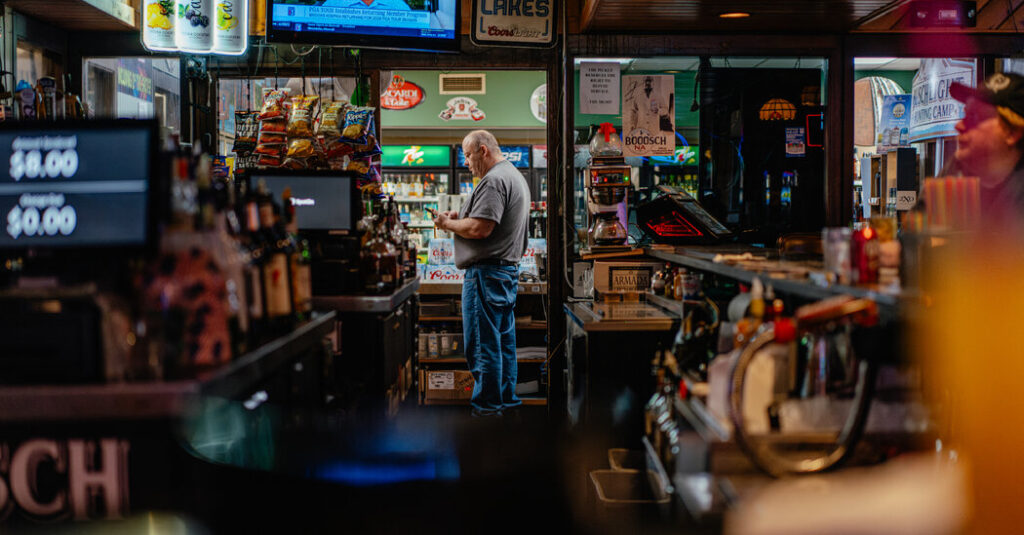
The regulars file into Ye Olde Pickle Factory in Nisswa, Minn., before 10 a.m. most days, taking their seats at the bar. Chili pepper lights hang from the ceiling, and neon beer signs glow against wood-paneled walls. A television flickers on. “The Price Is Right” is about to start.
They have been doing this since the mid-1980s, gathering in this small, dim room, waiting for someone on the game show to spin exactly $1 on the big wheel. When that happens, everyone receives a token for a free drink. Lately, they had been in a lull. No one had hit the dollar in weeks — until Wednesday.
Nisswa is a town of about 2,000 people in the Brainerd Lakes Area, a popular summer vacation destination about 150 miles north of Minneapolis. Most of the regulars on hand this morning say they prefer not to go the city anymore. Not since the summer of 2020, when George Floyd was murdered by a police officer and the city erupted.
Now, Minneapolis is in the news again. An Immigration and Customs Enforcement agent shot and killed a woman, Renee Good, during an immigration operation last week, and demonstrators are back on the streets.
What did the regulars make of it?
Ms. Good’s death was tragic, they said. Horrific.
But they also said that she had asked for trouble.
“You obey the law officer,” a man in a veteran’s ball cap said, “and question it later.”
This is the divide, in a single sentence. In Minneapolis, protesters saw an innocent woman killed by a federal agent and took to the streets. At “the Pickle,” the regulars saw a woman who should have complied.
In bars, cafes and coffee shops across rural Minnesota, the same conversations were unfolding. Ms. Good’s death had become a mirror, reflecting back a fracture that had been deepening for years — not just in their state, but across the country, wherever rural areas chafe against the political power of big cities.
Deb Lund and Connie Jenson, both in their early 70s, sat at the bar. A Busch Light cooler nearby read “Welcome Hunters!” A patron had brought smoked salmon to share, and someone passed a Tupperware container down the line.
This area, like most of rural Minnesota, votes solidly Republican. It was not always this way. For decades, rural Minnesota was home to moderate Democrats who would vote for candidates from their own party who aligned with their views. The rightward shift was catalyzed by the rise of Donald J. Trump. Now the regulars at the Pickle say that what everyone in the region seems to agree on is that life there is safer and quieter than in the Twin Cities.
Most of the regulars avoid Minneapolis if they can. They see the city as dangerous, out of control and something to flee.
“I don’t even want to go there,” Ms. Jenson said of Minneapolis. “Not anymore. Not since the George Floyd riots.”
Ms. Lund used to live in Crystal, a Minneapolis suburb. “I worked my butt off to get up here,” she said, “and there’s no way I’m going back.”
The regulars once bristled when Gov. Tim Walz, a Democrat, referred to rural Minnesota as “the land of rocks and cows.” Now they call themselves “rocks and cows” with a kind of pride.
“It’s a hopeless feeling,” Ms. Jenson said, “that most everything is controlled by the city.”
There is a term for what Ms. Lund and Ms. Jenson are expressing. Christopher Federico, a professor of political science and psychology at the University of Minnesota, calls it “rural consciousness” — a sense that living in a rural area comes with consequences: less political power, fewer resources, less respect.
“One thing we find is that individuals who are high in rural consciousness feel misunderstood by people living in nonrural areas,” Professor Federico said. “To some extent, there’s evidence they feel shortchanged.”
There is nothing uniquely Minnesotan about this. The same fault line runs through Illinois, California, New York — anywhere a major metropolis dominates state politics, as it is in Minnesota by the Twin Cities. Rural citizens have become more conservative and more Republican across the country. But in Minnesota, the shift has been particularly pronounced. Today, less populated areas of the state vote Republican by a margin of roughly two to one, according to Tim Lindberg, an associate professor of political science at the University of Minnesota, Morris, who studies rural politics.
This sense of alienation is not new. But in recent years it has become tightly bound to Republican partisanship — a shift accelerated by conservative media and political leaders who frame cities as dangerous and lawless.
At the Pickle, neither Ms. Lund nor Ms. Jenson had seen President Trump’s recent social media post calling for “a day of reckoning and retribution” in Minnesota.
“I like the reckoning part,” Ms. Jenson said when told of the post.
As for retribution, she had a target in mind: the allegations of fraud in Minnesota’s child care and nutrition programs that federal prosecutors have been investigating.
The protesters filling the streets of Minneapolis after Ms. Good was killed? Mr. Jenson wondered aloud about that.
“Do you think they’re paid?” she said.
But elsewhere in rural Minnesota, the shooting had unsettled even some conservatives.
In Pine City, about 75 miles north of Minneapolis, Trever DePoppe, 23, helps manage a pro shop that screens jerseys for local sports teams. He considers himself a Republican. He supports ICE.
He is also troubled by the killing.
“I don’t think the shooting was necessarily 100 percent justified,” Mr. DePoppe said. “I can see both sides of it. Obviously when you drive into someone that has a gun pointed, that’s probably not the smartest idea. But at the same time, why do you have a gun pulled in that situation? And then to walk away on your body cam and be using foul language toward the person?”
“I think it’s great to start to get some of the illegal immigrants out of the state,” he added. “I think it’s bad how they are going about it.”
Mr. DePoppe had never seen an ICE agent in town. He said many residents see the Twin Cities — also known as “the Cities” in these parts — as almost another world.
“Until something happens up here, it’s not a problem for anyone up here,” he said. “A lot of people don’t watch the news anymore because all you see is the stuff that happens in the Cities. It’s depressing, traumatizing. It’s things that we don’t think about until it happens up here, but down in the Cities it happens every day.”
Mary Kay Brautigan, 74, a retired local real estate agent and a member of a local liberal activist group called the Blue Brigade, has a different view. She said she had been haunted by Ms. Good’s last words, captured on video.
“I can’t sleep at night because of that sound bite in my head,” she said. “‘Dude, we’re not trying to hurt you.’ That’s how we feel — dudes, we’re not trying to hurt you when we are out there.”
“Minnesota is under attack right now,” she added. “Seriously under attack. And I don’t know what the defense is other than to keep standing for what we believe in.”
Nancy Mach, 79, another Blue Brigade member, who is a retired dean of student affairs at a local community college, said navigating the divide in a small town required care. In Pine City, she sees the same people every day — including friends she plays trivia with on Thursday nights.
“They’re fun, you know,” she said. “It’s just that you have to avoid the political piece, which is too bad, because we’re not going to learn from others by avoiding it. But it’s the only way we can exist right now.”
Back at the Pickle, Lani Thompsen knows that delicate dance well.
Ms. Thompsen has been tending bar there for 40 years. She has lived in Nisswa since she was 10. The regulars recently threw her an anniversary party. She is a lifelong Democrat; they are, by and large, Republicans.
She calls them family.
“It’s a mutual respect,” Ms. Thompsen said. “They don’t talk real bad when I’m around, and I choose not to fight with them.”
Before ICE arrived in the state, she said, her customers talked about what they were making for dinner, where the fish were biting or how Connie’s quilts were coming along.
These are people who take care of each other.
A customer brings smoked salmon for others to share. The regulars throw their Democratic bartender a party. They organize gatherings for National Soup Day, the Fall Fling and National Pickle Day.
Ms. Jenson and her husband leave for lunch every day, Ms. Thompsen said. But they often return near the end of her shift to say goodbye.
Attention turned to the television. The contestants were about to spin the wheel for the Showcase Showdown.
One hundred fifty miles to the south, protesters were following ICE vehicles through the streets of Minneapolis.
Kurt Streeter writes about identity in America — racial, political, religious, gender and more. He is based on the West Coast.
The post One State, Two Very Different Views of Minneapolis appeared first on New York Times.