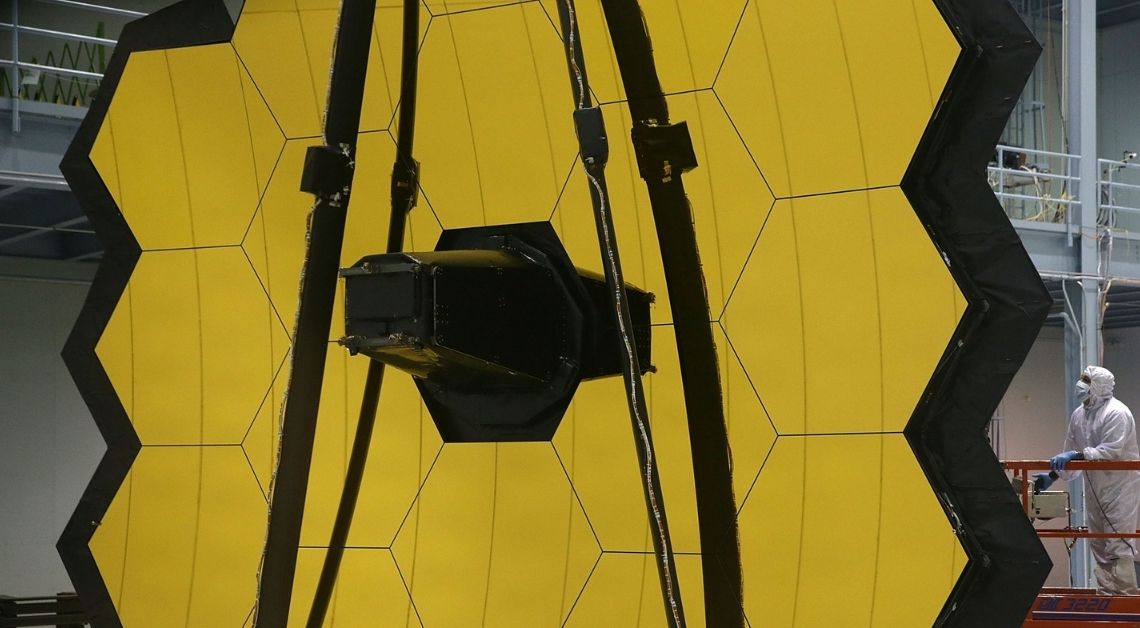
The James Webb space telescope is one of humanity’s greatest and priciest creations. Designed to give us an even better look at our universe in any piece of space tech before it, the James Webb space telescope still isn’t perfect.
In fact, it has one small blind spot that can be blamed more on the subject it’s studying than the telescope itself: stars, specifically, how difficult they can be to study.
Never fear, because, as detailed by Ars Technica, NASA’s got a whole new, much smaller space telescope that was just launched into low Earth orbit this week. It’s called Pandora, and it’s designed to supplement the James Webb Space Telescope’s findings and cover some of the telescope’s $10 billion cost.
When astronomers use Webb to study exoplanets, they rely on a trick of light. As a planet passes in front of its star, some starlight filters through the planet’s atmosphere, picking up chemical signatures along the way.
The problem is that stars themselves have spots, flares, and chemical signals that can drown out or even mimic those planetary signatures. If, for instance, scientists might think they’ve found water on a distant world when they’re really just seeing weird behavior from its nearby star.
Pandora’s job is to clear up that confusion. Orbiting just 380 miles above the earth, the $20 million satellite will stare at 20 exoplanet systems, keeping a watchful eye on the planet itself and its star at the same time to track how a stars light changes over hours, days, and months to help astronomers decipher between what’s going on the planet and the noise generated by the nearby star.
GJ 486 b is a distant planet observed by the James Webb telescope that left scientists wondering whether Webb was detecting water from the planet or if its nearby star was influencing the data. Pandora is designed specifically to clear up any confusion from cases like that.
If Pandora functions as it’s designed to, it’ll help Webb accomplish one of its primary missions: to help us figure out if there’s life out there in the universe.
The post NASA’s Pandora Mission Will Help the James Webb Telescope Find New Habitable Planets appeared first on VICE.