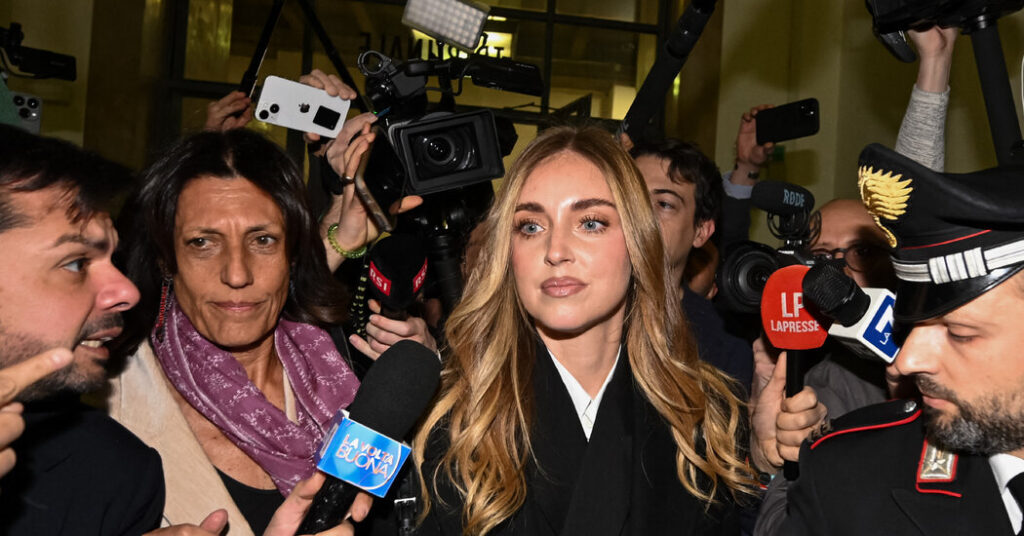
A court in Milan closed a fraud case on Wednesday against Chiara Ferragni, Italy’s most famous influencer, that involved accusations of charity fraud and had prompted an exodus of sponsors and followers.
Ms. Ferragni, 38, had built a formidable empire online sharing the intricacies of her life. Then, she was accused of misleading consumers in 2022 with the sale of a pink-boxed Christmas cake, or pandoro, and the brewing scandal brought her unwanted attention.
Prosecutors had initially accused her of aggravated fraud and asked for a prison sentence of 20 months. But the charge was downgraded to fraud by the judge, who then dismissed it because a victim had not filed a formal complaint, as required in Italy to uphold a fraud case. Victims had previously withdrawn a complaint under the terms of a settlement.
“A nightmare I have experienced for two years is over,” Ms. Ferragni told reporters outside the courtroom in Milan on Wednesday.
She said in a social media post to her 28 million followers on Instagram on Thursday that the judge determined “that there were not even the basic grounds for a criminal trial to exist.” One of her defense lawyers, Marcello Bana, said in an interview that he hoped Milan prosecutors would not appeal.
A prosecutor on the case, Eugenio Fusco, confirmed that Ms. Ferragni had been cleared of the charges, adding that prosecutors had not determined whether they would appeal. The judge had 90 days after his decision to file his verdict, after which prosecutors could decide whether to appeal, Mr. Fusco said.
In 2022, Ms. Ferragni was accused of misleading consumers by endorsing a cake, produced by the Balocco bakery conglomerate, that was priced at about $10, about two and a half times more than that of a normal Balocco pandoro. In promotional messaging, Ms. Ferragni implied to her followers that sales from the cakes would go toward buying equipment for cancer treatment at a children’s hospital.
But an Italian journalist, Selvaggia Lucarelli, questioned how much of the proceeds were going to Ms. Ferragni and how much would be going to the hospital. Balocco, she reported, had already made a donation to the hospital, and Ms. Ferragni’s partnership with the bakery conglomerate was a commercial venture.
The revelation, which came to be known as “Pandoro Gate,” eventually led to a media frenzy around Ms. Ferragni, who had until then been widely known as part of a first generation of social media influencers promoting brands around their fashion choices and lifestyle.
In December 2023, the Italian Competition Authority, which regulates commercial practices, fined Ms. Ferragni roughly 1.1 million euros (about $1.3 million) and Balocco 420,000 euros (about $487,000) over what it called misleading advertising. Companies affiliated with Ms. Ferragni, the authority said, had made more than 1 million euros in licensing fees, without paying anything to the children’s hospital.
Ms. Ferragni apologized to her followers in an unusually unglamorous video, shared to Instagram in 2023, saying that she had made “a communication error” and would donate 1 million euros to the hospital. “I realize that I could have been more vigilant,” she said.
But the accusations embroiled Ms. Ferragni in more scandal. Prime Minister Giorgia Meloni criticized her in a speech, suggesting that Ms. Ferragni was not a good role model. Sponsors, among them Coca-Cola, dropped their partnerships with her, and hundreds of thousands of people on Instagram unfollowed her.
The case against Ms. Ferragni led to tighter regulations for influencers in Italy. In November, the nation’s regulatory agency for communication industries announced new rules requiring that influencers with more than 500,000 followers on a single platform — or those who average more than 1 million viewers a month across platforms — register as a “relevant influencer.”
An Italian consumer rights group brought a class-action suit against Ms. Ferragni in 2023, accusing her of misleading consumers. Shortly after, prosecutors in Milan said that they would investigate her. Ms. Ferragni, they said, had misled consumers previously, including on a collaboration with a sweets company in which she implied that sales from Easter eggs would go toward a charity group, they said.
Ms. Ferragni had since settled the class action suit, agreeing to pay 150 euros, or about $174, to each buyer of the limited edition pandoro cakes and to make a donation to a foundation for female victims of domestic violence.
Aimee Ortiz contributed reporting.
Isabella Kwai is a Times reporter based in London, covering breaking news and other trends.
The post Milan Court Closes Fraud Case Against Italian Influencer Chiara Ferragni appeared first on New York Times.