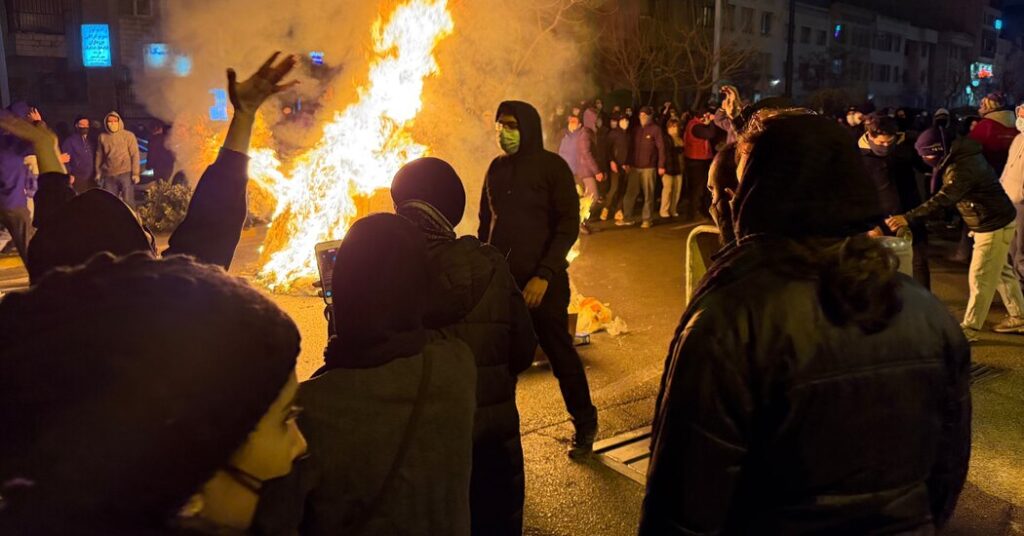
No country is watching the protests in Iran with greater interest than Israel, which sees the Islamic Republic as a mortal enemy and an existential threat.
Iran has been the obsession of Prime Minister Benjamin Netanyahu of Israel, who has portrayed the government in Tehran and its supreme leader, Ayatollah Ali Khamenei, as a global menace on the order of Nazi Germany. The two countries fought a 12-day war last June in which Israel, briefly joined by the United States, bombed Iranian military and nuclear sites while Iran bombarded Israel with ballistic missiles.
Israelis would cheer if the Iranian regime were to fall.
Yet former officials and analysts say that the Israeli leadership is unlikely to do much to try to precipitate a regime change, seeing the Iranian government as far from the brink of collapse and the current protests as insufficient to push it to that point. Israel is unlikely to attack Iran unless it is invited into a U.S.-led operation, or unless Iran attacks Israel first, they say.
And its caution about a U.S. attack on Iran is well justified, experts said. The risks of blowback against Israel — including a new war — are too great. And the chances that anything short of a major offensive could topple Iran’s authoritarian clerical rulers are too remote.
Here is how Israel views the protests and its own options.
Few expect the protesters to prevail.
Israeli analysts predict that the current wave of demonstrations in Iran will be short-lived. The protesters lack leadership and the means to defend themselves, they said, pointing to reports this week that Iranian security forces had killed thousands of demonstrators.
“If there were millions of people on the street, it would be very difficult to stop them. You cannot kill everyone,” said Sima Shine, a veteran former Iran expert at Israel’s Mossad spy agency. “But we don’t see millions. We see thousands. And this regime knows how to handle that. Their first tool is to kill people, and to make sure that everybody knows that they’re killing.”
Israeli analysts say the protests are being suppressed in part by the Iranian Revolutionary Guard Corps and its volunteer militia, the Basij.
Both are highly motivated to defend the existing power structure because their fates are tied to that of the government, which has brutalized the Iranian people for years, said Zohar Palti, formerly the head of the Mossad’s intelligence directorate.
“If the regime changes, they’re dead,” he added. “That’s the reason they’re killing people in the streets.”
A successful uprising would require a well-organized opposition capable of keeping pressure on Iran even in the face of sustained, violent repression, said Eyal Hulata, who was Israel’s national security adviser from 2021 to 2023.
“This is something that is lacking in Iran, and this is the main reason why everyone is a bit skeptical that this might actually succeed,” he said.
Toppling a state from afar is hard.
Using tools like social media to amplify opposition voices or cyberattacks to sabotage the government — the kinds of things that can be done from afar, apart from military action — is not enough to threaten the Islamic Republic, experts say.
“I haven’t seen that cyber knows how to collapse countries,” Mr. Palti said.
And with Iran cutting off the internet and stifling independent reporting on the protests, it has been difficult even for Israel — whose intelligence service has repeatedly embarrassed the Iranians with its ability to operate in their country — to obtain an accurate picture of the situation on the ground.
All of which underscores the difficulties of toppling a government from afar.
“Israel cannot change the regime in Iran,” Mr. Hulata said. “Israel can provide assistance to opposition groups, maybe exert a little bit of influence,” he added. “But this in itself is not sufficient.”
What could make a difference in Iran, several experts said, is a much bigger military action hampering the government’s ability to crack down on the protests. That could entail targeting Revolutionary Guard forces, the Basij, or Iran’s command-and-control systems. That is no small challenge in such a vast country.
Israeli leaders would also welcome an attack on Iran’s ballistic missiles and missile factories, which they and other countries in the region see as threats and which Iran considers a vital deterrent.
But such a strike would not be for Israel to mount, analysts said. It would be up to the United States.
Israel’s options are limited.
At the moment, for Israel, the likely gains from any intervention in Iran are far outweighed by the risks of intervening, experts said.
“Most of the options are bad for Israel,” said Danny Citrinowicz, a former Iran expert for Israeli military intelligence.
For Israel, the biggest risk is that its actions give credence to the Iranian government’s assertion that foreign provocateurs are behind these protests.
Israel is “doing the utmost to be seen as looking at events from the outside,” Mr. Citrinowicz said, lest Iran use evidence of any overt Israeli actions to justify the use of force against protesters.
After an obscure Israeli government minister told a radio interviewer that the country had operatives in Iran “right now,” Mr. Netanyahu ordered officials to stop giving interviews on the subject.
There is also the risk of blowback directly against Israel at a time when it already has troops in Gaza, the Israeli-occupied West Bank, Syria and Lebanon, and is still replenishing its stocks of defensive munitions after two years of fending off attacks from multiple countries.
Any Israeli intervention detected by Iran could increase the likelihood of a serious miscalculation by Tehran, experts said.
If Iran believes Israel is building up to an attack, it could mount a pre-emptive strike against Israel. Israel’s air force could be expected to respond with force, given how poorly Iran’s air defenses performed in the June war. But experts say it would make little sense to put Israeli citizens at risk if such an intervention has little chance of toppling the regime.
U.S. action could help — or hurt.
Israeli national-security experts spoke with great respect for U.S. military capabilities to threaten the Iranian government. But they also said that a limited American action, like a symbolic strike on a few targets, could be counterproductive, especially if the United States were to follow up by agreeing to new talks with Iran on its nuclear program.
Ms. Shine said that would amount to a betrayal of the Iranian protesters, whom Mr. Trump has repeatedly encouraged, unless the United States imposed preconditions that aided the protesters, like restoring internet service.
Moreover, Ms. Shine said, negotiations would raise the possibility that Iran could reach an agreement with the United States that lifts economic sanctions on Tehran but — like the Obama administration’s nuclear deal with Iran, which Mr. Netanyahu adamantly opposed — doesn’t restrict its ballistic-missile arsenal.
“I was always for an agreement,” Ms. Shine said. “But this regime is so bad, and what they’re doing now is so bad that you ask yourself if it’s not time to do everything you can to see that it collapses.”
The shah’s son inspires little confidence.
Reza Pahlavi, the exiled son of the last shah of Iran, has put himself forward as a future leader of Iran. Mr. Netanyahu welcomed him to Israel in 2023, and some ministers in his government have promoted Mr. Pahlavi online.
Some demonstrators in Iran appear to be rallying around him, judging from videos that show crowds raising the flag flown by his father’s monarchy and chanting, “Long live the shah.”
But Israeli national security experts were skeptical of Mr. Pahlavi’s ability to rally significant Iranian support, saying he lacked experience, charisma and a meaningful base inside the country.
Mr. Citrinowicz, the former Israeli military analyst, said it was a mistake for Mr. Pahlavi to meet with Mr. Netanyahu and for Israeli officials to continue to amplify him because it associates the idea of regime change with Israel. That risks alienating some potential demonstrators.
There is also little chance of Mr. Pahlavi returning to Iran, he said.
“Most Iranians,” he said, “don’t want to replace one dictator with another.”
David M. Halbfinger is the Jerusalem bureau chief, leading coverage of Israel, Gaza and the West Bank. He also held that post from 2017 to 2021. He was the Politics editor of The Times from 2021 to 2025.
The post Israel Watches Iran Protests Closely, But Is Wary of Intervening appeared first on New York Times.