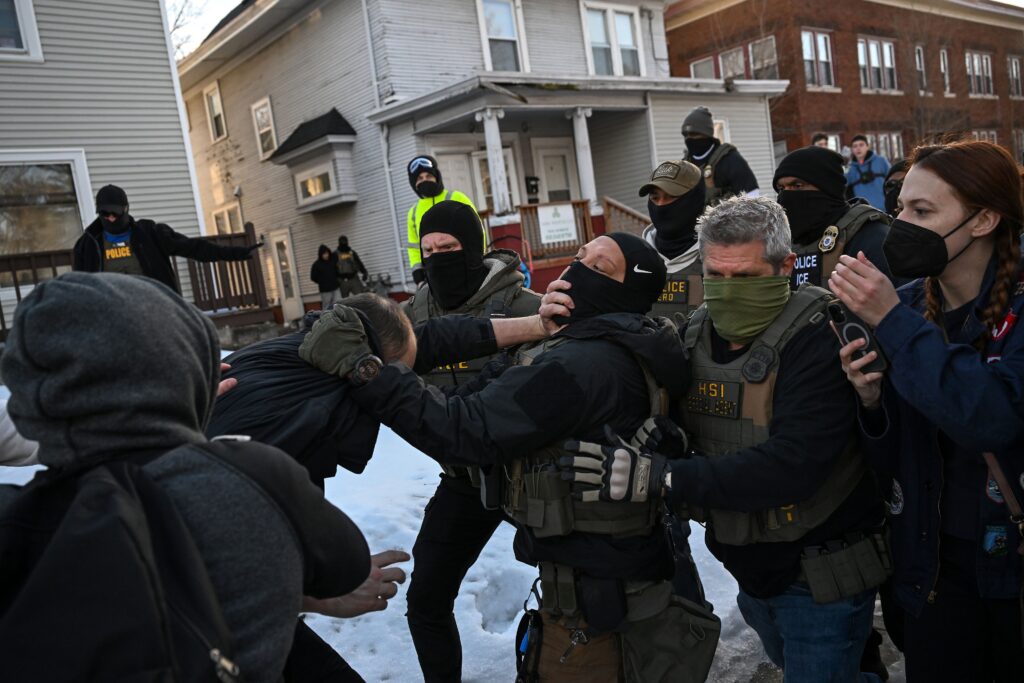
SAN FRANCISCO — As immigration agents and protesters clash in the streets, a parallel battle is unfolding over sensitive data used to identify and, as each side sees it, hold those on the other side to account.
Government officers are using new technological tools featuring real-time location data and license-plate tracking to detain immigrants and investigate protesters. Activists, outmatched in force and spending, are using burner phones and donated dash cams to counter those efforts, recording masked agents in action and compiling lists of names and badge numbers of Immigration and Customs Enforcement agents and other law enforcement personnel.
In response, the government has charged activists under criminal statutes and tried to compel online platforms to reveal the identities of activists using their sites.
In one such case, a federal judge in San Francisco held a hearing Wednesday over whether to throw out ICE’s demand that Meta identify users of anonymous Facebook and Instagram accounts that tracked raids in Montgomery County, Pennsylvania.
In a court filing last month, an ICE official said it was investigating “the open organization of people to impede immigration based investigations and operations,” posing “a serious threat to law enforcement officer safety.”
The American Civil Liberties Union, which is defending the anonymous account-holder, is asking that the subpoenas issued to Meta be quashed on First Amendment grounds. “This isn’t being litigated because of any criminal activity but rather because the government wants to tamp down on people who are opposing this activity,” ACLU attorney Ari Shapell said.
At Wednesday’s hearing, attorneys for both sides said they knew of no court ruling on whether ICE could unmask its critics with an administrative subpoena, which does not require it to establish that a crime was probably committed. The attorney for ICE said the lower standard was appropriate because no one was yet being accused of wrongdoing.
U.S. Magistrate Judge Peter Kang expressed skepticism at ICE’s view of its authority but did not say when he planned to rule.
Authorities withdrew a subpoena to Meta in November over a different Instagram account that reported on ICE activity in Los Angeles following objections from the account holder whose information was being sought.
Since federal authorities convinced Apple and Google to take down some raid-tracking apps such as ICEBlock, activists have turned to more obscure sites and direct methods. During the Los Angeles enforcement surge last year, they posted fliers around town bearing the names and faces of ICE agents.
Homeland Security Secretary Kristi L. Noem has called actions to identify officers criminal. Three women who put the home address of an ICE agent online were indicted in September in Los Angeles on charges of conspiracy to reveal protected information with the intent to intimidate, and officials have promised more such charges.
The defendants asked for a dismissal last month, arguing that applying the statute regarding the “protection of individuals performing certain official duties” amounted to an unconstitutional restriction on free speech.
Department of Homeland Security Assistant Secretary Tricia McLaughlin said Tuesday that attempts to dox, or reveal the identity, of its officers “will be prosecuted to the fullest extent of the law.”
“Our law enforcement officers are on the front lines arresting terrorists, gang members, murderers, pedophiles, and rapists. Now, thanks to the malicious rhetoric of sanctuary politicians, they are under constant threat from violent agitators,” McLaughlin told The Washington Post. “The disgusting doxing of our officers put their lives and their families in serious danger.”
While an ICE agent’s killing of Minneapolis activist Renée Good on Jan. 7 underscored the enormous risks to activists, it also showed how critical video footage can be in the fight for public opinion. For many, videos from various viewpoints challenged the narrative that Good was trying to injure the agent who fired at her as she drove.
The outrage over her death has spurred more protests and more recording.
“It’s become pretty clear that documenting what all these agents are doing is important to people’s civil liberties,” said Dan Feidt, a Minneapolis-raised co-founder of a nonprofit media site focused on social movements, Unicorn Riot. “It also plays out in court, where it does have a major effect.”
Before Good’s death, other volunteers watching ICE agents outside Minneapolis city limits were accused of obstructing traffic or law enforcement. Another volunteer, Nick Benson, said cameras would have revealed those claims to be groundless, stopping the police investigation.
Benson asked on social media for donations of dashboard cameras, and more than 400 were sent after Good’s shooting, Benson said. “I was thinking we would get maybe 10 dash cams from friends,” Benson told The Post. “Suddenly we were thrown into the national spotlight, and people were looking for a way to help.”
ICE, for its part, is taking pictures of people on the street and using an app called Mobile Fortify to check the images against databases, officials said. And it is wielding its $30 billion budget, tripled by Trump’s One Big Beautiful Bill Act, to expand its surveillance capabilities with data from license-plate readers, social media scrapers and location-tracking services.
Most of those services are based on the ingestion of masses of information as opposed to targeted inquiries, and most don’t require a warrant, said Cooper Quintin, a technologist at the Electronic Frontier Foundation tracking government contracts.
“It’s not just undocumented people, and not just people who committed crimes,” Quintin said. “We’ve built a giant surveillance panopticon.”
McLaughlin, of DHS, did not immediately respond to a request for comment on that characterization.
Just as many ICE agents and allied officers are wearing masks to make identification harder, activists are trying to protect their own privacy with encrypted messaging, fake names and small groups based on trust.
Where families of undocumented immigrants are staying home as much as possible to avoid being apprehended, volunteers bringing food and running errands in cities such as Minneapolis and New Orleans have learned to avoid giving out the addresses and names of the people they are serving.
“They are running out of food, running out of money, and the rent is due,” said Edith Romero, an organizer with New Orleans activist coalition Eye On Surveillance. “We do a lot of threat modeling to help people understand the safest way to get food to people.”
The post ICE and activists clash over doxing and privacy, in court and streets appeared first on Washington Post.