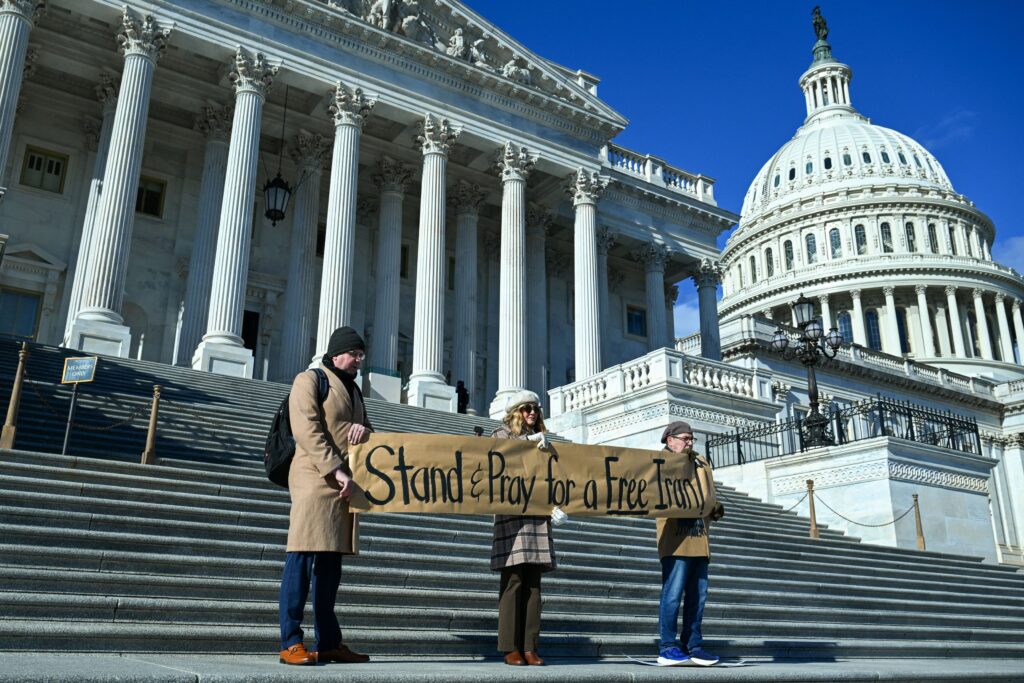
When thinking about the political transition that’s so desperately needed in Iran, it’s useful to conduct a thought experiment: When have outside attempts to encourage political change succeeded and when have they made the situation worse?
The list of negative examples is long. Iraq and Afghanistan are the most bitter recent examples. But arguably the misapplication of force is the leitmotif of modern U.S. foreign policy, a chain of failure girdling the globe from Cuba to Somalia, Nicaragua to the Democratic Republic of Congo.
We’re not alone in our inability to use military power to impose political change. Israel, supposedly the master of covert operations, has been trying without success to pound the Palestinians into compliant coexistence for half a century. China doesn’t do much better trying to combat Taiwanese democracy, nor does Russia in its campaign to throttle Ukrainian sovereignty. Foreign pressure tends to stiffen people’s resolve rather than break it.
So let’s think carefully about how the United States should help overthrow the despotic clerical regime in Iran that has slaughtered thousands of its own people over the past week, according to the group Iran Human Rights. Bombing the military and security forces would send a righteous message, but would it help create a pathway to a modern, democratic Iran? The Trump administration seems to have growing doubts, along with Persian Gulf allies like Saudi Arabia and Qatar. They’re right to wonder.
“The Pottery Barn rule is wrong,” said one former senior U.S. official. “You break it. You don’t own it. There’s nothing to own.”
Successful foreign interventions have a common theme: They create or exploit fissures in the ruling elites, especially in security forces. Foreign support encourages people to jump ship rather than cling to a battered hull. It peels away disenchanted elites by giving them a chance to survive and even prosper under a future regime.
For some examples, start with the American Revolution 250 years ago: French assistance didn’t defeat the British, but it allowed George Washington’s ragged forces to survive repeated defeats and eventually prevail. The Soviet Union wasn’t toppled by force. It rotted from the inside out, and the KGB decided the choice was reform or die. Slobodan Milosevic wasn’t overthrown in Serbia. His regime collapsed beneath him in a mostly bloodless electoral putsch.
The good guys succeeded in each of these cases because outside pressure was steady and systematic, rather than a spasm of violence. The CIA pressured the Soviet Union at the edges — shipping Qurans to Uzbekistan and samizdat manuscripts to Moscow — but not head-on. And when elites like Boris Yeltsin began to defect, Washington was there to catch them. The United States managed to dissolve the huge security services in Eastern European countries like Poland and East Germany by artful transition, rather than killing the bad guys.
The problem in Iran: Rather than splitting the regime, threats by President Donald Trump and the Israeli government seem to have fostered cohesion. Farzin Nadimi, an Iran expert at the Washington Institute for Near East Policy, told me Wednesday that he sees “no signs of fragmentation, purges, or refusal to follow orders.” Unlike in some past crises, civil servants and oil workers mostly stayed on their jobs. As for the regular military, he says, “they hate the regime, but they stood silent.”
Iranian security forces may be winning this week’s street battles, but many analysts remain convinced that they have lost the war. The regime maintains power only at the point of a gun. It may kill enough dissenters to survive for months or even years (though I doubt the latter). But it cannot govern effectively atop a pile of corpses.
Here are some ways to foster a transition in the aftermath of this month’s bloodbath. Tighten sanctions and other pressures on the security forces. Add incentives for business and political leaders to demonstrate independence. Force Iran to open the internet or lose its access to international financial transactions. Iran’s regional governors are unaffiliated with the Islamic Revolutionary Guards Corps and mostly dislike the regime: Where possible, work with them and help them prosper.
Vali Nasr, a prominent Iran expert who was dean of the Johns Hopkins School of Advanced International Studies, fears that “a very dark tunnel” lies ahead. “Currently there is no organized political movement in Iran that can lead the protests and assert authority in a day after and take over security and governance,” he argues.
If Nasr is right, then change those parameters: Iran’s friends should operate on the assumption that regime change is inevitable — and keep planning for the transition. Reza Pahlavi, the son of the deposed shah, may be too much a creature of the past to lead a new Iran. But his “Iran Prosperity Project” published a superb transition blueprint in July that’s smarter than anything the U.S. government or Iraqi exiles produced before the 2003 invasion.
Study that plan, whatever you think of Pahlavi. Agency by agency, it details how to rebuild a cohesive Iran. It lists 34 military, intelligence and police organizations and describes the approach that should be taken to each — dissolving a few, retaining and vetting the others.
Iranian “moderates” aren’t the face of a new Iran. But most of them know that the regime has failed, and they’re waiting for the death of Supreme Leader Ali Khamenei and an inevitable period of transformation. The U.S. should test figures like parliament speaker Mohammad-Bagher Ghalibaf, national security secretary Ali Larijani, former defense minister Ali Shamkhani and even President Masoud Pezeshkian. As the regime weakens, they’ll have incentives to save themselves and their families. “Saying we will work with people who have reasonable policies is a good policy,” says the former senior U.S. official.
The most important part of a long-term strategy of regime change is to work with Iran’s amazing diaspora — which is a walking advertisement for how future Iran could prosper. Dara Khosrowshahi, the CEO of Uber, told me this week that he has been talking regularly with a group of more than 20 Iranian American chief executives about how to encourage transition: “We are willing to help. We are willing to get our hands dirty,” he said.
Khosrowshahi told a group of opposition supporters by video last year that in Iran’s future role as a regional technical hub, “the sky’s the limit.” Bring it on! The Middle East battle I’d like to see is one among Iran, Israel, Saudi Arabia and the United Arab Emirates for tech supremacy.
Despite this week’s bloody repression, the campaign for Iran’s political transition is just beginning. A strong, steady American policy can help eventually sink this regime. It may look strong, but it signed its death warrant this week, in blood.
The post How the U.S. can help bring a new Iran into focus appeared first on Washington Post.