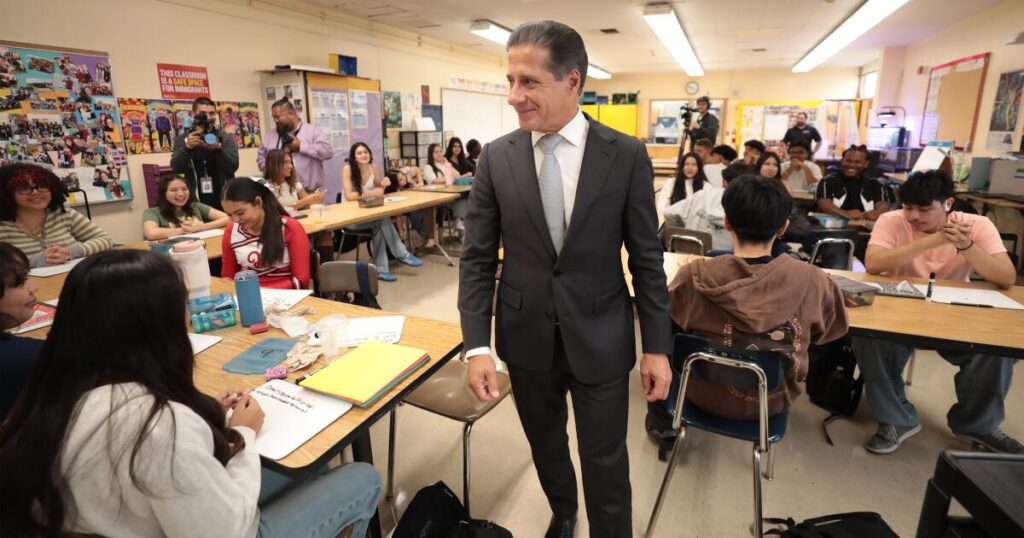
The Los Angeles school district is falling short of meeting school board-approved academic goals set four years ago, but students continue to improve faster on key academic measurements than the state as a whole, based on data released Tuesday.
The presentation to the Board of Education during a five-hour meeting kicks off a deeper evaluation as leaders prepare the district’s next strategic plan, which would take affect in July.
The data served as a reality check amid acclaim that L.A. Unified has heaped on itself and also has received from state officials applauding the district’s positive education news.
By the yardstick of its own goals, the nation’s second-largest school system is likely to fall short by nearly every parameter — taking in sample measures of literacy, math and social emotional learning.
“Have we reached everything we promised we would reach?” Supt. Alberto Carvalho said in opening remarks. “Absolutely not. And what you will see, whether it’s in a private sector or public sector, no one ever reaches all of the goals that are designed.”
Otherwise, he said, the goals are not ambitious enough.
Several options for lowering targets in the next strategic plan were presented to the board by senior staff and consultants.
In terms of test scores, Los Angeles Unified recovered from pandemic setbacks in five years — which many state school districts have yet to do. In the 2025 tests, the L.A. school system surpassed its achievement levels of 2018-19, L.A.’s previous high-water mark under the current testing system.
Last week, Gov. Gavin Newsom singled out L.A. Unifed for praise in his State of the State address, noting he had invited Carvalho to attend in person.
“I just want to say this to the teachers, the classified employees and to the parents of L.A. Unified school kids, you should be very proud of [the] progress you’re making,” he said. Carvalho, he added, “has just been doing a remarkable job.”
Literacy for third-graders
The district goals single out third-grade reading because by third grade, students should be reading to learn rather than learning to read. Those not reading well by third grade will have significant difficulty in every subject.
In 2022, the board-approved goal called for third-graders as a group to improve by 30 points on a measure called distance from standard. In this measure, the number 0 means grade level.
Here’s how it works.
If third-graders as a group combined for a score of zero, then third-graders, on average, would be scoring at grade level on the English language arts portion of the state’s standardized tests.
In 2021-22 the collective third-grade score was 32.9 points below zero, or -32.9 — as calculated using state standardized tests. Over the four years of the strategic plan, a 30-point improvement would have brought third-graders to a -2.9 score.
With one year to go, third-graders are at -17.6 — a clear improvement but still well below the goal.
At their current average rate of improvement, they would rise to -13.8 by the end of the plan’s fourth and final year.
One limitation of distance-from-standard is that it provides no data on what percentage of students are meeting academic standards.
L.A. Unified has opted not to include that measure in its goals, which board member Nick Melvoin wants to change.
“I still think we want to make sure that what we’re doing is transparent and communicable to the public,” Melvoin said. “When you hear that you’re 20 below standard, you don’t know if that’s really close to meeting your goal or way, way below. And so that’s why those proficiency levels are so really important.”
In a different kind of measurement used statewide, about 43.6% of L.A. Unified third-graders tested as proficient or better in English language arts, closing most of a nearly five-percentage-point gap with the state over three years. The statewide figure was 44.2%
Across all tested grades, 46.5% of L.A. Unified students met or exceeded the state standard in English. Statewide, the figure was 48.8%.
A similar narrative in math
Math scores, referred to in the district goals as “numeracy,” paint a similar picture.
Instead of relying on third grade alone, the district’s goals combined math results for grades 3 through 5 in one measure, and grades 6 through 8 in a second measure.
Math scores started off lower than English scores, and the school district therefore set a higher goal of a 40-point distance-from-standard improvement over four years. Once again, the district is not on track to get there.
For grades 6 to 8 in 2021-22, for example, students were at -81.1 in the distance-from-standard that measures from zero. By 2024-25, they were -56.5. It will be a longshot to get to the goal of -41.1 by the end of this year.
Overall, in L.A. Unified, about 36.8% of students met or exceeded math standards for their grade level. Statewide, the number was 37.3%.
College prep also short of goal
At the secondary level, the 2022 strategic plan measured the number of students who were eligible to apply to a University of California or Cal State campus as a benchmark of achievement.
Approved courses in certain subject areas are required by the university systems and students must earn a grade of C or better in each of them. Crossing this bar doesn’t guarantee admission but demonstrates academic preparation for college.
The L.A. Unified goal calls for 70% of high school graduates to achieve UC/CSU eligibility by the end of the current academic year.
The percentage has increased — from 50.5% in 2021-22 to 58.4% in 2024-25. Yet jumping from there to 70% by June seems improbable.
A corollary concern is that grade inflation and other factors appear to be weakening the validity of this measure statewide.
Between 2020 and 2025, for example, the number of first-year UC San Diego students whose math skills fall below the high school level increased nearly thirty-fold, according to research. And 70% of those students fell below middle school levels, about 1 in 12 entering students.
Hard to track social emotional growth
District efforts to measure the fourth goal — social emotional learning — made little headway over the last three years. The district has yet to develop a process that provides meaningful data. Social emotional learning relates to developing and applying skills for understanding and managing emotions, setting positive goals, building healthy relationships and making responsible decisions.
Despite these difficulties, board members seem inclined to keep trying to develop a social emotional learning measure.
“It is one of the bigger things, I believe, in this process that we call education,” said board member Sherlett Hendy Newbill.
A majority of board members also seemed to want to add a measure for science, for which there are state tests in grades 5 and 8 and once in high school.
Staff members said they would explore a proposal for science, while also advising board members to limit the strategic plan goals to a small number. They said this would allow for intense focus and better accountability.
The post How did LAUSD students measure up to district goals? The wins, shortfalls and 2026 plan appeared first on Los Angeles Times.