House Democrats can point to plenty of actions by President Donald Trump that they consider impeachable offenses, including the U.S. military assault on Venezuela that captured its head of state. But party leaders don’t seem eager to do much about it until after November.
Many Democrats fear that calling for Trump’s removal would only distract from other issues they want to keep top of mind for voters heading into the midterms. And they recognize that with Republicans controlling both the House and Senate, trying to impeach Trump for a third time is not only impractical but could also risk emboldening Trump’s base to the political benefit of Republicans.
Yet the calculus could change if Democrats regain the House majority next year.
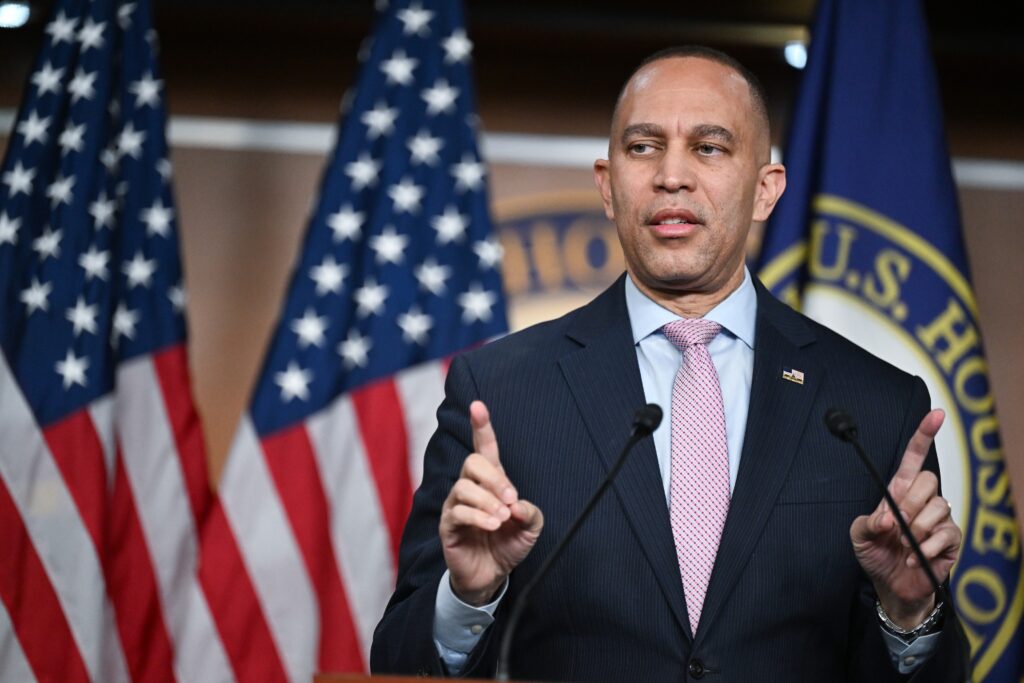
House Minority Leader Hakeem Jeffries (D-New York) told reporters this week that holding Trump and his administration accountable is “a conversation that we’re not going to run away from.” But Jeffries said that it will be held “at the appropriate time,” quickly adding that “what unites us at this moment” is focusing on issues including the cost of living and health care.
Trump has repeatedly warned that Republicans must not let Democrats regain control of the House. In a speech last week meant to energize the House GOP, he told lawmakers that they must “win the midterms, because if we don’t win the midterms, they’ll find a reason to impeach me.”
Republicans had already been campaigning on the sentiment in hopes of showing their base what’s at stake in the midterms. A recent fundraising email sent by WinRed, which raises money for GOP candidates, said it was “pleading” with supporters to take Trump’s directive seriously, stressing: “The Democrats are already moving to impeach the President and his Cabinet the SECOND they take control of the House.”
House Democratic leaders have largely spent the last year trying to tamp down calls for impeachment, reminding their colleagues that a majority of the country voted for Trump despite federal indictments on dozens of criminal charges, and the fact that Trump cannot run for a third term. Most House Democrats have fallen in line, rebuking attempts by rogue lawmakers to try to impeach Trump.
But over the past week, House Democrats have expressed a greater willingness to try to impeach Trump administration officials, particularly Homeland Security Secretary Kristi L. Noem after an Immigration and Customs Enforcement officer shot and killed Renée Good in Minneapolis last week. Democrats have launched an investigation into Noem, and leaders are not ruling out forcing a vote to try to remove her.
Under House rules, a single lawmaker can file an impeachment resolution against the president or a Cabinet official and force a vote. But the party in power has far more sway in the process, controlling committees that can launch investigations, issue subpoenas to compel testimony and hold high-profile hearings to sway public opinion.
“When we are in the majority, we will continue to ask tough questions, and we will have more tools to use, but in the meantime we should be focused on what the American people want to see,” Democratic Caucus Chair Pete Aguilar (D-California) said.
Democrats have pointed to an array of Trump actions, aside from the military operation in Venezuela, as potential grounds for impeachment. Among them: seeking federal prosecutions of political adversaries, threatening the death penalty for members of Congress who produced a video urging the military not to obey unlawful orders, and using the military for law enforcement in several Democratic-led cities.
Reps. Alexandria Ocasio-Cortez (D-New York) and Pramila Jayapal (D-Washington) both said they believe Trump has committed a wide range of impeachable offenses over the past year — but both acknowledged the difficulty of the minority party seeking to remove him from office.
Not only do Democrats lack the votes to launch a formal impeachment inquiry, but hearings would probably be run by the GOP-controlled House Judiciary Committee under the direction of ultraconservative Rep. Jim Jordan (R-Ohio).
Trump was first impeached in 2019 for pressuring Ukrainian President Volodymyr Zelensky to launch an investigation into Democrat Joe Biden, his potential 2020 election opponent, with the threat of withholding congressionally approved military funding. Trump was impeached two years later for “incitement” of the Jan. 6, 2021, Capitol insurrection. He was acquitted by the Senate both times.
The lack of convictions emboldened many of Trump’s supporters, who argued he was being unfairly targeted by Democrats. Democratic leaders are wary of playing into Trump’s hands with elections looming.
In coming weeks, Jeffries and his leadership team could face tests as it aims to tamp down impeachment talk about Trump until after the midterms. Aguilar said that impeachment is “not something that the leadership team is focused on,” but he said he recognizes some outspoken Democrats are “going to represent the viewpoints of their district.”
Trump’s actions in Venezuela have prompted some to speak out. Rep. April McClain Delaney (D-Maryland) said she would like to see the House Democratic caucus begin strategizing now how “to rein in this lawlessness” so they’re prepared if they take the majority.
“If that means impeachment, then that means impeachment,” Delaney said.
Several other Democrats, many of whom spoke on the condition of anonymity to discuss private deliberations, said that though they’re not calling for impeachment now, future moves by Trump on the world stage could change that — particularly if he directs the military to invade Greenland or Colombia without the consent of Congress.
Rep. Dan Goldman (D-New York), who is facing myriad liberal primary challengers, called for impeachment proceedings in light of the military operation in Venezuela earlier this month but noted that the “reality is we cannot initiate any official investigations.”
Rep. Nancy Pelosi (D-California), who oversaw Trump’s two impeachments as House speaker, told USA Today in a recent interview that impeachment is “not an incidental thing” that Democrats can predict now that they would pursue.
“There has to be cause. There has to be reason,” she said. “The person most responsible for impeaching President Trump when I was speaker was President Trump.”
A unilateral attempt by Rep. Shri Thanedar (D-Michigan) last year was met with private pressure from his colleagues, who pleaded that he pull his threat to impeach Trump because it would cloud Democrats’ attempt to spotlight Republican plans to cut Medicaid and other benefits as they advanced their massive tax and immigration bill.
Rep. Al Green (D-Texas), who introduced three articles of impeachment against Trump in his first term, forced two impeachment votes last year. There was a notable shift between both votes, with more Democrats supporting a vote on impeachment in December than earlier in the year. During the most recent failed effort, in December, Jeffries argued that impeachment “requires a comprehensive investigative process.”
Democrats on the House Homeland Security Committee have launched such an investigation against Noem. Leaders and top Democratic aides believe that gathering evidence now could give committees a leg up in the majority to move quickly in removing her.
But some Democrats do not want to wait. Rep. Robin Kelly (D-Illinois), who is running for Senate, introduced three articles of impeachment against Noem on Wednesday, alleging that she “wreaked havoc” and that “her rogue ICE agents” had gone too far in harassing American citizens, including Good. More than 70 Democrats have backed her effort.
Democrats view forcing Republicans to defend Cabinet officials as a potential liability for them as favorability for ICE among voters has plummeted in recent polls. Republicans used a similar strategy in 2024 when they impeached Homeland Security Secretary Alejandro Mayorkas as a rebuke to then-President Joe Biden’s immigration strategy.
Jeffries said that Democrats “haven’t ruled anything in and we haven’t ruled anything out” in terms of how to rebuke Noem or the Homeland Security department as lawmakers weigh impeachment or withholding votes that would fund the department ahead of a Jan. 30 government funding deadline. But Jeffries did threaten “all members of the Trump administration” that Democrats could move swiftly to hold them accountable if the party regains the majority in the midterms.
“The incitement and engagement in state violence against the American people is a serious crime. Donald Trump will leave office long before the five-year statute of limitations [on federal crimes] expires. You are hereby put on notice,” Jeffries warned on social media.
The post House Democrats aren’t eager to impeach Trump. But that could change. appeared first on Washington Post.