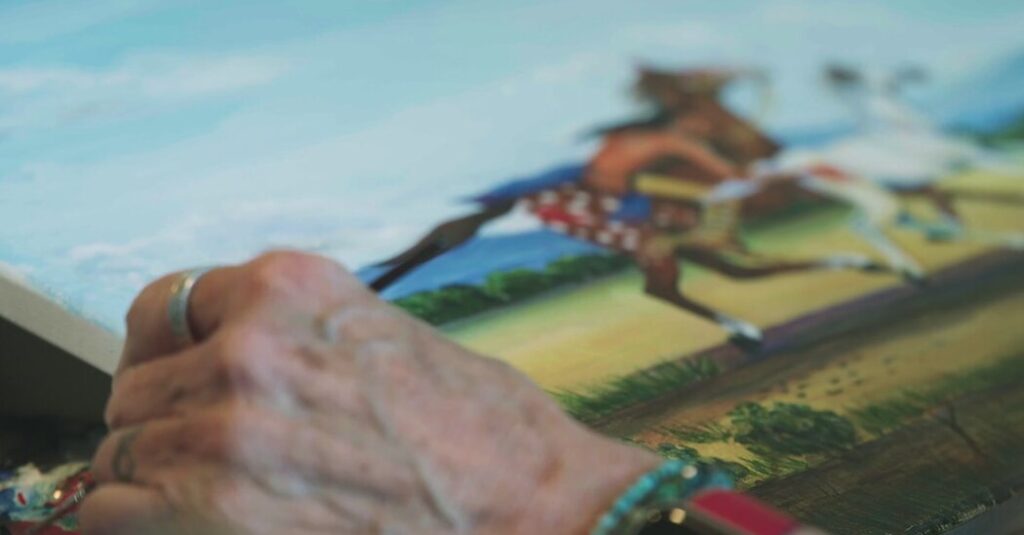
Harvey Pratt, a self-taught Native American artist whose talents found broad expression as a forensic artist for law enforcement agencies and as the designer of the National Native American Veterans Memorial on the Mall in Washington, died on Dec. 31 at his home in Guthrie, Okla., north of Oklahoma City. He was 84.
The cause was stomach cancer, his son Nathan said.
Mr. Pratt spent 45 years working for the Oklahoma State Bureau of Investigation, where his murals adorn the walls of the headquarters. His sketches, airbrushed photographs and facial reconstructions of homicide victims were used in high-profile cases, including the 1995 Oklahoma City bombing and efforts to identify victims of serial killers like Ted Bundy and the Green River Killer in Washington State.
A member of the Cheyenne and Arapaho tribes of Oklahoma, Mr. Pratt drew and painted as a child, but in college an art teacher told him he lacked talent. He dropped out and joined the Marine Corps, serving in Vietnam, and then was hired as a police officer in Midwest City, Okla. He was on patrol there in the mid-1960s when a detective told him that a woman shot by an intruder was not likely to live.
“He said, ‘Do you think you could go over there and make a drawing with her?’” Mr. Pratt recalled in a 2012 oral history interview for Oklahoma State University. The drawing he did was his first forensic sketch of a suspect, and it led to an arrest and conviction.
“If I had not been successful that time,” Mr. Pratt said in the oral history, “I’d probably have never done another one. But I’ve done probably 5,000 drawings all over the country.”
In 1972, he was hired by the state investigation bureau as a narcotics officer, but he continued to do forensic artwork, earning a reputation in the 1980s for pushing the boundaries of the craft.
He airbrushed photos of unidentified bodies that were often in a state of decomposition and recreated the soft tissue of the face to produce lifelike images that could be used in requests to the public to identify a victim.
“Man, all of a sudden I was identifying bodies all over the country,” Mr. Pratt told Tulsa World in 2009. “They were just inundating me with photographs, because no one was doing that.”
He also made age-progression drawings of missing children. One, of a 6-year-old boy from California whom he aged a decade, was recognized by a teacher in Texas as one of her students. It turned out to be the missing child.
Mr. Pratt had a reputation for conducting in-depth interviews of witnesses and crime victims that resulted in highly accurate sketches of suspects.
When the F.B.I. was conducting a global manhunt for the masked Islamic State executioner known as Jihadi John and was seen in videos in 2014 beheading the journalist James Foley and other captives, Mr. Pratt offered to make a sketch.
“He said, ‘I can draw that guy,’” a former F.B.I. analyst, Scott Behenna, told The Oklahoman in 2017. “I said, ‘Harvey, he has a mask on.’ He said, ‘I’ve seen pictures, and the light and the shadows, where his mask is touching, I can draw that guy.’ I said, ‘Oh, man. Send that to me.’”
The terrorist was identified in 2015 as Mohammed Emwazi and was killed in a drone strike. It is unclear if Mr. Pratt’s drawing played a role in unmasking him, but Mr. Behenna said the sketches bore an uncanny resemblance to the man.
Mr. Pratt was promoted up the ranks at the State Bureau of Investigation into supervisory roles, eventually serving as interim director in 2010 before retiring in 2017. He was inducted into the Oklahoma Law Enforcement Hall of Fame in 2012.
His design for the National Native American Veterans Memorial, on the grounds of the National Museum of the American Indian, part of the Smithsonian Institution, was selected from more than 120 submissions. The memorial, which features an upright stainless-steel circle balanced on a carved stone drum, opened in 2020.
The design was partly inspired by Mr. Pratt’s maternal grandfather, who called Native Americans “circle people” because they are so closely attuned to the changing seasons and the cycle of human life.
Harvey Phillip Pratt was born on April 13, 1941, in El Reno, Okla., the sixth of seven children of Oscar Noble Pratt, who was Cheyenne and Arapaho, and Anna (Guerrier) Pratt, who was Cheyenne and Sioux. He was 9 when his father died of tuberculosis.
“I had three brothers, and we were raised by a single mother, so we didn’t have a lot,” he said in a 2020 interview. His mother was a noted storyteller, and his brother Charles became a sculptor and metalsmith.
Harvey attended Saint Patrick’s Indian Mission School in Anadarko, Okla., where a group of early 20th-century student painters known as the Kiowa Five developed a two-dimensional style inspired by the artwork of Plains Indians. Mr. Pratt later said his own style was influenced by the Kiowa painters.
He enrolled at Central State College (now the University of Central Oklahoma) in Edmond, Okla., where his ambition to become a commercial illustrator was discouraged. In 1962, he joined the Marines and was assigned to a military police unit in the 3rd Marine Division, whose mission was to guard an airfield in Da Nang, Vietnam.
After his tour in Vietnam, he served two more years and was discharged at the rank of a lance corporal in 1965.
In addition to doing forensic work, Mr. Pratt was a painter and sculptor whose works reflected Native American themes and were shown at galleries, museums and art fairs.
In 1996, he was chosen to be a peace chief of the Southern Cheyenne, a high tribal honor, and he took the name White Thunder.
Mr. Pratt’s first marriage, to Mary Frances Immenschuh, and his second, to Michelle Moran, ended in divorce. In 1997, he married Gina Posey Christian, an agent with the state Alcoholic Beverage Laws Enforcement Commission, whom he met when she posed as a corpse for a class he was teaching.
In addition to his son Nathan, from his second marriage, she survives him, along with another son from his second marriage, Judson; two children from his first marriage, Jason and Tracy Hardin; a brother, Otto; and five grandchildren.
In an interview with American Legion magazine in 2020, Mr. Pratt said he was often asked why Native Americans chose to join the military and fight for a country that had treated them so badly.
His answer was that the creator gave the Americas to the Indians long before the Europeans arrived. “This land is Indian country,” he said. “It is always Indian country, regardless of who owns it. That’s what we fight for.”
Trip Gabriel is a Times reporter on the Obituaries desk.
The post Harvey Pratt, Who Designed the Native American Veterans Memorial, Dies at 84 appeared first on New York Times.