Justice Brett M. Kavanaugh sometimes says the quiet part out loud. He did that last month when the Supreme Court refused to let President Trump deploy National Guard troops in Illinois.
The decision was a rare loss for the administration at the court, and it seemed to prompt Mr. Trump to abandon his efforts to deploy troops in Illinois, Oregon and California.
But Justice Kavanaugh, in a footnote in a concurring opinion, suggested that the ruling could be a speed bump on the road to greater presidential power. He pointed to the possibility of Mr. Trump invoking a different law, the Insurrection Act, to send more conventional military troops to American cities.
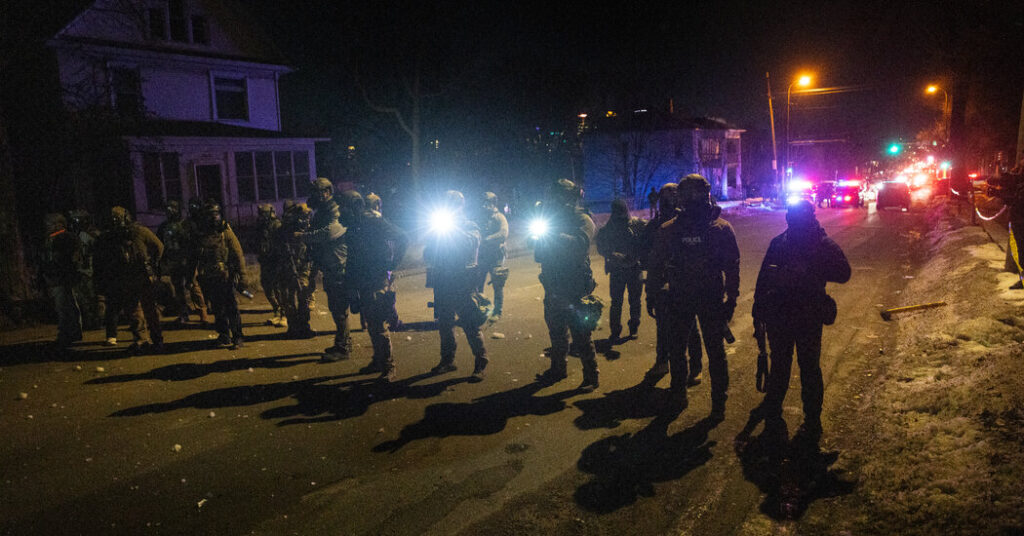
Less than a month later, Mr. Trump suggested he might do exactly that in response to violence and protests in Minneapolis.
“If the corrupt politicians of Minnesota don’t obey the law and stop the professional agitators and insurrectionists from attacking the Patriots of I.C.E., who are only trying to do their job, I will institute the INSURRECTION ACT, which many Presidents have done before me,” he wrote on Thursday on social media.
In his own social media post hours earlier, Todd Blanche, the deputy attorney general, had called the opposition to immigration raids in the state a “Minnesota insurrection.”
Mr. Trump has long floated the possibility of invoking the act, and he did not need a sentence in a footnote to give him any ideas. But Justice Kavanaugh’s statement did make plain that the Supreme Court’s action in blocking one kind of deployment could set the stage for other, more aggressive ones.
Mr. Trump relied on a different law to order National Guard troops to cities last summer, an obscure measure adopted in 1903 and 1908 that said deployments were allowed for three reasons.
One, concerning foreign invasions, plainly did not apply to the events in Illinois. The second permissible reason for deploying the Guard was if a rebellion was underway, or if there was danger of one. That is a stretch, and the majority did not cite it, much less discuss it. The court’s order focused on the third reason: the president’s right to deploy the National Guard if he is unable to execute laws “with regular forces.”
Five justices joined the unsigned majority opinion, which rejected the Trump administration’s position that “regular forces” referred to civilian law enforcement like Immigration and Customs Enforcement agents. Instead, the majority said, the term referred to the military. Since there had been no showing that those forces would be unable to execute the laws, the administration lost — at least for the time being.
Justice Kavanaugh voted with the majority but did not sign its opinion, and accepted only part of its reasoning. Such a “concurrence in the judgment” is unusual in cases decided on the court’s emergency docket.
Speaking for himself, Justice Kavanaugh surveyed the legal landscape and said what the majority had left unstated.
“As I read it,” he wrote, “the court’s opinion does not address the president’s authority under the Insurrection Act.”
.css-1mxer6r{max-width:600px;width:calc(100% – 40px);margin:1.5rem auto 1.75rem;height:auto;margin-left:auto;margin-right:auto;font-family:nyt-franklin;color:var(–color-content-secondary,#363636);border-top:1px solid var(–color-stroke-quaternary,#DFDFDF);border-bottom:1px solid var(–color-stroke-quaternary,#DFDFDF);padding-top:20px;padding-bottom:20px;}@media only screen and (min-width:1024px){.css-1mxer6r{width:600px;}}.css-1medn6k{font-family:nyt-franklin,helvetica,arial,sans-serif;font-weight:500;font-size:1.0625rem;line-height:1.5rem;}@media only screen and (max-width:480px){.css-1medn6k{font-size:1rem;line-height:1.375rem;}}.css-1f84s5v{font-weight:700;font-size:1.0625rem;}@media only screen and (max-width:480px){.css-1f84s5v{font-size:1rem;}}.css-1f84s5v a{color:var(–color-signal-editorial,#326891);-webkit-text-decoration:underline;text-decoration:underline;}.css-1f84s5v a:hover{-webkit-text-decoration:none;text-decoration:none;}.css-1hvpcve{font-size:17px;font-weight:300;line-height:25px;}.css-1hvpcve em{font-style:italic;}.css-1hvpcve strong{font-weight:bold;}.css-1hvpcve a{font-weight:500;color:var(–color-content-secondary,#363636);}.css-214jt4{margin-top:15px;margin-bottom:9px;}@media only screen and (max-width:480px){.css-214jt4{font-size:14px;margin-top:15px;margin-bottom:10px;}}.css-214jt4 a{color:var(–color-signal-editorial,#326891);-webkit-text-decoration:underline;text-decoration:underline;font-weight:500;font-size:16px;}@media only screen and (max-width:480px){.css-214jt4 a{font-size:13px;}}.css-214jt4 a:hover{-webkit-text-decoration:none;text-decoration:none;}.css-1mxer6r{max-width:600px;width:calc(100% – 40px);margin:1.5rem auto 1.75rem;height:auto;margin-left:auto;margin-right:auto;font-family:nyt-franklin;color:var(–color-content-secondary,#363636);border-top:1px solid var(–color-stroke-quaternary,#DFDFDF);border-bottom:1px solid var(–color-stroke-quaternary,#DFDFDF);padding-top:20px;padding-bottom:20px;}@media only screen and (min-width:1024px){.css-1mxer6r{width:600px;}}.css-1medn6k{font-family:nyt-franklin,helvetica,arial,sans-serif;font-weight:500;font-size:1.0625rem;line-height:1.5rem;}@media only screen and (max-width:480px){.css-1medn6k{font-size:1rem;line-height:1.375rem;}}.css-1f84s5v{font-weight:700;font-size:1.0625rem;}@media only screen and (max-width:480px){.css-1f84s5v{font-size:1rem;}}.css-1f84s5v a{color:var(–color-signal-editorial,#326891);-webkit-text-decoration:underline;text-decoration:underline;}.css-1f84s5v a:hover{-webkit-text-decoration:none;text-decoration:none;}.css-1hvpcve{font-size:17px;font-weight:300;line-height:25px;}.css-1hvpcve em{font-style:italic;}.css-1hvpcve strong{font-weight:bold;}.css-1hvpcve a{font-weight:500;color:var(–color-content-secondary,#363636);}.css-214jt4{margin-top:15px;margin-bottom:9px;}@media only screen and (max-width:480px){.css-214jt4{font-size:14px;margin-top:15px;margin-bottom:10px;}}.css-214jt4 a{color:var(–color-signal-editorial,#326891);-webkit-text-decoration:underline;text-decoration:underline;font-weight:500;font-size:16px;}@media only screen and (max-width:480px){.css-214jt4 a{font-size:13px;}}.css-214jt4 a:hover{-webkit-text-decoration:none;text-decoration:none;}
Got a news tip about the courts? If you have information to share about the Supreme Court or other federal courts, please contact us.
See how to send a secure message at nytimes.com/tips
The Insurrection Act, a set of laws adopted in the nation’s first century, authorizes the president to use the National Guard or more traditional armed forces to quell widespread public unrest. It seems to give him substantial leeway in determining when circumstances warrant invoking it.
The law repeatedly says the president can use force “as he considers necessary,” for instance. And a leading precedent, Martin v. Mott, from 1827, said that “the authority to decide whether the exigency has arisen belongs exclusively to the president.”
If lawfully invoked, the Insurrection Act would also seem to satisfy the Posse Comitatus Act, a bedrock 1878 law that prohibits the use of the military for law enforcement unless authorized by Congress.
The Insurrection Act has been invoked throughout the nation’s history, typically at the request of local officials. It was last used in 1992, following riots in Los Angeles in the wake of the acquittals of four white police officers accused of beating Rodney King, a Black motorist.
The military has also been deployed under the act to address labor disputes, conflicts with Native Americans, looting after natural disasters, and to enforce court orders in the civil rights era.
Should Mr. Trump invoke the Insurrection Act to send troops to Minneapolis or other cities over the objections of local officials, there will certainly be court challenges, and the Supreme Court may well have another chance to consider what Justice Neil M. Gorsuch in his dissent in the Illinois case called a fraught and grave question: “When, if ever, may the federal government deploy the professional military for domestic law enforcement purposes consistent with the Constitution?”
Justice Kavanaugh’s concurring opinion, on the other hand, said the Constitution itself may provide a source of presidential power to deploy troops.
“The court’s opinion does not address or purport to disturb the president’s long-asserted Article II authority to use the U.S. military (as distinct from the National Guard) to protect federal personnel and property and thereby ensure the execution of federal law,” Justice Kavanaugh wrote.
He cited with approval an essay in October by Jack Goldsmith, a law professor at Harvard and an authority on executive power. The essay’s title: “President Trump Holds the Legal Cards on the Use of the Military in the Domestic Sphere.”
Justice Kavanaugh all but suggested that the challengers’ victory in the Illinois case was Pyrrhic.
“One apparent ramification of the court’s opinion is that it could cause the president to use the U.S. military more than the National Guard to protect federal personnel and property in the United States,” he wrote.
Professor Goldsmith, for his part, wrote that litigation over any invocation of the Insurrection Act was inevitable, and that the Trump administration, against all odds, may find a way to lose it. But, he wrote, that will not be easy.
“Every single word of the Insurrection Act will be intensely contested in court should the president invoke it,” Professor Goldsmith wrote. “And given the administration’s tendency to blunder, to bully, to overstep and to develop factual predicates inadequately, not to mention the president’s always-legally unhelpful social media activity, litigation might be tough and victory for the administration in every instance cannot be assumed.”
The day after the Illinois decision landed, Professor Goldsmith wrote in a blog post that the Supreme Court had closed one door and opened another.
“Yesterday’s defeat,” he wrote, “could provide ‘cover’ for the Trump administration to go the Insurrection Act route.”
Adam Liptak covers the Supreme Court and writes Sidebar, a column on legal developments. A graduate of Yale Law School, he practiced law for 14 years before joining The Times in 2002.
The post Did a Supreme Court Loss Embolden Trump on the Insurrection Act? appeared first on New York Times.