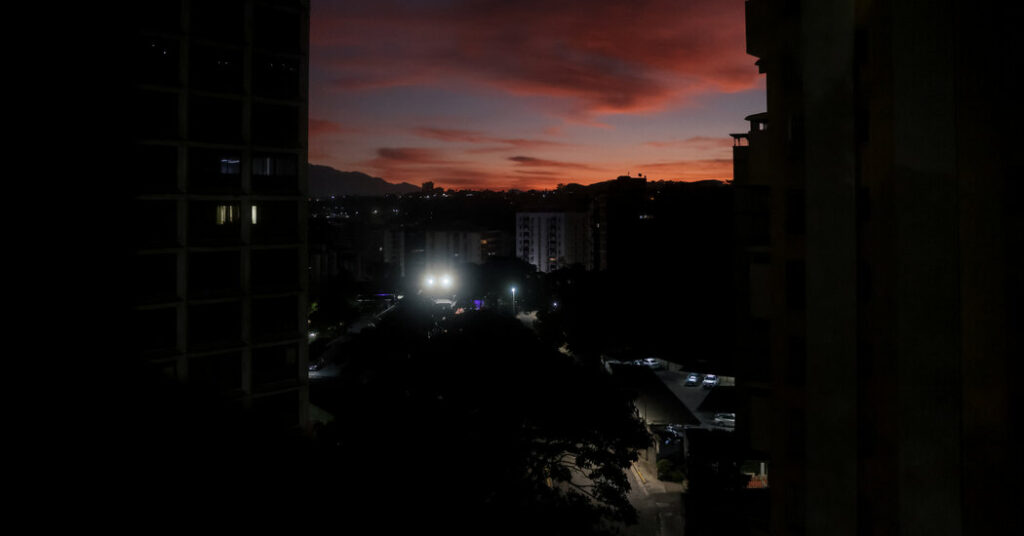
The cyberattack that plunged Venezuela’s capital into darkness this month demonstrated the Pentagon’s ability not just to turn off the lights, but also to allow them to be turned back on, according to U.S. officials briefed on the operation.
The Jan. 3 operation was one of the most public displays of offensive U.S. cyber-capabilities in recent years. It showed that at least with a country like Venezuela, whose military does not have sophisticated defenses against cyberattacks, the United States could use cyberweapons with powerful and precise effects.
The U.S. military also used cyberweapons to interfere with air defense radar, according to people briefed on the matter, who discussed sensitive details of the operation on the condition of anonymity. (Venezuela’s most powerful radar was not functional, however.)
Turning off the power in Caracas and interfering with radar allowed U.S. military helicopters to move into the country undetected on their mission to capture Nicolás Maduro, the Venezuelan president who has now been brought to the United States to face drug charges.
Senators on the Armed Services Committee are set to ask questions about the Venezuela operation at the confirmation hearing on Thursday of Lt. Gen. Joshua M. Rudd, President Trump’s nominee to lead the U.S. Cyber Command and the National Security Agency.
General Rudd, a longtime special operation forces commander, is currently the deputy head of the Indo-Pacific Command. If confirmed, he would lead an agency and command that have had a number of senior officials forced out by Laura Loomer, the far-right conspiracy theorist and Trump ally.
Mr. Trump fired Gen. Tim Haugh, the former head of the Cyber Command and the N.S.A., in April after Ms. Loomer noted that he had been appointed by the previous administration.
Lawmakers received classified briefings on the cyberoperations this week, but General Rudd’s confirmation hearing will be their first opportunity to pose questions in public about the raid as well as the Trump administration’s plans for more aggressive cyberoperations.
In a news conference hours after the raid that captured Mr. Maduro, Mr. Trump made reference to the cyberoperation, though he did not explicitly say what it was.
“It was dark, the lights of Caracas were largely turned off due to a certain expertise that we have, it was dark, and it was deadly,” Mr. Trump said.
In a statement on Wednesday, a spokeswoman for the U.S. Cyber Command said the organization “was proud to support Operation Absolute Resolve,” as the mission was named. She added that the command was equipped to execute orders of the president at any point.
The attack caused most of Caracas’s residents to lose their power for a few minutes, though some neighborhoods near the military base where Mr. Maduro was captured were left without electricity for up to 36 hours.
Experts have long worried that a cyberattack on the power grid could cause widespread collateral damage, particularly if hospitals or trauma centers lost power while trying to treat badly injured people. But that did not happen in Caracas, in large measure because the power was restored quickly.
In addition, after years of blackouts, Caracas was better prepared for a power outage. Most hospitals in the city have installed backup generators.
Medical workers said there were no known fatalities during the cyberattack in areas that depend on constant power, such as maternity wards or intensive care units. Because the attack happened in the early hours, most people were asleep and were mostly unaffected by the blackout.
In 2019, the Maduro government accused the United States of conducting a cyberattack on a hydropower plant that plunged much of the country into darkness for a week.
The power failures caused sporadic outbursts of looting and unrest, bringing the government close to collapse.
“The electric war announced and led by the US imperialism against our people will be defeated,” Mr. Maduro wrote on social media in March 2019.
At the time, the first Trump administration was trying to push Mr. Maduro from power.
But Mike Pompeo, then the secretary of state, denied any U.S. involvement in the power failure, blaming it instead on Cuban engineering.
Mr. Maduro’s government never provided evidence for the cyberattack, and electrical experts said the blackout could have been caused by poor maintenance and underinvestment. A union official at the state electricity company said at the time that the blackout was caused by a brush fire under a power line, which destabilized the grid.
Nevertheless, in the following years, Venezuelan officials increasingly pointed to a U.S. plot behind frequent industrial incidents in the country, without providing evidence. Rumors of U.S.-directed saboteurs only increased in the tense month before Mr. Maduro was captured.
Adam Sella contributed reporting from Washington.
Julian E. Barnes covers the U.S. intelligence agencies and international security matters for The Times. He has written about security issues for more than two decades.
The post Cyberattack in Venezuela Demonstrated Precision of U.S. Capabilities appeared first on New York Times.