For a year, Wall Street’s dominant theme has been the so-called K-shaped economy, in which the well-to-do have powered financial activity despite lower earners’ struggles.
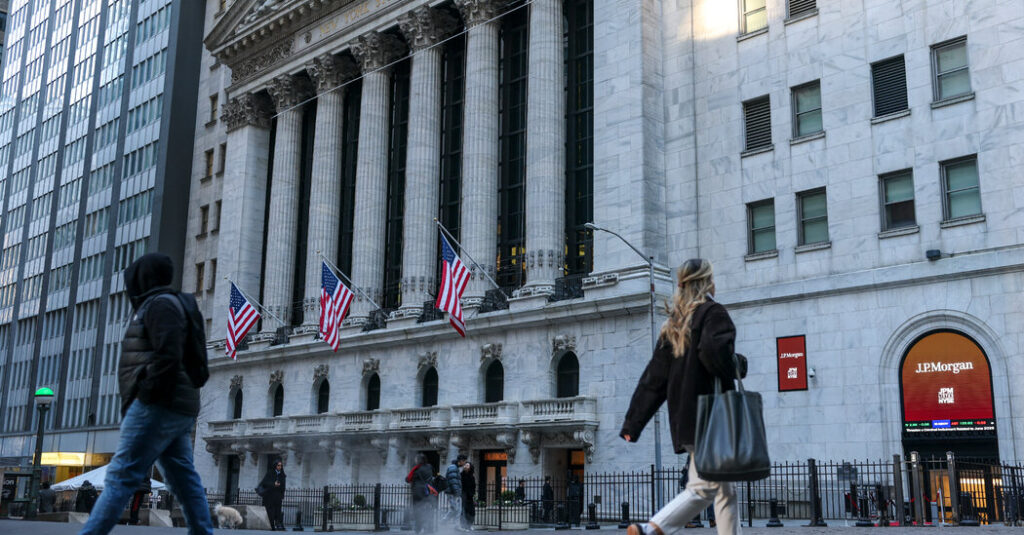
This week, the nation’s largest banks reported a broadly disappointing set of quarterly earnings, marking the first stumble after a yearlong spree of rising markets and softening regulations paid off handsomely for the finance set.
Results at Bank of America, Citi, JPMorgan Chase and Wells Fargo all fell short of expectations and their shares fell. Troubles ranged from delayed merger deals (JPMorgan) to stubborn expenses (Citi) to questions about the efficacy of artificial intelligence tools (Bank of America). Banks that do business largely with rich individuals and corporations, such as Goldman Sachs and Morgan Stanley, fared comparatively better.
Results from major lenders are closely watched because they contain hints about the state of the economy and ordinary American consumers.
Wells Fargo’s chief executive, Charles Scharf, said his organization had not seen a “meaningful” shift among the customer data it collects, including checking account flows, direct deposit amounts, overdraft activity and payments. Another Wells Fargo executive described “very consistent activity.”
Wells Fargo’s quarterly results disappointed for a different reason: Lower-than-expected profits, in part because mortgage lending stayed weak in a slow housing market. The bank’s stock saw its steepest fall in six months.
The Trump effect
For yet another quarter, Trump administration policies loomed large. This time, the banks were asked by reporters and Wall Street analysts about President Trump’s threatened 10 percent cap on credit card interest rates. Although it’s not clear how or if Mr. Trump could unilaterally impose that ceiling, bankers mostly gave identical responses by arguing that charging lower rates would cause them to lend less to riskier borrowers with patchier credit.
And Jeremy Barnum, JPMorgan’s chief financial officer, was candid about what a cap would mean for the bottom line. “It would obviously be bad for us,” he said.
Bank of America stumbles again
Brian Moynihan, Bank of America’s chief executive, kicked off 2025 by being publicly dressed down by Mr. Trump in a Davos, Switzerland, interview, and the lender’s stock lagged its rivals for much of the year.
On Wednesday, Wall Street analysts repeatedly prodded Mr. Moynihan and his chief financial officer during a question-and-answer session about why the bank’s expenses (including head count) remained high despite purported efficiency improvements, as well as its relatively slow pace of growth. Mr. Moynihan eventually conceded in response: “You should expect us to get back on a streak.” Shares dropped anyway.
Artificial intelligence makes inroads
Banks are not typically seen as on the cutting edge of technology, and Wall Street has been more eager to lend into the A.I. boom than to talk specifics about how it may change their own businesses.
Bank of America said its much-promoted “virtual financial assistant,” nicknamed Erica, was used less than before by customers in the fourth quarter. Executives attempted to argue that this was sign that the bank was doing a better job warding off questions before they even needed to be asked.
Goldman Sachs on Thursday said that it was debuting “a new operating model propelled by artificial intelligence.” A bank spokesman said that included creating a more enjoyable experience for the bank’s staff as the technology automated what he described as mundane tasks.
The sky is not falling
There are reasons for optimism on Wall Street. Investment bank traders took advantage of strong financial markets to bolster profits.
A rise in mergers and acquisitions, exemplified by the $100 billion bidding war between Netflix and Paramount for Warner Bros. Discovery, is also a boon to Wall Street dealmakers.
And for all of this week’s angst, large bank stocks are up strongly over the past 12 months, even after this week’s stumble.
Rob Copeland is a finance reporter for The Times, writing about Wall Street and the banking industry.
The post Cracks Begin to Appear at the Nation’s Biggest Banks appeared first on New York Times.